
Aschaffenburg
Hofgartenstraße 1A, 63739 Aschaffenburg, Deutschland
Schöntal Aschaffenburg | Park & Magnolias
The Schöntal is one of the most distinctive green spaces in the city center of Aschaffenburg. The city describes the area as a historical park in the English garden style with an area of 9.2 hectares, and it is precisely this mix of landscape, history, and proximity to the city that makes it particularly appealing. Those who take a walk here do not experience an ordinary city park, but a developed area with a clear identity: blossoms in spring, quiet paths in everyday life, visible traces of the city's history, and a location that connects well with a visit around City Galerie, the old town, and the castle surroundings. The Schöntal is thus a place for people who want to move more slowly in Aschaffenburg without sacrificing urban proximity. Particularly striking are the largest magnolia grove in Bavaria, the ruins of the former Beguine complex, and the different forms of open and closed Schöntal, which give the area its spatial depth. ([aschaffenburg.de](https://www.aschaffenburg.de/Freizeit-Tourismus/Sport-und-Freizeit/index.php?FID=4173.12292.1&La=1&ModID=7&NavID=4173.871&object=tx%7C4173.5.1&utm_source=openai))
Schöntal currently: Blossoms, tranquility, and city life in the heart of Aschaffenburg
Currently, the Schöntal primarily presents itself as a place for short breaks, moments in nature, and easily accessible city walks. The city of Aschaffenburg explicitly points out in spring that the first flowers are blooming in the park and that visitors should be considerate. Those who wish to take photographs should, according to the city, stay on the paths rather than stepping onto the meadows. This fits perfectly with the character of this green space: The Schöntal is not just a backdrop but a sensitive, well-maintained urban space that is used by many people and therefore needs attention. Especially in the transitional periods between winter and spring, it becomes clear how strongly the park acts as a green island in the city center. Crocuses, young blossoms, and the wide sightlines give it a light, open atmosphere, while the paths simultaneously create a calm structure that one does not always expect in an urban location. At the same time, Schöntal is a place where everyday life and culture meet directly. In summer, the area becomes a stage, in winter it immerses itself in a festive atmosphere, and in between, it remains a popular spot for people looking for a break from the hustle and bustle of the city. The official city website clearly places the Schöntal within the network of Aschaffenburg's parks and green spaces, thus in an urban landscape that is consciously maintained and used for leisure, recreation, and identity. This also explains why the Schöntal repeatedly appears in current city announcements: It is not only a historical heritage but a vibrant part of today's Aschaffenburg. ([aschaffenburg.de](https://www.aschaffenburg.de/Service/Fr%C3%BChling-im-Park-Sch%C3%B6ntal-Bitte-R%C3%BCcksicht-nehmen.php?FID=4173.11626.1&La=1&ModID=7&NavID=4173.7&object=tx%2C4173.5.1&utm_source=openai))
Schöntal Magnolias: The largest magnolia grove in Bavaria as a spring highlight
When talking about the Schöntal, many first think of the magnolias. Not by chance, as the city of Aschaffenburg refers to the local stock as the largest magnolia grove in Bavaria. This is a strong unique selling point that has made the park well-known far beyond the city limits. In spring, the area transforms into a vividly colorful natural image, where the blossoms are not just a decorative detail but the actual reason for many visits. Precisely because the park is located in the urban fabric, an appealing contrast arises: On one side, streets, houses, and the paths of the city center, on the other side, a blooming landscape that, at the right moment, almost appears park-like and festive. This mix makes the Schöntal particularly photogenic and explains why the city itself repeatedly emphasizes consideration when entering the meadows. Those who want to take good pictures should stick to the paths, as the city explicitly states that photographing from there is quite possible. The magnolia grove is thus not only a sight but also a sensitive natural experience that depends on the behavior of the visitors. The municipal green space pages and current spring notices also show that the Schöntal is closely linked to the seasonal perception of Aschaffenburg. In the cover images of the city, crocuses, Schöntal, and magnolias also regularly appear, highlighting the high recognition value. For SEO and for real visitors, this is important: The Schöntal stands not only for a place but for a very specific spring moment in Aschaffenburg that connects nature, city, and quality of stay in a rare density. ([aschaffenburg.de](https://www.aschaffenburg.de/Freizeit-Tourismus/Sport-und-Freizeit/index.php?FID=4173.12292.1&La=1&ModID=7&NavID=4173.871&object=tx%7C4173.5.1&utm_source=openai))
Schöntal History: From city ditch to historical park landscape
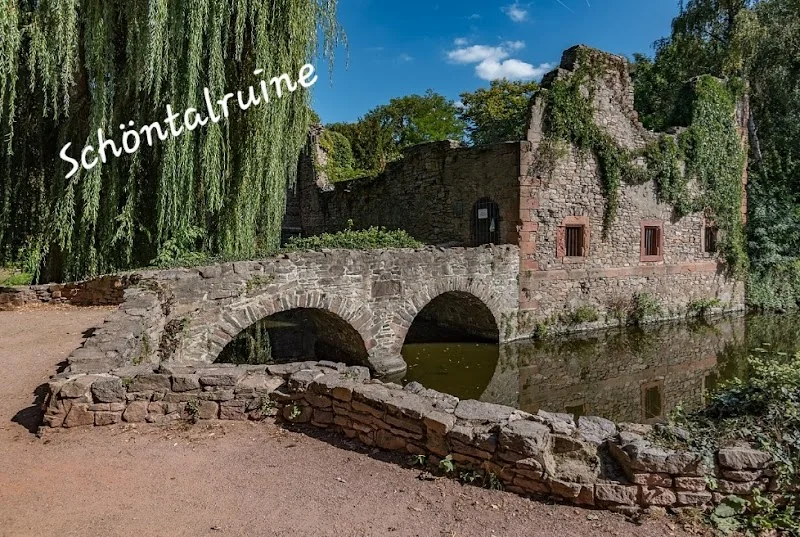
The history of the Schöntal is closely linked to the development of Aschaffenburg itself. The city describes the area as a historical park in the English garden style, and in the park, ruins refer to the former settlement of the Beguines. These are the remains of the wall of the church built in 1543/44 dedicated to the Holy Sepulchre. This historical layer makes the place special: Schöntal is not a newly created leisure park but a landscape where city history, religious history, and garden art merge. The reference to the women's order of the Beguines and the small monastery complex shows how deep the roots of the place run. Additionally, the Open Schöntal was originally part of the medieval city ditch. With the expansion of the city and the railway, this area was filled in during the 19th century and developed into an avenue of fruit trees that connects the castle garden with the Schöntal park. This created a green transition that still makes the historical city structure readable today. Particularly notable is also the Herstall Tower from 1545, which is referred to as the last remaining outer tower of the former city gate. Together with spring flowers, perennial beds, and the walkable fountain, it shapes the Open Schöntal as a green mile that, despite its city center location, has an almost boulevard-like character. For visitors, this historical depth is important because it makes the Schöntal appear not only as a pretty park area but as a piece of urban architecture in the open air. Those who walk here move through different layers of time: from the medieval ditch to the early modern monastery and church complex to the landscaped city center green space. It is precisely this connection of past and present that makes the SEO term Schöntal Aschaffenburg so strong. ([aschaffenburg.de](https://www.aschaffenburg.de/Freizeit-Tourismus/Sport-und-Freizeit/index.php?FID=4173.12292.1&La=1&ModID=7&NavID=4173.871&object=tx%7C4173.5.1&utm_source=openai))
Access and parking at Schöntal
The access to the Schöntal is particularly practical because the facility is located right in the city center. This is an advantage for walking, but for arriving by car, it means that one should consider the city's parking logic in the city center. The city of Aschaffenburg publishes its parking information centrally and points out that there are resident parking areas in the city center. For visitors around the Schöntal, the combination of a short distance and an appropriate parking strategy is therefore crucial. The area around City Galerie is particularly obvious because access to the park is regularly located there during events. In the event announcements, the entrance City Galerie is explicitly mentioned, and during the Budenzauber, a bus stop Park Schöntal is also named. This shows that the location is well integrated into the urban pathway network both on foot and by public transport. Those arriving by car should rather expect urban parking options than a dedicated large parking area directly at the park; the City Galerie area is the obvious starting point for that. The public parking overview of the city also names the City Galerie parking garage as part of the central offer. For a location page, this is exactly the right information: The Schöntal is excellently accessible, but the real strength lies in its city center location with its short distances, not in a separate large parking lot directly at the green space. Those planning their visit can thus combine it with a city stroll and enter the park directly from the parking lot or bus stop. Especially during events, this proximity becomes particularly visible, as the audience, paths, and green space can be easily connected. ([aschaffenburg.de](https://www.aschaffenburg.de/Leben-in-Aschaffenburg/KFZ-Stra%C3%9Fe-und-Verkehr/Stra%C3%9Fe-Verkehr/Parken-in-Aschaffenburg?utm_source=openai))
Schöntal Events: Summer stage, Budenzauber, and vibrant urban culture
The Schöntal is not only a place for walking but also a stage for city life. This is particularly evident at the summer stage in the Schöntal park, which is mentioned in the official event notices with the entrance City Galerie. There are free picnic blanket concerts as part of summer in Aschaffenburg; guests are asked to bring their own food and drinks, and deck chairs are available on-site for free rental. This mix of uncomplicated culture, relaxed atmosphere, and public green space is typical for the Schöntal and explains why the park is so heavily frequented during the summer months. The musical offerings are also diverse, as the event pages show different formats from band and DJ performances to family and participatory offerings. Additionally, the Aschaffenburg Budenzauber in winter focuses on several stations around the city center, including the Schöntal park, the access path to City Galerie, and the Open Schöntal at the fountain. This means that the location is not limited to one season but is integrated into the event life of the city throughout the year. It is also particularly interesting that events in the Schöntal can be well combined with family-friendly formats. The family festival Picnic in the Schöntal shows that the park also functions as a casual meeting point where greenery, community, and leisure come together very directly. For those searching for Schöntal current or Schöntal events, it is therefore important: The place lives not only from its history but also from regularly updated event formats that become particularly visible in summer and during the Advent season. This utilization makes the area so attractive for visitors because it is both a historical park and a contemporary event venue. ([mein.aschaffenburg.de](https://mein.aschaffenburg.de/event/eroeffnung-sommer/?utm_source=openai))
Open and closed Schöntal: Paths, play areas, and consideration in everyday life
For understanding the location, it is helpful to distinguish between Open and Closed Schöntal. The Open Schöntal is the elongated green area between Friedrich and Weißenburger Straße. The city describes it as a former city ditch that was filled in at the end of the 19th century and today appears as an attractive green mile with spring flowers, perennial beds, and a walkable fountain. The Herstall Tower from 1545 additionally gives the area historical profile. In contrast, the Closed Schöntal is explicitly listed as a separate area in the city's green space directories; it also includes green strips on Würzburger Straße in front of the Schöntal wall as well as the plane tree avenue with a connecting path to City Galerie. This makes it clear that Schöntal is not just a park in the narrower sense but a cohesive urban green complex with different spatial edges and uses. For families, the Closed Schöntal is particularly interesting because the city's family guide lists several play equipment there, including double swings, table tennis tables, a merry-go-round, boulders for climbing, a combination play structure with a bridge and slide, a water play area, and toddler swings. This makes the area suitable for shorter stays with children. At the same time, there are clear rules in the Schöntal: The green space regulations explicitly mention both the closed and open Schöntal, and in these areas, the consumption of alcohol is prohibited; however, the city may grant exceptions for individual events. Additionally, the city requests that in spring, the flower areas be preserved and that visitors stay on the paths. This mix of usability, protection, and urban quality is characteristic of the Schöntal. Therefore, those visiting the park experience not only a beautiful place but a consciously regulated public green space that maintains a balance between quality of life, historical substance, and everyday use. ([aschaffenburg.de](https://www.aschaffenburg.de/dokumente/Kultur-und-Tourismus/Parks_und_Gaerten.pdf?utm_source=openai))
Sources:
- City of Aschaffenburg - Green Spaces and Parks ([aschaffenburg.de](https://www.aschaffenburg.de/Freizeit-Tourismus/Sport-und-Freizeit/index.php?FID=4173.12292.1&La=1&ModID=7&NavID=4173.871&object=tx%7C4173.5.1&utm_source=openai))
- City of Aschaffenburg - Green Space Regulations ([aschaffenburg.de](https://www.aschaffenburg.de/loadDocument.phtml?Ext=PDF&FID=4173.165.1&utm_source=openai))
- City of Aschaffenburg - Family Guide ([aschaffenburg.de](https://www.aschaffenburg.de/dokumente/Buerger-in-Aschaffenburg/Familien/Familienwegweiser2022_online.pdf?utm_source=openai))
- My Aschaffenburg - Summer Stage in Schöntal Park ([mein.aschaffenburg.de](https://mein.aschaffenburg.de/event/eroeffnung-sommer/?utm_source=openai))
- My Aschaffenburg - Aschaffenburg Budenzauber ([mein.aschaffenburg.de](https://mein.aschaffenburg.de/event/aschaffenburger-budenzauber/?utm_source=openai))
- City of Aschaffenburg - Parking in Aschaffenburg ([aschaffenburg.de](https://www.aschaffenburg.de/Leben-in-Aschaffenburg/KFZ-Stra%C3%9Fe-und-Verkehr/Stra%C3%9Fe-Verkehr/Parken-in-Aschaffenburg?utm_source=openai))
Show moreShow less
Schöntal Aschaffenburg | Park & Magnolias
The Schöntal is one of the most distinctive green spaces in the city center of Aschaffenburg. The city describes the area as a historical park in the English garden style with an area of 9.2 hectares, and it is precisely this mix of landscape, history, and proximity to the city that makes it particularly appealing. Those who take a walk here do not experience an ordinary city park, but a developed area with a clear identity: blossoms in spring, quiet paths in everyday life, visible traces of the city's history, and a location that connects well with a visit around City Galerie, the old town, and the castle surroundings. The Schöntal is thus a place for people who want to move more slowly in Aschaffenburg without sacrificing urban proximity. Particularly striking are the largest magnolia grove in Bavaria, the ruins of the former Beguine complex, and the different forms of open and closed Schöntal, which give the area its spatial depth. ([aschaffenburg.de](https://www.aschaffenburg.de/Freizeit-Tourismus/Sport-und-Freizeit/index.php?FID=4173.12292.1&La=1&ModID=7&NavID=4173.871&object=tx%7C4173.5.1&utm_source=openai))
Schöntal currently: Blossoms, tranquility, and city life in the heart of Aschaffenburg
Currently, the Schöntal primarily presents itself as a place for short breaks, moments in nature, and easily accessible city walks. The city of Aschaffenburg explicitly points out in spring that the first flowers are blooming in the park and that visitors should be considerate. Those who wish to take photographs should, according to the city, stay on the paths rather than stepping onto the meadows. This fits perfectly with the character of this green space: The Schöntal is not just a backdrop but a sensitive, well-maintained urban space that is used by many people and therefore needs attention. Especially in the transitional periods between winter and spring, it becomes clear how strongly the park acts as a green island in the city center. Crocuses, young blossoms, and the wide sightlines give it a light, open atmosphere, while the paths simultaneously create a calm structure that one does not always expect in an urban location. At the same time, Schöntal is a place where everyday life and culture meet directly. In summer, the area becomes a stage, in winter it immerses itself in a festive atmosphere, and in between, it remains a popular spot for people looking for a break from the hustle and bustle of the city. The official city website clearly places the Schöntal within the network of Aschaffenburg's parks and green spaces, thus in an urban landscape that is consciously maintained and used for leisure, recreation, and identity. This also explains why the Schöntal repeatedly appears in current city announcements: It is not only a historical heritage but a vibrant part of today's Aschaffenburg. ([aschaffenburg.de](https://www.aschaffenburg.de/Service/Fr%C3%BChling-im-Park-Sch%C3%B6ntal-Bitte-R%C3%BCcksicht-nehmen.php?FID=4173.11626.1&La=1&ModID=7&NavID=4173.7&object=tx%2C4173.5.1&utm_source=openai))
Schöntal Magnolias: The largest magnolia grove in Bavaria as a spring highlight
When talking about the Schöntal, many first think of the magnolias. Not by chance, as the city of Aschaffenburg refers to the local stock as the largest magnolia grove in Bavaria. This is a strong unique selling point that has made the park well-known far beyond the city limits. In spring, the area transforms into a vividly colorful natural image, where the blossoms are not just a decorative detail but the actual reason for many visits. Precisely because the park is located in the urban fabric, an appealing contrast arises: On one side, streets, houses, and the paths of the city center, on the other side, a blooming landscape that, at the right moment, almost appears park-like and festive. This mix makes the Schöntal particularly photogenic and explains why the city itself repeatedly emphasizes consideration when entering the meadows. Those who want to take good pictures should stick to the paths, as the city explicitly states that photographing from there is quite possible. The magnolia grove is thus not only a sight but also a sensitive natural experience that depends on the behavior of the visitors. The municipal green space pages and current spring notices also show that the Schöntal is closely linked to the seasonal perception of Aschaffenburg. In the cover images of the city, crocuses, Schöntal, and magnolias also regularly appear, highlighting the high recognition value. For SEO and for real visitors, this is important: The Schöntal stands not only for a place but for a very specific spring moment in Aschaffenburg that connects nature, city, and quality of stay in a rare density. ([aschaffenburg.de](https://www.aschaffenburg.de/Freizeit-Tourismus/Sport-und-Freizeit/index.php?FID=4173.12292.1&La=1&ModID=7&NavID=4173.871&object=tx%7C4173.5.1&utm_source=openai))
Schöntal History: From city ditch to historical park landscape
The history of the Schöntal is closely linked to the development of Aschaffenburg itself. The city describes the area as a historical park in the English garden style, and in the park, ruins refer to the former settlement of the Beguines. These are the remains of the wall of the church built in 1543/44 dedicated to the Holy Sepulchre. This historical layer makes the place special: Schöntal is not a newly created leisure park but a landscape where city history, religious history, and garden art merge. The reference to the women's order of the Beguines and the small monastery complex shows how deep the roots of the place run. Additionally, the Open Schöntal was originally part of the medieval city ditch. With the expansion of the city and the railway, this area was filled in during the 19th century and developed into an avenue of fruit trees that connects the castle garden with the Schöntal park. This created a green transition that still makes the historical city structure readable today. Particularly notable is also the Herstall Tower from 1545, which is referred to as the last remaining outer tower of the former city gate. Together with spring flowers, perennial beds, and the walkable fountain, it shapes the Open Schöntal as a green mile that, despite its city center location, has an almost boulevard-like character. For visitors, this historical depth is important because it makes the Schöntal appear not only as a pretty park area but as a piece of urban architecture in the open air. Those who walk here move through different layers of time: from the medieval ditch to the early modern monastery and church complex to the landscaped city center green space. It is precisely this connection of past and present that makes the SEO term Schöntal Aschaffenburg so strong. ([aschaffenburg.de](https://www.aschaffenburg.de/Freizeit-Tourismus/Sport-und-Freizeit/index.php?FID=4173.12292.1&La=1&ModID=7&NavID=4173.871&object=tx%7C4173.5.1&utm_source=openai))
Access and parking at Schöntal
The access to the Schöntal is particularly practical because the facility is located right in the city center. This is an advantage for walking, but for arriving by car, it means that one should consider the city's parking logic in the city center. The city of Aschaffenburg publishes its parking information centrally and points out that there are resident parking areas in the city center. For visitors around the Schöntal, the combination of a short distance and an appropriate parking strategy is therefore crucial. The area around City Galerie is particularly obvious because access to the park is regularly located there during events. In the event announcements, the entrance City Galerie is explicitly mentioned, and during the Budenzauber, a bus stop Park Schöntal is also named. This shows that the location is well integrated into the urban pathway network both on foot and by public transport. Those arriving by car should rather expect urban parking options than a dedicated large parking area directly at the park; the City Galerie area is the obvious starting point for that. The public parking overview of the city also names the City Galerie parking garage as part of the central offer. For a location page, this is exactly the right information: The Schöntal is excellently accessible, but the real strength lies in its city center location with its short distances, not in a separate large parking lot directly at the green space. Those planning their visit can thus combine it with a city stroll and enter the park directly from the parking lot or bus stop. Especially during events, this proximity becomes particularly visible, as the audience, paths, and green space can be easily connected. ([aschaffenburg.de](https://www.aschaffenburg.de/Leben-in-Aschaffenburg/KFZ-Stra%C3%9Fe-und-Verkehr/Stra%C3%9Fe-Verkehr/Parken-in-Aschaffenburg?utm_source=openai))
Schöntal Events: Summer stage, Budenzauber, and vibrant urban culture
The Schöntal is not only a place for walking but also a stage for city life. This is particularly evident at the summer stage in the Schöntal park, which is mentioned in the official event notices with the entrance City Galerie. There are free picnic blanket concerts as part of summer in Aschaffenburg; guests are asked to bring their own food and drinks, and deck chairs are available on-site for free rental. This mix of uncomplicated culture, relaxed atmosphere, and public green space is typical for the Schöntal and explains why the park is so heavily frequented during the summer months. The musical offerings are also diverse, as the event pages show different formats from band and DJ performances to family and participatory offerings. Additionally, the Aschaffenburg Budenzauber in winter focuses on several stations around the city center, including the Schöntal park, the access path to City Galerie, and the Open Schöntal at the fountain. This means that the location is not limited to one season but is integrated into the event life of the city throughout the year. It is also particularly interesting that events in the Schöntal can be well combined with family-friendly formats. The family festival Picnic in the Schöntal shows that the park also functions as a casual meeting point where greenery, community, and leisure come together very directly. For those searching for Schöntal current or Schöntal events, it is therefore important: The place lives not only from its history but also from regularly updated event formats that become particularly visible in summer and during the Advent season. This utilization makes the area so attractive for visitors because it is both a historical park and a contemporary event venue. ([mein.aschaffenburg.de](https://mein.aschaffenburg.de/event/eroeffnung-sommer/?utm_source=openai))
Open and closed Schöntal: Paths, play areas, and consideration in everyday life
For understanding the location, it is helpful to distinguish between Open and Closed Schöntal. The Open Schöntal is the elongated green area between Friedrich and Weißenburger Straße. The city describes it as a former city ditch that was filled in at the end of the 19th century and today appears as an attractive green mile with spring flowers, perennial beds, and a walkable fountain. The Herstall Tower from 1545 additionally gives the area historical profile. In contrast, the Closed Schöntal is explicitly listed as a separate area in the city's green space directories; it also includes green strips on Würzburger Straße in front of the Schöntal wall as well as the plane tree avenue with a connecting path to City Galerie. This makes it clear that Schöntal is not just a park in the narrower sense but a cohesive urban green complex with different spatial edges and uses. For families, the Closed Schöntal is particularly interesting because the city's family guide lists several play equipment there, including double swings, table tennis tables, a merry-go-round, boulders for climbing, a combination play structure with a bridge and slide, a water play area, and toddler swings. This makes the area suitable for shorter stays with children. At the same time, there are clear rules in the Schöntal: The green space regulations explicitly mention both the closed and open Schöntal, and in these areas, the consumption of alcohol is prohibited; however, the city may grant exceptions for individual events. Additionally, the city requests that in spring, the flower areas be preserved and that visitors stay on the paths. This mix of usability, protection, and urban quality is characteristic of the Schöntal. Therefore, those visiting the park experience not only a beautiful place but a consciously regulated public green space that maintains a balance between quality of life, historical substance, and everyday use. ([aschaffenburg.de](https://www.aschaffenburg.de/dokumente/Kultur-und-Tourismus/Parks_und_Gaerten.pdf?utm_source=openai))
Sources:
- City of Aschaffenburg - Green Spaces and Parks ([aschaffenburg.de](https://www.aschaffenburg.de/Freizeit-Tourismus/Sport-und-Freizeit/index.php?FID=4173.12292.1&La=1&ModID=7&NavID=4173.871&object=tx%7C4173.5.1&utm_source=openai))
- City of Aschaffenburg - Green Space Regulations ([aschaffenburg.de](https://www.aschaffenburg.de/loadDocument.phtml?Ext=PDF&FID=4173.165.1&utm_source=openai))
- City of Aschaffenburg - Family Guide ([aschaffenburg.de](https://www.aschaffenburg.de/dokumente/Buerger-in-Aschaffenburg/Familien/Familienwegweiser2022_online.pdf?utm_source=openai))
- My Aschaffenburg - Summer Stage in Schöntal Park ([mein.aschaffenburg.de](https://mein.aschaffenburg.de/event/eroeffnung-sommer/?utm_source=openai))
- My Aschaffenburg - Aschaffenburg Budenzauber ([mein.aschaffenburg.de](https://mein.aschaffenburg.de/event/aschaffenburger-budenzauber/?utm_source=openai))
- City of Aschaffenburg - Parking in Aschaffenburg ([aschaffenburg.de](https://www.aschaffenburg.de/Leben-in-Aschaffenburg/KFZ-Stra%C3%9Fe-und-Verkehr/Stra%C3%9Fe-Verkehr/Parken-in-Aschaffenburg?utm_source=openai))
Schöntal Aschaffenburg | Park & Magnolias
The Schöntal is one of the most distinctive green spaces in the city center of Aschaffenburg. The city describes the area as a historical park in the English garden style with an area of 9.2 hectares, and it is precisely this mix of landscape, history, and proximity to the city that makes it particularly appealing. Those who take a walk here do not experience an ordinary city park, but a developed area with a clear identity: blossoms in spring, quiet paths in everyday life, visible traces of the city's history, and a location that connects well with a visit around City Galerie, the old town, and the castle surroundings. The Schöntal is thus a place for people who want to move more slowly in Aschaffenburg without sacrificing urban proximity. Particularly striking are the largest magnolia grove in Bavaria, the ruins of the former Beguine complex, and the different forms of open and closed Schöntal, which give the area its spatial depth. ([aschaffenburg.de](https://www.aschaffenburg.de/Freizeit-Tourismus/Sport-und-Freizeit/index.php?FID=4173.12292.1&La=1&ModID=7&NavID=4173.871&object=tx%7C4173.5.1&utm_source=openai))
Schöntal currently: Blossoms, tranquility, and city life in the heart of Aschaffenburg
Currently, the Schöntal primarily presents itself as a place for short breaks, moments in nature, and easily accessible city walks. The city of Aschaffenburg explicitly points out in spring that the first flowers are blooming in the park and that visitors should be considerate. Those who wish to take photographs should, according to the city, stay on the paths rather than stepping onto the meadows. This fits perfectly with the character of this green space: The Schöntal is not just a backdrop but a sensitive, well-maintained urban space that is used by many people and therefore needs attention. Especially in the transitional periods between winter and spring, it becomes clear how strongly the park acts as a green island in the city center. Crocuses, young blossoms, and the wide sightlines give it a light, open atmosphere, while the paths simultaneously create a calm structure that one does not always expect in an urban location. At the same time, Schöntal is a place where everyday life and culture meet directly. In summer, the area becomes a stage, in winter it immerses itself in a festive atmosphere, and in between, it remains a popular spot for people looking for a break from the hustle and bustle of the city. The official city website clearly places the Schöntal within the network of Aschaffenburg's parks and green spaces, thus in an urban landscape that is consciously maintained and used for leisure, recreation, and identity. This also explains why the Schöntal repeatedly appears in current city announcements: It is not only a historical heritage but a vibrant part of today's Aschaffenburg. ([aschaffenburg.de](https://www.aschaffenburg.de/Service/Fr%C3%BChling-im-Park-Sch%C3%B6ntal-Bitte-R%C3%BCcksicht-nehmen.php?FID=4173.11626.1&La=1&ModID=7&NavID=4173.7&object=tx%2C4173.5.1&utm_source=openai))
Schöntal Magnolias: The largest magnolia grove in Bavaria as a spring highlight
When talking about the Schöntal, many first think of the magnolias. Not by chance, as the city of Aschaffenburg refers to the local stock as the largest magnolia grove in Bavaria. This is a strong unique selling point that has made the park well-known far beyond the city limits. In spring, the area transforms into a vividly colorful natural image, where the blossoms are not just a decorative detail but the actual reason for many visits. Precisely because the park is located in the urban fabric, an appealing contrast arises: On one side, streets, houses, and the paths of the city center, on the other side, a blooming landscape that, at the right moment, almost appears park-like and festive. This mix makes the Schöntal particularly photogenic and explains why the city itself repeatedly emphasizes consideration when entering the meadows. Those who want to take good pictures should stick to the paths, as the city explicitly states that photographing from there is quite possible. The magnolia grove is thus not only a sight but also a sensitive natural experience that depends on the behavior of the visitors. The municipal green space pages and current spring notices also show that the Schöntal is closely linked to the seasonal perception of Aschaffenburg. In the cover images of the city, crocuses, Schöntal, and magnolias also regularly appear, highlighting the high recognition value. For SEO and for real visitors, this is important: The Schöntal stands not only for a place but for a very specific spring moment in Aschaffenburg that connects nature, city, and quality of stay in a rare density. ([aschaffenburg.de](https://www.aschaffenburg.de/Freizeit-Tourismus/Sport-und-Freizeit/index.php?FID=4173.12292.1&La=1&ModID=7&NavID=4173.871&object=tx%7C4173.5.1&utm_source=openai))
Schöntal History: From city ditch to historical park landscape
The history of the Schöntal is closely linked to the development of Aschaffenburg itself. The city describes the area as a historical park in the English garden style, and in the park, ruins refer to the former settlement of the Beguines. These are the remains of the wall of the church built in 1543/44 dedicated to the Holy Sepulchre. This historical layer makes the place special: Schöntal is not a newly created leisure park but a landscape where city history, religious history, and garden art merge. The reference to the women's order of the Beguines and the small monastery complex shows how deep the roots of the place run. Additionally, the Open Schöntal was originally part of the medieval city ditch. With the expansion of the city and the railway, this area was filled in during the 19th century and developed into an avenue of fruit trees that connects the castle garden with the Schöntal park. This created a green transition that still makes the historical city structure readable today. Particularly notable is also the Herstall Tower from 1545, which is referred to as the last remaining outer tower of the former city gate. Together with spring flowers, perennial beds, and the walkable fountain, it shapes the Open Schöntal as a green mile that, despite its city center location, has an almost boulevard-like character. For visitors, this historical depth is important because it makes the Schöntal appear not only as a pretty park area but as a piece of urban architecture in the open air. Those who walk here move through different layers of time: from the medieval ditch to the early modern monastery and church complex to the landscaped city center green space. It is precisely this connection of past and present that makes the SEO term Schöntal Aschaffenburg so strong. ([aschaffenburg.de](https://www.aschaffenburg.de/Freizeit-Tourismus/Sport-und-Freizeit/index.php?FID=4173.12292.1&La=1&ModID=7&NavID=4173.871&object=tx%7C4173.5.1&utm_source=openai))
Access and parking at Schöntal
The access to the Schöntal is particularly practical because the facility is located right in the city center. This is an advantage for walking, but for arriving by car, it means that one should consider the city's parking logic in the city center. The city of Aschaffenburg publishes its parking information centrally and points out that there are resident parking areas in the city center. For visitors around the Schöntal, the combination of a short distance and an appropriate parking strategy is therefore crucial. The area around City Galerie is particularly obvious because access to the park is regularly located there during events. In the event announcements, the entrance City Galerie is explicitly mentioned, and during the Budenzauber, a bus stop Park Schöntal is also named. This shows that the location is well integrated into the urban pathway network both on foot and by public transport. Those arriving by car should rather expect urban parking options than a dedicated large parking area directly at the park; the City Galerie area is the obvious starting point for that. The public parking overview of the city also names the City Galerie parking garage as part of the central offer. For a location page, this is exactly the right information: The Schöntal is excellently accessible, but the real strength lies in its city center location with its short distances, not in a separate large parking lot directly at the green space. Those planning their visit can thus combine it with a city stroll and enter the park directly from the parking lot or bus stop. Especially during events, this proximity becomes particularly visible, as the audience, paths, and green space can be easily connected. ([aschaffenburg.de](https://www.aschaffenburg.de/Leben-in-Aschaffenburg/KFZ-Stra%C3%9Fe-und-Verkehr/Stra%C3%9Fe-Verkehr/Parken-in-Aschaffenburg?utm_source=openai))
Schöntal Events: Summer stage, Budenzauber, and vibrant urban culture
The Schöntal is not only a place for walking but also a stage for city life. This is particularly evident at the summer stage in the Schöntal park, which is mentioned in the official event notices with the entrance City Galerie. There are free picnic blanket concerts as part of summer in Aschaffenburg; guests are asked to bring their own food and drinks, and deck chairs are available on-site for free rental. This mix of uncomplicated culture, relaxed atmosphere, and public green space is typical for the Schöntal and explains why the park is so heavily frequented during the summer months. The musical offerings are also diverse, as the event pages show different formats from band and DJ performances to family and participatory offerings. Additionally, the Aschaffenburg Budenzauber in winter focuses on several stations around the city center, including the Schöntal park, the access path to City Galerie, and the Open Schöntal at the fountain. This means that the location is not limited to one season but is integrated into the event life of the city throughout the year. It is also particularly interesting that events in the Schöntal can be well combined with family-friendly formats. The family festival Picnic in the Schöntal shows that the park also functions as a casual meeting point where greenery, community, and leisure come together very directly. For those searching for Schöntal current or Schöntal events, it is therefore important: The place lives not only from its history but also from regularly updated event formats that become particularly visible in summer and during the Advent season. This utilization makes the area so attractive for visitors because it is both a historical park and a contemporary event venue. ([mein.aschaffenburg.de](https://mein.aschaffenburg.de/event/eroeffnung-sommer/?utm_source=openai))
Open and closed Schöntal: Paths, play areas, and consideration in everyday life
For understanding the location, it is helpful to distinguish between Open and Closed Schöntal. The Open Schöntal is the elongated green area between Friedrich and Weißenburger Straße. The city describes it as a former city ditch that was filled in at the end of the 19th century and today appears as an attractive green mile with spring flowers, perennial beds, and a walkable fountain. The Herstall Tower from 1545 additionally gives the area historical profile. In contrast, the Closed Schöntal is explicitly listed as a separate area in the city's green space directories; it also includes green strips on Würzburger Straße in front of the Schöntal wall as well as the plane tree avenue with a connecting path to City Galerie. This makes it clear that Schöntal is not just a park in the narrower sense but a cohesive urban green complex with different spatial edges and uses. For families, the Closed Schöntal is particularly interesting because the city's family guide lists several play equipment there, including double swings, table tennis tables, a merry-go-round, boulders for climbing, a combination play structure with a bridge and slide, a water play area, and toddler swings. This makes the area suitable for shorter stays with children. At the same time, there are clear rules in the Schöntal: The green space regulations explicitly mention both the closed and open Schöntal, and in these areas, the consumption of alcohol is prohibited; however, the city may grant exceptions for individual events. Additionally, the city requests that in spring, the flower areas be preserved and that visitors stay on the paths. This mix of usability, protection, and urban quality is characteristic of the Schöntal. Therefore, those visiting the park experience not only a beautiful place but a consciously regulated public green space that maintains a balance between quality of life, historical substance, and everyday use. ([aschaffenburg.de](https://www.aschaffenburg.de/dokumente/Kultur-und-Tourismus/Parks_und_Gaerten.pdf?utm_source=openai))
Sources:
- City of Aschaffenburg - Green Spaces and Parks ([aschaffenburg.de](https://www.aschaffenburg.de/Freizeit-Tourismus/Sport-und-Freizeit/index.php?FID=4173.12292.1&La=1&ModID=7&NavID=4173.871&object=tx%7C4173.5.1&utm_source=openai))
- City of Aschaffenburg - Green Space Regulations ([aschaffenburg.de](https://www.aschaffenburg.de/loadDocument.phtml?Ext=PDF&FID=4173.165.1&utm_source=openai))
- City of Aschaffenburg - Family Guide ([aschaffenburg.de](https://www.aschaffenburg.de/dokumente/Buerger-in-Aschaffenburg/Familien/Familienwegweiser2022_online.pdf?utm_source=openai))
- My Aschaffenburg - Summer Stage in Schöntal Park ([mein.aschaffenburg.de](https://mein.aschaffenburg.de/event/eroeffnung-sommer/?utm_source=openai))
- My Aschaffenburg - Aschaffenburg Budenzauber ([mein.aschaffenburg.de](https://mein.aschaffenburg.de/event/aschaffenburger-budenzauber/?utm_source=openai))
- City of Aschaffenburg - Parking in Aschaffenburg ([aschaffenburg.de](https://www.aschaffenburg.de/Leben-in-Aschaffenburg/KFZ-Stra%C3%9Fe-und-Verkehr/Stra%C3%9Fe-Verkehr/Parken-in-Aschaffenburg?utm_source=openai))
Upcoming Events

DJ Luc live in Aschaffenburg – Summer Stage 2026
Summer beats in Schöntal Park: DJ Luc invites Aschaffenburg to a free open-air evening full of vibes. 19.08.2026, free entry. #Aschaffenburg #SummerStage
DJ Demian Sky: Vinyl-Set at Park Schöntal
Experience a relaxing vinyl set by DJ Demian Sky at Park Schöntal. Free entry!

Jürgen Wüst & Sven Claussen
A free summer evening in Aschaffenburg: Jürgen Wüst & Sven Claussen transform Park Schöntal into a vibrant sound field. September 5, 2026, 6:00 PM. #Aschaffenburg

Günter Kolb – A Cow for Ghana
Saxophone sounds, picnic blanket, and benefit thought: Günter Kolb transforms Park Schöntal in Aschaffenburg into a summery feel-good stage. Free admission. #Aschaffenburg #Live

DisGo live in Aschaffenburg – Summer Stage in Schöntal Park 2026
Aschaffenburg gets groove in the open air: DisGo brings Motown, Disco, and hits to the summer stage. Free entry, live on 12.09.2026. #Aschaffenburg
Frequently Asked Questions
Reviews
Animesh Kumar
30. March 2023
A small park next to the city center. Very nice place to take a small walk, sit in peace listening to the birds and the running water of the stream. It's great for a small gathering of friends, and you can see many small kids playing around. There's a very beautiful part of the park with well-maintained cherry blossoms. A visit is absolutely recommended during the beginning of spring when these flowers bloom.
Azam Jafari Rastegar
11. August 2024
A ruined castle in the middle of a small lake. It's attractive, especially if you have an eye for the birds in the corners. If you're in Aschaffenburg and want to take a break for an hour, watching a picturesque view, it will be a good choice.
Carl Cencig
29. July 2023
Just a wonderful and relaxing part of Aschaffenburg. I took a stroll through the park. Lots of people enjoying the weather and outdoor activities. The ruins of a church can be found within the park.
Imed
11. August 2025
Great place to relax and enjoy nature. It's peaceful and perfect for a calm walk or a quiet break.
Chatti Dodo
6. April 2021
Lovely park and there's a beautiful Magnolia garden! Such an amazing pink area! If you're a flower lover, you should visit here! 😍