
Johann Schweikhard von Cronberg
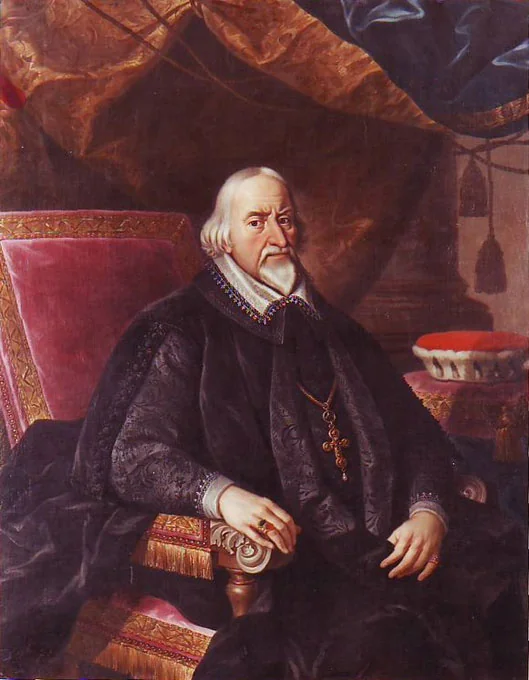
Image from Wikipedia
Image from Wikipedia
Johann Schweikhard von Cronberg – The Conciliatory Power Politician of the Electoral Mainz Baroque Era
An Archbishop Between Counter-Reformation, Imperial Politics, and Cultural Heritage
Johann Schweikhard von Cronberg is one of the defining figures of Electoral Mainz history in the early modern period. Born on July 15, 1553, in Kronberg im Taunus and died on September 17, 1626, in Aschaffenburg, he led the Archdiocese of Mainz from 1604 to 1626 and simultaneously held one of the most important political positions of his time as the archchancellor of the Holy Roman Empire. His years in power coincided with an era marked by confessional conflicts, shifts in power, and the onset of the Thirty Years' War. ([de.wikipedia.org](https://de.wikipedia.org/wiki/Johann_Schweikhard_von_Cronberg))
Background and Spiritual Formation
Schweikhard came from the long-established noble family of von Cronberg in the Archdiocese of Mainz. As the third son of the Electoral Mainz marshal, grand master, and chief bailiff Hartmut XIII. von Cronberg and Barbara von Sickingen, his path in life was early directed toward the ecclesiastical state. He became a cathedral vicar as early as 1564, and in 1566 a canon of St. Alban in Mainz; later, he pursued studies and training at the Collegium Germanicum in Rome, where he absorbed important spiritual and intellectual impulses. This early formation laid the foundation for a career that closely intertwined ecclesiastical education, dynastic networking, and institutional power thinking. ([de.wikipedia.org](https://de.wikipedia.org/wiki/Johann_Schweikhard_von_Cronberg))
Notably, the family's religious background is significant: Schweikhard's grandfather Hartmut XII. was regarded as a supporter of Martin Luther, while Johann Schweikhard himself rose in a Catholic context. This constellation explains the reconciliatory, at times mediating attitude attributed to him in later years. He moved confidently between confessional fronts without compromising the interests of the Catholic Archdiocese. ([de.wikipedia.org](https://de.wikipedia.org/wiki/Johann_Schweikhard_von_Cronberg))
The Rise to Elector of Mainz
Following a series of ecclesiastical offices within the Mainz and Würzburg cathedral chapters, Johann Schweikhard was elected Archbishop of Mainz in 1604 after the death of Johann Adam von Bicken, with only a few opposing votes. The election went to a man viewed as politically astute and committed to a moderate Catholic line. The opposing candidate Julius Echter von Mespelbrunn was seen as more contentious due to his staunch re-Catholicization efforts, further strengthening Schweikhard's position. After receiving papal confirmation and episcopal consecration, he officially took over the leadership of the archdiocese in the autumn of 1604. ([de.wikipedia.org](https://de.wikipedia.org/wiki/Johann_Schweikhard_von_Cronberg))
His accession to office was received positively by the Protestant estates of the empire, as he was considered peaceful and conciliatory. Nevertheless, he was not a political procrastinator: as the first director of the Catholic League and as imperial archchancellor, he exerted considerable influence on imperial politics. Schweikhard aimed to secure the status of the Catholic Church while also avoiding an outright break with the Protestants. This dual strategy of persistence and moderation continues to shape his historical profile to this day. ([de.wikipedia.org](https://de.wikipedia.org/wiki/Johann_Schweikhard_von_Cronberg))
Imperial Politics in the Crisis of the Early Baroque
Schweikhard's reign coincided with an escalation of European conflicts. He reacted with concern to the acceptance of the Bohemian crown by Friedrich V., but remained determined to maintain dialogue with the Protestant estates of the empire. The Mainz Accord of 1621, a three-month truce between imperial troops and the Protestant Union, was established with his involvement. This demonstrates him as a politician who sought to keep temporary windows of peace open amid escalating tensions. ([de.wikipedia.org](https://de.wikipedia.org/wiki/Johann_Schweikhard_von_Cronberg))
He also took a firm stance against foreign interference: He opposed the intervention of Henry IV in the Jülich-Cleves succession dispute and the Spanish invasion of the Palatinate following Friedrich V's defeat at the White Mountain. He eventually reached an arrangement with Matthias after much reluctance but supported Ferdinand II as crucial for the empire's survival. Schweikhard thus acted not as an ideological hardliner but as a prince concerned with stability, hierarchy, and dynastic order. ([de.wikipedia.org](https://de.wikipedia.org/wiki/Johann_Schweikhard_von_Cronberg))
Counter-Reformation, Administration, and Construction Policy
In ecclesiastical political terms, Schweikhard consistently advanced the Counter-Reformation in the Archdiocese of Mainz without provoking Protestant resistance through harsh violence. He strongly supported the Capuchins and Jesuits, founded monasteries and colleges, and also backed institutional educational endeavors. The Jesuits established the Kronberg Gymnasium in Aschaffenburg, named after him, which continues to exist as a language and humanities high school. Thus, he combined confessional consolidation with sustainable educational and cultural policies. ([de.wikipedia.org](https://de.wikipedia.org/wiki/Johann_Schweikhard_von_Cronberg))
His style of governance also included an intensive construction policy. In Aschaffenburg, he commissioned a magnificent Renaissance-style palace to be built by the Strasbourg architect Georg Ridinger, which served as a second residence for the Mainz Electors and Archbishops. He fortified the city of Mainz, restored the Bergstraße to the archdiocese in 1623, and renewed the fortifications. The palace Johannisburg, which he renovated and stabilized, and the so-called Schweikardsburg on the Jakobsberg are testaments to a rule that left its mark not only politically but also architecturally. ([de.wikipedia.org](https://de.wikipedia.org/wiki/Johann_Schweikhard_von_Cronberg))
Musical Culture at the Court: Patron of Church Music
Though Johann Schweikhard was not a musician in the strictest sense, music played a prominent role at his court. Numerous composers, including Protestants, dedicated works to him; under his rule, the electoral court chapel developed into a prestigious ensemble. Jan Le Febure served as court chapel master and court organist, later succeeded by Gabriel Plautz. This personnel continuity indicates how deeply Schweikhard's court was integrated into the church musical culture of his time. ([taunus-nachrichten.de](https://www.taunus-nachrichten.de/kronberg/nachrichten/kronberg/schweikard-kronberg-freund-foerderer-kirchenmusik-id209822.html))
Particularly revealing is his library of musical scores in Aschaffenburg, which collected works by French, German, and Italian masters. Music was not merely an ornamental aspect of court life for Schweikhard but part of a representative and intellectual order. The court chapel also performed at the coronations of Matthias and Ferdinand II in 1612 and 1619 in the Frankfurt Cathedral. Thus, music became the sonic expression of political legitimacy and Catholic representation. ([taunus-nachrichten.de](https://www.taunus-nachrichten.de/kronberg/nachrichten/kronberg/schweikard-kronberg-freund-foerderer-kirchenmusik-id209822.html))
Witch Trials and the Dark Side of Authority
Johann Schweikhard's historical legacy also includes the significant intensification of witch persecutions in Electoral Mainz. Under his rule, the persecution was systematized; an investigative ordinance with 18 general and 98 special questions was sent to the courts. In total, many people fell victim to the proceedings during his reign from 1604 to 1626, including 84 in 1611 in Kleinwallstadt and over 170 in Lohr. These facts reveal the shadow side of a rule that understood itself as both an ordering and religiously disciplining force. ([de.wikipedia.org](https://de.wikipedia.org/wiki/Johann_Schweikhard_von_Cronberg))
The sources describe the witch trials as a means of Counter-Reformation and financial enrichment, as the wealth of the condemned was confiscated. The funds were partly used for the construction of the Johannisburg Palace. Schweikhard thus appears as a figure of an era in which piety, governance techniques, and repression were closely intertwined. This very ambivalence is what makes his historical relevance significant to this day. ([de.wikipedia.org](https://de.wikipedia.org/wiki/Johann_Schweikhard_von_Cronberg))
Reception, Impact, and Historical Legacy
The modern memory of Johann Schweikhard von Cronberg is characterized by a tension: on the one hand, he is regarded as a significant bishop of the Archdiocese of Mainz, while on the other hand, he remains relatively unknown outside of academic history. Regional contributions highlight his status as the restorer of Johannisburg Palace and as a promoter of church music and cultural education. In Aschaffenburg and Mainz, his name is inscribed in buildings, schools, and historical memorial sites, yet he never achieved widespread popularity. ([taunus-nachrichten.de](https://www.taunus-nachrichten.de/kronberg/aktuelles/kronberg/johann-schweikard-kronberg-%E2%80%93-vergessene-mainzer-erzbischof-id57155.html))
His significance lies in the connection between imperial politics, ecclesiastical reform, confessional control, and cultural representation. Schweikhard united the roles of diplomat, administrator, builder, and church prince in one person. Anyone seeking to understand the political culture of the early baroque will encounter a key figure who acted not through loud gestures but through institutional power, network building, and persistent stabilization. ([de.wikipedia.org](https://de.wikipedia.org/wiki/Johann_Schweikhard_von_Cronberg))
Conclusion: A Prince of Balance Who Continues to Resonate Today
Johann Schweikhard von Cronberg fascinates through his multifaceted nature: as a powerful elector and archchancellor, as a patron of education and church music, as a builder with a sense of representation, and as a player in a contentious religious policy. His biography shows how closely power, culture, and confession were interconnected in the early modern period. Those who get to know him do not encounter a loud hero but a strategic architect of his time, whose traces in Mainz and Aschaffenburg are still visible today. ([de.wikipedia.org](https://de.wikipedia.org/wiki/Johann_Schweikhard_von_Cronberg))
Anyone wishing to read history through places, buildings, and political decisions should certainly take a closer look at Johann Schweikhard von Cronberg. His world of residence, court chapel, imperial politics, and religious order presents a fascinating panorama of the early modern period. It is precisely for this reason that examining his legacy is especially worthwhile where architecture, music history, and power history intersect. ([taunus-nachrichten.de](https://www.taunus-nachrichten.de/kronberg/aktuelles/kronberg/johann-schweikard-kronberg-%E2%80%93-vergessene-mainzer-erzbischof-id57155.html))
Official Channels of Johann Schweikhard von Cronberg:
- Instagram: no official profile found
- Facebook: no official profile found
- YouTube: no official profile found
- Spotify: no official profile found
- TikTok: no official profile found
Sources:
- Wikipedia – Johann Schweikhard von Cronberg
- Deutsche Biographie – Johann Schweikard von Cronberg
- regionalgeschichte.net – Biography of Johann Schweikard von Cronberg
- Taunus-Nachrichten – Johann Schweikard von Cronberg, the Forgotten Archbishop of Mainz
- Taunus-Nachrichten – Schweikard von Cronberg, Friend and Patron of Church Music
- Wikidata – Johann Schweikhard von Cronberg