
Alzenau
63755 Alzenau, Deutschland
terroir f Alzenau | Working in the Vineyard & Viewing Point
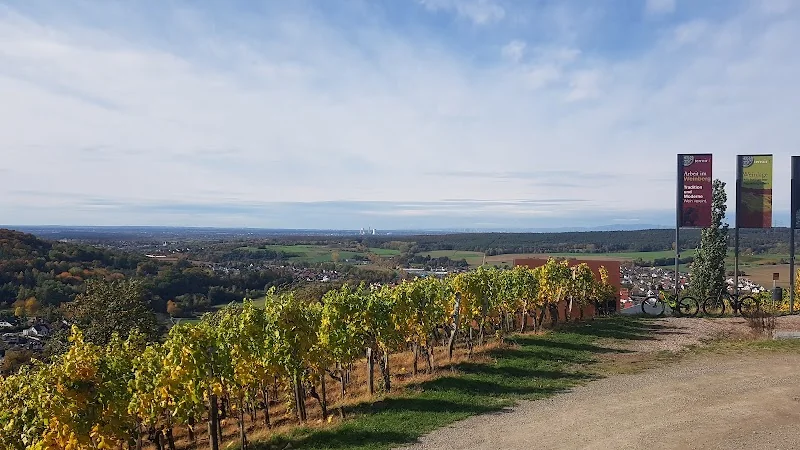
terroir f Alzenau is located in the Michelbacher Apostelgarten and is much more than a beautiful viewpoint in the vineyards: The site is designed as a viewing and information point and tells the story of viticulture where it originated. The official presentation focuses on the theme of working in the vineyard and connects it with the contrasts of tradition and modernity. Historical vineyard houses, stone barriers, and the steep slope itself make visible how strongly landscape, craftsmanship, and patience have shaped viticulture. At the same time, the new vineyard house made of corten steel sets a consciously modern accent and positions the site as a magical point of Franconian wine. The location is in Michelbach, known as the northernmost Franconian wine village, and offers a view over the Kahlgrund to the skyline of Frankfurt. Thus, terroir f Alzenau becomes a place where landscape, culture, and wine knowledge come together directly. ([franken-weinland.de](https://www.franken-weinland.de/poi/terroir_f_alzenau-20786/))
Working in the Vineyard: Tradition and Modernity in the Michelbacher Apostelgarten
The guiding theme of the site is not coincidentally working in the vineyard. The official description emphasizes that the Michelbacher Apostelgarten, with its historical vineyard houses, stone barriers, and steep topography, is a visible testament to hard work. This is precisely the strength of this place: It not only shows how beautiful vineyard landscapes can be, but also how much knowledge, muscle power, and intergenerational experience are needed to cultivate vines on a steep slope. The new building at terroir f picks up this story and translates it into a contemporary design language. Corten steel does not stand here as an end in itself, but takes up the idea of the vineyard house and translates it into the present. Inside, this connection continues, as the presentation describes the technological development of viticulture from manual labor to the use of the latest technology. Thus, the visitor does not receive an abstract lesson but a spatially experienceable narrative about how viticulture has changed without losing its roots. This very tension makes terroir f Alzenau so relevant for people interested in wine, regional history, and authentic places. Therefore, those who visit the facility are not only at a viewpoint but at a small outdoor learning place where the work in the vineyard becomes readable as part of a vibrant cultural landscape. ([franken-weinland.de](https://www.franken-weinland.de/poi/terroir_f_alzenau-20786/))
The special appeal of the theme also lies in the fact that the history of viticulture here does not seem museum-like but takes place right in the landscape. The Michelbacher Apostelgarten is a protected vineyard site where the forms of old viticulture remain visible and are simultaneously embedded in a new design concept. Thus, a viticultural workspace becomes a place where visitors can understand why certain slopes are so valuable, why stones are not just a disturbance but a documentation of centuries of cultivation, and how the traditional vineyard house can be read as a symbol of an entire culture. This is particularly important for guests who are looking for authentic sights and expect not only a beautiful photo but also substantive added value. Alzenau achieves something rare here: The place conveys the history of viticulture without distance, but also without romantic idealization. It shows the reality of work on the slope and makes it aesthetically accessible. Therefore, those interested in terroir f Alzenau are not only looking for a viewpoint but an example of how regional identity can become visible in public space. ([franken-weinland.de](https://www.franken-weinland.de/poi/terroir_f_alzenau-20786/))
View from terroir f Alzenau: Kahlgrund to Frankfurt
The view is one of the most important reasons why terroir f Alzenau has such a strong impact. The official description states that the view from the Apostelgarten sweeps over the Kahlgrund to the skyline of Frankfurt. This distant view gives the place an impressive expanse that makes the contrast between the small-scale vineyard and the large urban space visible. This is where the emotional power of the site lies: The visitor stands in a historical vineyard location and simultaneously looks into a landscape that opens up far beyond the immediate vineyard. The location benefits from the special topography of the Alzenau area, as the northern foothills of the Spessart meet the open Main plain, which has always provided the city with mild climatic conditions for viticulture. The city's wine culture side also emphasizes that the steep locations and mild climate create the conditions for high-quality white wines. Therefore, terroir f Alzenau is not only a beautiful viewpoint but also a place where geographical and viticultural connections can be read directly. Those who linger here experience a landscape that is not only decorative but also explicable. ([franken-weinland.de](https://www.franken-weinland.de/poi/terroir_f_alzenau-20786/))
Particularly interesting is the connection between the viewing experience and the regional wine identity. In the official city communication, the Apostelgarten is described as a vineyard where the westernmost grapes in Franconia grow. Additionally, the site is not just any slope but is located in a centuries-old cultivation area that is protected as a monument. This combination of geographical marginality, historical depth, and wide view makes the place a model for what terroir f in Franconia should achieve: to make the landscape readable and its wine history sensually experienceable. The view towards Frankfurt is more than just a beautiful backdrop. It shows how closely different habitats come together here without losing their independence. For photography fans, this is particularly appealing because the vineyard, sky, distant view, and architecture are constantly re-staged in the changing times of day. For wine enthusiasts, the view serves as an entry point into a deeper understanding of location, climate, and culture. Thus, terroir f Alzenau is a viewpoint with substance: The wide view is not detached from the vine but part of its story. ([alzenau.de](https://www.alzenau.de/Freizeit-G%C3%A4ste/Kunst-Kultur-Events/Veranstaltungen/index.php?FID=2413.6962.1&La=1&ModID=11&NavID=2413.18&bn=1&date=2013-5&object=tx%7C2413.29.1&sfreg=1&sfvort=1&utm_source=openai))
Historical Vineyard Houses and Monument Protection in the Michelbacher Apostelgarten
One of the strongest reasons to engage with terroir f Alzenau is the special historical environment. The official description refers to historical vineyard houses, stone barriers, and the steep slope itself as testimonies of vineyard work. Additionally, the Franconian tourism site describes the place as a location in the midst of a protected vineyard area, where a freshly renovated historical stone house forms the landmark of Michelbacher viticulture. This reference is not merely decorative but structurally important: The new vineyard house and the old stone house symbolically represent the transition between past and present viticulture culture. The architecture of corten steel takes up the theme of the vineyard house without copying the old. This creates an exciting dialogue between material, memory, and landscape. Thus, when walking through the Apostelgarten, one sees not only vines but also architectural traces of a cultivated landscape that has been farmed for centuries. This is precisely what makes the place so attractive for visitors interested in landscape architecture, monument preservation, or regional history. ([franken-weinland.de](https://www.franken-weinland.de/poi/terroir_f_alzenau-20786/))
The official city website even goes a step further and describes the Apostelgarten as one of the very few nature and monument-protected vineyards in Germany. This is crucial for the perception of the place, as it explains why the slope should not simply be understood as a pure recreational area. Here, protection, use, and narration overlap. The vineyard is a lively production space, a historical document, and a tourist viewpoint at the same time. Additionally, the regional peculiarity that Michelbach is considered the northernmost Franconian wine village and that wine culture is particularly strongly anchored in the landscape makes the site even more significant. The vineyard locations are officially named Steinberg, Apostelgarten, and Aloisengarten. Thus, terroir f Alzenau is not isolated but part of a whole, clearly named wine landscape. This is particularly important for SEO and user intent: Those searching for images, information, or backgrounds about terroir f Alzenau often also look for the Apostelgarten, for monument protection, for vineyard houses, or for the Michelbacher vineyard. All these terms actually belong together here and describe the same cultural space. ([alzenau.de](https://www.alzenau.de/Freizeit-G%C3%A4ste/Kunst-Kultur-Events/Veranstaltungen/index.php?FID=2413.6962.1&La=1&ModID=11&NavID=2413.18&bn=1&date=2013-5&object=tx%7C2413.29.1&sfreg=1&sfvort=1&utm_source=openai))
Vineyard Tours and Walks Around the Viewing Point
terroir f Alzenau is not just for quiet viewing but also a starting point for guided experiences. The city of Alzenau has announced several vineyard tours around the viewing and information point. At an official event, tours through the Michelbacher vineyard started every 30 minutes with wine experience guides, and a walk in the Apostelgarten was described as an opportunity to get to know nature, views, voices, moods, and wines. The Franconian tourism site adds to this experiential character by starting the wine journey Spessart-Mainland with a walk to the viewpoint in Alzenau. There, visitors learn more about the technological development of viticulture. This fits perfectly with the concept of the site: The place is not only a point of view but also a point of narration. Tours turn the landscape into a readable story, and this makes the region tangible for guests looking for more than a quick stop. ([alzenau.de](https://www.alzenau.de/Freizeit-G%C3%A4ste/Kunst-Kultur-Events/Kunst/Weinbergf%C3%BChrungen-Aussichts-und-Informationspunkt-Terroir-f-.php?FID=2413.1613.1&ModID=11&NavID=2413.250&object=tx%2C2413.29.1&utm_source=openai))
The practical quality of the experience is also remarkable. The official event texts point out that after the walk, a visit to a wine tavern is possible and that participation in a tour may require registration. Even if one does not participate in an organized tour, the place remains part of a well-connected wine and hiking experience, as the Alzenau region with its wineries, wine taverns, and viewpoints is integrated into tourist routes. Thus, terroir f Alzenau is particularly suitable for visitors looking for a combination of movement, landscape, and culinary experiences. This is highly relevant for search queries like vineyard tours Alzenau, Apostelgarten circular route, or viewpoint Franconian wine, as visitors find concrete points of connection here. The place thus provides not only a photographic motif but a whole logic of use: walk, tour, rest, wine knowledge, view. This mix makes it a good example of modern wine tourism that does not rely solely on pure eventization but on substantively comprehensible local quality. ([alzenau.de](https://www.alzenau.de/Freizeit-G%C3%A4ste/Kunst-Kultur-Events/Veranstaltungen/index.php?FID=2413.6962.1&La=1&ModID=11&NavID=2413.18&bn=1&date=2013-5&object=tx%7C2413.29.1&sfreg=1&sfvort=1&utm_source=openai))
Visit on Site: Access, Rest Area, and Orientation in Michelbach
Those who want to visit terroir f Alzenau will find a clear statement on the official pages: The viewing and information point is open to the public. It can also be used as a station for vineyard tours or as a rest and picnic area. This is an important point for user expectations, as many visitors specifically search for practical information and want to know whether a place is freely accessible. The answer here is clearly yes, not only as a viewpoint but also as a place to linger. The location in the Michelbacher Apostelgarten vineyard makes orientation easy: Michelbach is the district that is directly linked to terroir f in the official texts. For travel, the place name Michelbach or Michelbacher Apostelgarten is therefore the most important orientation. The official information address also mentions the city info point at Hanauer Straße 1 in 63755 Alzenau, should visitors wish for further information. Thus, terroir f Alzenau is well integrated into the urban infrastructure and is not just a remote vineyard but an accessible place within the city and wine landscape. ([alzenau.de](https://www.alzenau.de/Freizeit-G%C3%A4ste/Kunst-Kultur-Events/Weinkultur/Terroir-f/?utm_source=openai))
For practical planning, it is also helpful that the experience is not tied to a specific event time. While tours and wine walks are often linked to dates, the actual place is designed as a public viewpoint. This means: One can also incorporate it into their own route independently of an event, for example, as a destination for a walk through the Michelbacher vineyard or as a resting point during a tour through the Kahlgrund. The official tourism description suggests that the place can be well combined with other experiences in Alzenau, such as regional gastronomy or with other wine villages in the region. Those who enjoy photography will also find a strong combination of vineyard, modern building, historical house, and distant view. For a relaxed visit, it is therefore advisable not only to make a short detour but to allow enough time to truly perceive the relationships between landscape, architecture, and viticulture. Precisely because the place is both an information point and a resting place, it fulfills two typical user needs at once: knowledge and stay. This makes it strong in content and pleasantly usable in everyday life. ([alzenau.de](https://www.alzenau.de/Freizeit-G%C3%A4ste/Kunst-Kultur-Events/Weinkultur/Terroir-f/?utm_source=openai))
Why the terroir-f Point Alzenau is So Special for Franconian Wine
The terroir-f concept has been described by Franconian wine sites as a collection of magical places of Franconian wine, each telling its own story about the region. Alzenau plays a special role in this because the site consistently addresses the theme of working in the vineyard. It stands not for mere representation but for a genuine narrative core: Viticulture here is craftsmanship, landscape care, technology, and culture at the same time. The Franconian tourism site also emphasizes that visitors can enjoy breathtaking distant views at the terroir-f locations and feel the special spirit of the place. This happens particularly intensely in Alzenau because the site is not only a viewpoint but lies in a protected vineyard area and is readable through both historical and modern elements. Thus, those who visit the place learn not only about Franconian wine but also about how a region makes its identity spatially visible. The official wine culture site of the city adds to this with a note about the mild climate, steep locations, and regionally typical grape variety diversity. Alzenau is therefore not an interchangeable wine village but a clearly characterized wine space with its own narrative. ([franken-weinland.de](https://www.franken-weinland.de/rund-um-den-wein/basiswissen/terroir-f/?utm_source=openai))
Especially for visitors who are specifically looking for images, backgrounds, or a special excursion destination, terroir f Alzenau is a strong hit. It combines the search intentions for viewpoint, vineyard, history, tours, picnic area, tradition, and modern architecture in a single place. The official texts also show that Alzenau is not only locally but also touristically embedded in larger routes. The wine journey Spessart-Mainland begins here, making the site a starting point for further discoveries in the Franconian wine country. This embedding is important because it gives the place additional relevance: It is a starting point, a learning place, a viewing place, and a symbol for regional change in viticulture. Therefore, if one wonders why terroir f Alzenau is so frequently searched for, the answer lies in this very complexity. It is a place that cannot be reduced to a single function and is precisely why it remains memorable. This makes it interesting for guests, locals, and wine lovers alike. ([franken-weinland.de](https://www.franken-weinland.de/landschaft-und-wein/tourenvorschlaege/weinreise-spessart-mainland/))
Sources:
Mehr anzeigenWeniger anzeigen
terroir f Alzenau | Working in the Vineyard & Viewing Point
terroir f Alzenau is located in the Michelbacher Apostelgarten and is much more than a beautiful viewpoint in the vineyards: The site is designed as a viewing and information point and tells the story of viticulture where it originated. The official presentation focuses on the theme of working in the vineyard and connects it with the contrasts of tradition and modernity. Historical vineyard houses, stone barriers, and the steep slope itself make visible how strongly landscape, craftsmanship, and patience have shaped viticulture. At the same time, the new vineyard house made of corten steel sets a consciously modern accent and positions the site as a magical point of Franconian wine. The location is in Michelbach, known as the northernmost Franconian wine village, and offers a view over the Kahlgrund to the skyline of Frankfurt. Thus, terroir f Alzenau becomes a place where landscape, culture, and wine knowledge come together directly. ([franken-weinland.de](https://www.franken-weinland.de/poi/terroir_f_alzenau-20786/))
Working in the Vineyard: Tradition and Modernity in the Michelbacher Apostelgarten
The guiding theme of the site is not coincidentally working in the vineyard. The official description emphasizes that the Michelbacher Apostelgarten, with its historical vineyard houses, stone barriers, and steep topography, is a visible testament to hard work. This is precisely the strength of this place: It not only shows how beautiful vineyard landscapes can be, but also how much knowledge, muscle power, and intergenerational experience are needed to cultivate vines on a steep slope. The new building at terroir f picks up this story and translates it into a contemporary design language. Corten steel does not stand here as an end in itself, but takes up the idea of the vineyard house and translates it into the present. Inside, this connection continues, as the presentation describes the technological development of viticulture from manual labor to the use of the latest technology. Thus, the visitor does not receive an abstract lesson but a spatially experienceable narrative about how viticulture has changed without losing its roots. This very tension makes terroir f Alzenau so relevant for people interested in wine, regional history, and authentic places. Therefore, those who visit the facility are not only at a viewpoint but at a small outdoor learning place where the work in the vineyard becomes readable as part of a vibrant cultural landscape. ([franken-weinland.de](https://www.franken-weinland.de/poi/terroir_f_alzenau-20786/))
The special appeal of the theme also lies in the fact that the history of viticulture here does not seem museum-like but takes place right in the landscape. The Michelbacher Apostelgarten is a protected vineyard site where the forms of old viticulture remain visible and are simultaneously embedded in a new design concept. Thus, a viticultural workspace becomes a place where visitors can understand why certain slopes are so valuable, why stones are not just a disturbance but a documentation of centuries of cultivation, and how the traditional vineyard house can be read as a symbol of an entire culture. This is particularly important for guests who are looking for authentic sights and expect not only a beautiful photo but also substantive added value. Alzenau achieves something rare here: The place conveys the history of viticulture without distance, but also without romantic idealization. It shows the reality of work on the slope and makes it aesthetically accessible. Therefore, those interested in terroir f Alzenau are not only looking for a viewpoint but an example of how regional identity can become visible in public space. ([franken-weinland.de](https://www.franken-weinland.de/poi/terroir_f_alzenau-20786/))
View from terroir f Alzenau: Kahlgrund to Frankfurt
The view is one of the most important reasons why terroir f Alzenau has such a strong impact. The official description states that the view from the Apostelgarten sweeps over the Kahlgrund to the skyline of Frankfurt. This distant view gives the place an impressive expanse that makes the contrast between the small-scale vineyard and the large urban space visible. This is where the emotional power of the site lies: The visitor stands in a historical vineyard location and simultaneously looks into a landscape that opens up far beyond the immediate vineyard. The location benefits from the special topography of the Alzenau area, as the northern foothills of the Spessart meet the open Main plain, which has always provided the city with mild climatic conditions for viticulture. The city's wine culture side also emphasizes that the steep locations and mild climate create the conditions for high-quality white wines. Therefore, terroir f Alzenau is not only a beautiful viewpoint but also a place where geographical and viticultural connections can be read directly. Those who linger here experience a landscape that is not only decorative but also explicable. ([franken-weinland.de](https://www.franken-weinland.de/poi/terroir_f_alzenau-20786/))
Particularly interesting is the connection between the viewing experience and the regional wine identity. In the official city communication, the Apostelgarten is described as a vineyard where the westernmost grapes in Franconia grow. Additionally, the site is not just any slope but is located in a centuries-old cultivation area that is protected as a monument. This combination of geographical marginality, historical depth, and wide view makes the place a model for what terroir f in Franconia should achieve: to make the landscape readable and its wine history sensually experienceable. The view towards Frankfurt is more than just a beautiful backdrop. It shows how closely different habitats come together here without losing their independence. For photography fans, this is particularly appealing because the vineyard, sky, distant view, and architecture are constantly re-staged in the changing times of day. For wine enthusiasts, the view serves as an entry point into a deeper understanding of location, climate, and culture. Thus, terroir f Alzenau is a viewpoint with substance: The wide view is not detached from the vine but part of its story. ([alzenau.de](https://www.alzenau.de/Freizeit-G%C3%A4ste/Kunst-Kultur-Events/Veranstaltungen/index.php?FID=2413.6962.1&La=1&ModID=11&NavID=2413.18&bn=1&date=2013-5&object=tx%7C2413.29.1&sfreg=1&sfvort=1&utm_source=openai))
Historical Vineyard Houses and Monument Protection in the Michelbacher Apostelgarten
One of the strongest reasons to engage with terroir f Alzenau is the special historical environment. The official description refers to historical vineyard houses, stone barriers, and the steep slope itself as testimonies of vineyard work. Additionally, the Franconian tourism site describes the place as a location in the midst of a protected vineyard area, where a freshly renovated historical stone house forms the landmark of Michelbacher viticulture. This reference is not merely decorative but structurally important: The new vineyard house and the old stone house symbolically represent the transition between past and present viticulture culture. The architecture of corten steel takes up the theme of the vineyard house without copying the old. This creates an exciting dialogue between material, memory, and landscape. Thus, when walking through the Apostelgarten, one sees not only vines but also architectural traces of a cultivated landscape that has been farmed for centuries. This is precisely what makes the place so attractive for visitors interested in landscape architecture, monument preservation, or regional history. ([franken-weinland.de](https://www.franken-weinland.de/poi/terroir_f_alzenau-20786/))
The official city website even goes a step further and describes the Apostelgarten as one of the very few nature and monument-protected vineyards in Germany. This is crucial for the perception of the place, as it explains why the slope should not simply be understood as a pure recreational area. Here, protection, use, and narration overlap. The vineyard is a lively production space, a historical document, and a tourist viewpoint at the same time. Additionally, the regional peculiarity that Michelbach is considered the northernmost Franconian wine village and that wine culture is particularly strongly anchored in the landscape makes the site even more significant. The vineyard locations are officially named Steinberg, Apostelgarten, and Aloisengarten. Thus, terroir f Alzenau is not isolated but part of a whole, clearly named wine landscape. This is particularly important for SEO and user intent: Those searching for images, information, or backgrounds about terroir f Alzenau often also look for the Apostelgarten, for monument protection, for vineyard houses, or for the Michelbacher vineyard. All these terms actually belong together here and describe the same cultural space. ([alzenau.de](https://www.alzenau.de/Freizeit-G%C3%A4ste/Kunst-Kultur-Events/Veranstaltungen/index.php?FID=2413.6962.1&La=1&ModID=11&NavID=2413.18&bn=1&date=2013-5&object=tx%7C2413.29.1&sfreg=1&sfvort=1&utm_source=openai))
Vineyard Tours and Walks Around the Viewing Point
terroir f Alzenau is not just for quiet viewing but also a starting point for guided experiences. The city of Alzenau has announced several vineyard tours around the viewing and information point. At an official event, tours through the Michelbacher vineyard started every 30 minutes with wine experience guides, and a walk in the Apostelgarten was described as an opportunity to get to know nature, views, voices, moods, and wines. The Franconian tourism site adds to this experiential character by starting the wine journey Spessart-Mainland with a walk to the viewpoint in Alzenau. There, visitors learn more about the technological development of viticulture. This fits perfectly with the concept of the site: The place is not only a point of view but also a point of narration. Tours turn the landscape into a readable story, and this makes the region tangible for guests looking for more than a quick stop. ([alzenau.de](https://www.alzenau.de/Freizeit-G%C3%A4ste/Kunst-Kultur-Events/Kunst/Weinbergf%C3%BChrungen-Aussichts-und-Informationspunkt-Terroir-f-.php?FID=2413.1613.1&ModID=11&NavID=2413.250&object=tx%2C2413.29.1&utm_source=openai))
The practical quality of the experience is also remarkable. The official event texts point out that after the walk, a visit to a wine tavern is possible and that participation in a tour may require registration. Even if one does not participate in an organized tour, the place remains part of a well-connected wine and hiking experience, as the Alzenau region with its wineries, wine taverns, and viewpoints is integrated into tourist routes. Thus, terroir f Alzenau is particularly suitable for visitors looking for a combination of movement, landscape, and culinary experiences. This is highly relevant for search queries like vineyard tours Alzenau, Apostelgarten circular route, or viewpoint Franconian wine, as visitors find concrete points of connection here. The place thus provides not only a photographic motif but a whole logic of use: walk, tour, rest, wine knowledge, view. This mix makes it a good example of modern wine tourism that does not rely solely on pure eventization but on substantively comprehensible local quality. ([alzenau.de](https://www.alzenau.de/Freizeit-G%C3%A4ste/Kunst-Kultur-Events/Veranstaltungen/index.php?FID=2413.6962.1&La=1&ModID=11&NavID=2413.18&bn=1&date=2013-5&object=tx%7C2413.29.1&sfreg=1&sfvort=1&utm_source=openai))
Visit on Site: Access, Rest Area, and Orientation in Michelbach
Those who want to visit terroir f Alzenau will find a clear statement on the official pages: The viewing and information point is open to the public. It can also be used as a station for vineyard tours or as a rest and picnic area. This is an important point for user expectations, as many visitors specifically search for practical information and want to know whether a place is freely accessible. The answer here is clearly yes, not only as a viewpoint but also as a place to linger. The location in the Michelbacher Apostelgarten vineyard makes orientation easy: Michelbach is the district that is directly linked to terroir f in the official texts. For travel, the place name Michelbach or Michelbacher Apostelgarten is therefore the most important orientation. The official information address also mentions the city info point at Hanauer Straße 1 in 63755 Alzenau, should visitors wish for further information. Thus, terroir f Alzenau is well integrated into the urban infrastructure and is not just a remote vineyard but an accessible place within the city and wine landscape. ([alzenau.de](https://www.alzenau.de/Freizeit-G%C3%A4ste/Kunst-Kultur-Events/Weinkultur/Terroir-f/?utm_source=openai))
For practical planning, it is also helpful that the experience is not tied to a specific event time. While tours and wine walks are often linked to dates, the actual place is designed as a public viewpoint. This means: One can also incorporate it into their own route independently of an event, for example, as a destination for a walk through the Michelbacher vineyard or as a resting point during a tour through the Kahlgrund. The official tourism description suggests that the place can be well combined with other experiences in Alzenau, such as regional gastronomy or with other wine villages in the region. Those who enjoy photography will also find a strong combination of vineyard, modern building, historical house, and distant view. For a relaxed visit, it is therefore advisable not only to make a short detour but to allow enough time to truly perceive the relationships between landscape, architecture, and viticulture. Precisely because the place is both an information point and a resting place, it fulfills two typical user needs at once: knowledge and stay. This makes it strong in content and pleasantly usable in everyday life. ([alzenau.de](https://www.alzenau.de/Freizeit-G%C3%A4ste/Kunst-Kultur-Events/Weinkultur/Terroir-f/?utm_source=openai))
Why the terroir-f Point Alzenau is So Special for Franconian Wine
The terroir-f concept has been described by Franconian wine sites as a collection of magical places of Franconian wine, each telling its own story about the region. Alzenau plays a special role in this because the site consistently addresses the theme of working in the vineyard. It stands not for mere representation but for a genuine narrative core: Viticulture here is craftsmanship, landscape care, technology, and culture at the same time. The Franconian tourism site also emphasizes that visitors can enjoy breathtaking distant views at the terroir-f locations and feel the special spirit of the place. This happens particularly intensely in Alzenau because the site is not only a viewpoint but lies in a protected vineyard area and is readable through both historical and modern elements. Thus, those who visit the place learn not only about Franconian wine but also about how a region makes its identity spatially visible. The official wine culture site of the city adds to this with a note about the mild climate, steep locations, and regionally typical grape variety diversity. Alzenau is therefore not an interchangeable wine village but a clearly characterized wine space with its own narrative. ([franken-weinland.de](https://www.franken-weinland.de/rund-um-den-wein/basiswissen/terroir-f/?utm_source=openai))
Especially for visitors who are specifically looking for images, backgrounds, or a special excursion destination, terroir f Alzenau is a strong hit. It combines the search intentions for viewpoint, vineyard, history, tours, picnic area, tradition, and modern architecture in a single place. The official texts also show that Alzenau is not only locally but also touristically embedded in larger routes. The wine journey Spessart-Mainland begins here, making the site a starting point for further discoveries in the Franconian wine country. This embedding is important because it gives the place additional relevance: It is a starting point, a learning place, a viewing place, and a symbol for regional change in viticulture. Therefore, if one wonders why terroir f Alzenau is so frequently searched for, the answer lies in this very complexity. It is a place that cannot be reduced to a single function and is precisely why it remains memorable. This makes it interesting for guests, locals, and wine lovers alike. ([franken-weinland.de](https://www.franken-weinland.de/landschaft-und-wein/tourenvorschlaege/weinreise-spessart-mainland/))
Sources:
terroir f Alzenau | Working in the Vineyard & Viewing Point
terroir f Alzenau is located in the Michelbacher Apostelgarten and is much more than a beautiful viewpoint in the vineyards: The site is designed as a viewing and information point and tells the story of viticulture where it originated. The official presentation focuses on the theme of working in the vineyard and connects it with the contrasts of tradition and modernity. Historical vineyard houses, stone barriers, and the steep slope itself make visible how strongly landscape, craftsmanship, and patience have shaped viticulture. At the same time, the new vineyard house made of corten steel sets a consciously modern accent and positions the site as a magical point of Franconian wine. The location is in Michelbach, known as the northernmost Franconian wine village, and offers a view over the Kahlgrund to the skyline of Frankfurt. Thus, terroir f Alzenau becomes a place where landscape, culture, and wine knowledge come together directly. ([franken-weinland.de](https://www.franken-weinland.de/poi/terroir_f_alzenau-20786/))
Working in the Vineyard: Tradition and Modernity in the Michelbacher Apostelgarten
The guiding theme of the site is not coincidentally working in the vineyard. The official description emphasizes that the Michelbacher Apostelgarten, with its historical vineyard houses, stone barriers, and steep topography, is a visible testament to hard work. This is precisely the strength of this place: It not only shows how beautiful vineyard landscapes can be, but also how much knowledge, muscle power, and intergenerational experience are needed to cultivate vines on a steep slope. The new building at terroir f picks up this story and translates it into a contemporary design language. Corten steel does not stand here as an end in itself, but takes up the idea of the vineyard house and translates it into the present. Inside, this connection continues, as the presentation describes the technological development of viticulture from manual labor to the use of the latest technology. Thus, the visitor does not receive an abstract lesson but a spatially experienceable narrative about how viticulture has changed without losing its roots. This very tension makes terroir f Alzenau so relevant for people interested in wine, regional history, and authentic places. Therefore, those who visit the facility are not only at a viewpoint but at a small outdoor learning place where the work in the vineyard becomes readable as part of a vibrant cultural landscape. ([franken-weinland.de](https://www.franken-weinland.de/poi/terroir_f_alzenau-20786/))
The special appeal of the theme also lies in the fact that the history of viticulture here does not seem museum-like but takes place right in the landscape. The Michelbacher Apostelgarten is a protected vineyard site where the forms of old viticulture remain visible and are simultaneously embedded in a new design concept. Thus, a viticultural workspace becomes a place where visitors can understand why certain slopes are so valuable, why stones are not just a disturbance but a documentation of centuries of cultivation, and how the traditional vineyard house can be read as a symbol of an entire culture. This is particularly important for guests who are looking for authentic sights and expect not only a beautiful photo but also substantive added value. Alzenau achieves something rare here: The place conveys the history of viticulture without distance, but also without romantic idealization. It shows the reality of work on the slope and makes it aesthetically accessible. Therefore, those interested in terroir f Alzenau are not only looking for a viewpoint but an example of how regional identity can become visible in public space. ([franken-weinland.de](https://www.franken-weinland.de/poi/terroir_f_alzenau-20786/))
View from terroir f Alzenau: Kahlgrund to Frankfurt
The view is one of the most important reasons why terroir f Alzenau has such a strong impact. The official description states that the view from the Apostelgarten sweeps over the Kahlgrund to the skyline of Frankfurt. This distant view gives the place an impressive expanse that makes the contrast between the small-scale vineyard and the large urban space visible. This is where the emotional power of the site lies: The visitor stands in a historical vineyard location and simultaneously looks into a landscape that opens up far beyond the immediate vineyard. The location benefits from the special topography of the Alzenau area, as the northern foothills of the Spessart meet the open Main plain, which has always provided the city with mild climatic conditions for viticulture. The city's wine culture side also emphasizes that the steep locations and mild climate create the conditions for high-quality white wines. Therefore, terroir f Alzenau is not only a beautiful viewpoint but also a place where geographical and viticultural connections can be read directly. Those who linger here experience a landscape that is not only decorative but also explicable. ([franken-weinland.de](https://www.franken-weinland.de/poi/terroir_f_alzenau-20786/))
Particularly interesting is the connection between the viewing experience and the regional wine identity. In the official city communication, the Apostelgarten is described as a vineyard where the westernmost grapes in Franconia grow. Additionally, the site is not just any slope but is located in a centuries-old cultivation area that is protected as a monument. This combination of geographical marginality, historical depth, and wide view makes the place a model for what terroir f in Franconia should achieve: to make the landscape readable and its wine history sensually experienceable. The view towards Frankfurt is more than just a beautiful backdrop. It shows how closely different habitats come together here without losing their independence. For photography fans, this is particularly appealing because the vineyard, sky, distant view, and architecture are constantly re-staged in the changing times of day. For wine enthusiasts, the view serves as an entry point into a deeper understanding of location, climate, and culture. Thus, terroir f Alzenau is a viewpoint with substance: The wide view is not detached from the vine but part of its story. ([alzenau.de](https://www.alzenau.de/Freizeit-G%C3%A4ste/Kunst-Kultur-Events/Veranstaltungen/index.php?FID=2413.6962.1&La=1&ModID=11&NavID=2413.18&bn=1&date=2013-5&object=tx%7C2413.29.1&sfreg=1&sfvort=1&utm_source=openai))
Historical Vineyard Houses and Monument Protection in the Michelbacher Apostelgarten
One of the strongest reasons to engage with terroir f Alzenau is the special historical environment. The official description refers to historical vineyard houses, stone barriers, and the steep slope itself as testimonies of vineyard work. Additionally, the Franconian tourism site describes the place as a location in the midst of a protected vineyard area, where a freshly renovated historical stone house forms the landmark of Michelbacher viticulture. This reference is not merely decorative but structurally important: The new vineyard house and the old stone house symbolically represent the transition between past and present viticulture culture. The architecture of corten steel takes up the theme of the vineyard house without copying the old. This creates an exciting dialogue between material, memory, and landscape. Thus, when walking through the Apostelgarten, one sees not only vines but also architectural traces of a cultivated landscape that has been farmed for centuries. This is precisely what makes the place so attractive for visitors interested in landscape architecture, monument preservation, or regional history. ([franken-weinland.de](https://www.franken-weinland.de/poi/terroir_f_alzenau-20786/))
The official city website even goes a step further and describes the Apostelgarten as one of the very few nature and monument-protected vineyards in Germany. This is crucial for the perception of the place, as it explains why the slope should not simply be understood as a pure recreational area. Here, protection, use, and narration overlap. The vineyard is a lively production space, a historical document, and a tourist viewpoint at the same time. Additionally, the regional peculiarity that Michelbach is considered the northernmost Franconian wine village and that wine culture is particularly strongly anchored in the landscape makes the site even more significant. The vineyard locations are officially named Steinberg, Apostelgarten, and Aloisengarten. Thus, terroir f Alzenau is not isolated but part of a whole, clearly named wine landscape. This is particularly important for SEO and user intent: Those searching for images, information, or backgrounds about terroir f Alzenau often also look for the Apostelgarten, for monument protection, for vineyard houses, or for the Michelbacher vineyard. All these terms actually belong together here and describe the same cultural space. ([alzenau.de](https://www.alzenau.de/Freizeit-G%C3%A4ste/Kunst-Kultur-Events/Veranstaltungen/index.php?FID=2413.6962.1&La=1&ModID=11&NavID=2413.18&bn=1&date=2013-5&object=tx%7C2413.29.1&sfreg=1&sfvort=1&utm_source=openai))
Vineyard Tours and Walks Around the Viewing Point
terroir f Alzenau is not just for quiet viewing but also a starting point for guided experiences. The city of Alzenau has announced several vineyard tours around the viewing and information point. At an official event, tours through the Michelbacher vineyard started every 30 minutes with wine experience guides, and a walk in the Apostelgarten was described as an opportunity to get to know nature, views, voices, moods, and wines. The Franconian tourism site adds to this experiential character by starting the wine journey Spessart-Mainland with a walk to the viewpoint in Alzenau. There, visitors learn more about the technological development of viticulture. This fits perfectly with the concept of the site: The place is not only a point of view but also a point of narration. Tours turn the landscape into a readable story, and this makes the region tangible for guests looking for more than a quick stop. ([alzenau.de](https://www.alzenau.de/Freizeit-G%C3%A4ste/Kunst-Kultur-Events/Kunst/Weinbergf%C3%BChrungen-Aussichts-und-Informationspunkt-Terroir-f-.php?FID=2413.1613.1&ModID=11&NavID=2413.250&object=tx%2C2413.29.1&utm_source=openai))
The practical quality of the experience is also remarkable. The official event texts point out that after the walk, a visit to a wine tavern is possible and that participation in a tour may require registration. Even if one does not participate in an organized tour, the place remains part of a well-connected wine and hiking experience, as the Alzenau region with its wineries, wine taverns, and viewpoints is integrated into tourist routes. Thus, terroir f Alzenau is particularly suitable for visitors looking for a combination of movement, landscape, and culinary experiences. This is highly relevant for search queries like vineyard tours Alzenau, Apostelgarten circular route, or viewpoint Franconian wine, as visitors find concrete points of connection here. The place thus provides not only a photographic motif but a whole logic of use: walk, tour, rest, wine knowledge, view. This mix makes it a good example of modern wine tourism that does not rely solely on pure eventization but on substantively comprehensible local quality. ([alzenau.de](https://www.alzenau.de/Freizeit-G%C3%A4ste/Kunst-Kultur-Events/Veranstaltungen/index.php?FID=2413.6962.1&La=1&ModID=11&NavID=2413.18&bn=1&date=2013-5&object=tx%7C2413.29.1&sfreg=1&sfvort=1&utm_source=openai))
Visit on Site: Access, Rest Area, and Orientation in Michelbach
Those who want to visit terroir f Alzenau will find a clear statement on the official pages: The viewing and information point is open to the public. It can also be used as a station for vineyard tours or as a rest and picnic area. This is an important point for user expectations, as many visitors specifically search for practical information and want to know whether a place is freely accessible. The answer here is clearly yes, not only as a viewpoint but also as a place to linger. The location in the Michelbacher Apostelgarten vineyard makes orientation easy: Michelbach is the district that is directly linked to terroir f in the official texts. For travel, the place name Michelbach or Michelbacher Apostelgarten is therefore the most important orientation. The official information address also mentions the city info point at Hanauer Straße 1 in 63755 Alzenau, should visitors wish for further information. Thus, terroir f Alzenau is well integrated into the urban infrastructure and is not just a remote vineyard but an accessible place within the city and wine landscape. ([alzenau.de](https://www.alzenau.de/Freizeit-G%C3%A4ste/Kunst-Kultur-Events/Weinkultur/Terroir-f/?utm_source=openai))
For practical planning, it is also helpful that the experience is not tied to a specific event time. While tours and wine walks are often linked to dates, the actual place is designed as a public viewpoint. This means: One can also incorporate it into their own route independently of an event, for example, as a destination for a walk through the Michelbacher vineyard or as a resting point during a tour through the Kahlgrund. The official tourism description suggests that the place can be well combined with other experiences in Alzenau, such as regional gastronomy or with other wine villages in the region. Those who enjoy photography will also find a strong combination of vineyard, modern building, historical house, and distant view. For a relaxed visit, it is therefore advisable not only to make a short detour but to allow enough time to truly perceive the relationships between landscape, architecture, and viticulture. Precisely because the place is both an information point and a resting place, it fulfills two typical user needs at once: knowledge and stay. This makes it strong in content and pleasantly usable in everyday life. ([alzenau.de](https://www.alzenau.de/Freizeit-G%C3%A4ste/Kunst-Kultur-Events/Weinkultur/Terroir-f/?utm_source=openai))
Why the terroir-f Point Alzenau is So Special for Franconian Wine
The terroir-f concept has been described by Franconian wine sites as a collection of magical places of Franconian wine, each telling its own story about the region. Alzenau plays a special role in this because the site consistently addresses the theme of working in the vineyard. It stands not for mere representation but for a genuine narrative core: Viticulture here is craftsmanship, landscape care, technology, and culture at the same time. The Franconian tourism site also emphasizes that visitors can enjoy breathtaking distant views at the terroir-f locations and feel the special spirit of the place. This happens particularly intensely in Alzenau because the site is not only a viewpoint but lies in a protected vineyard area and is readable through both historical and modern elements. Thus, those who visit the place learn not only about Franconian wine but also about how a region makes its identity spatially visible. The official wine culture site of the city adds to this with a note about the mild climate, steep locations, and regionally typical grape variety diversity. Alzenau is therefore not an interchangeable wine village but a clearly characterized wine space with its own narrative. ([franken-weinland.de](https://www.franken-weinland.de/rund-um-den-wein/basiswissen/terroir-f/?utm_source=openai))
Especially for visitors who are specifically looking for images, backgrounds, or a special excursion destination, terroir f Alzenau is a strong hit. It combines the search intentions for viewpoint, vineyard, history, tours, picnic area, tradition, and modern architecture in a single place. The official texts also show that Alzenau is not only locally but also touristically embedded in larger routes. The wine journey Spessart-Mainland begins here, making the site a starting point for further discoveries in the Franconian wine country. This embedding is important because it gives the place additional relevance: It is a starting point, a learning place, a viewing place, and a symbol for regional change in viticulture. Therefore, if one wonders why terroir f Alzenau is so frequently searched for, the answer lies in this very complexity. It is a place that cannot be reduced to a single function and is precisely why it remains memorable. This makes it interesting for guests, locals, and wine lovers alike. ([franken-weinland.de](https://www.franken-weinland.de/landschaft-und-wein/tourenvorschlaege/weinreise-spessart-mainland/))
Sources:
Upcoming Events
No events found
Frequently Asked Questions
Reviews
Mirella Battaglia
20. July 2025
Great excursion spot with a view of Michelbach and the Frankfurt skyline
Frank Jäger
1. January 2022
Enjoyed the beautiful view today. A noteworthy place to linger.
Chris B.
24. May 2021
Great view over Michelbach all the way to the border towards Hesse. Speaking of which, Staudinger power plant.
Lisa
10. July 2021
A dreamy view in every season. A lovely place for a walk.
Peter Blumoer
30. November 2023
Superb view all the way to Frankfurt