
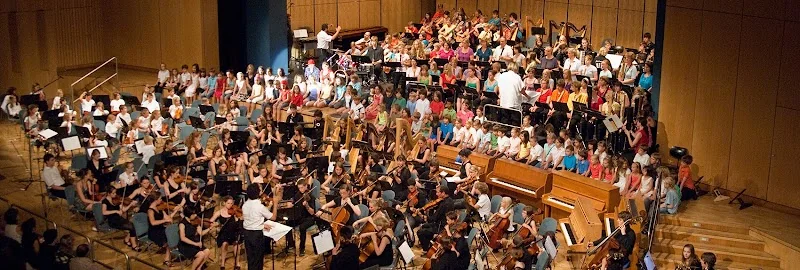
Kochstraße 8, Aschaffenburg
Kochstraße 8, 63739 Aschaffenburg, Germany
Municipal Music School Aschaffenburg | Lessons & Ensembles
The Municipal Music School Aschaffenburg at Kochstraße 8 combines historical depth with a modern, everyday-oriented teaching model. The official website features current images of the main building, teaching locations, and instruments, along with clear information on contact, registration, events, and the music library. Those looking for a music school in Aschaffenburg will find offers ranging from baby garden to singing and instrumental lessons, complemented by ensembles, recitals, and concerts. The guiding principle is easy to recognize: music should be experienced early, vibrantly, and joyfully. ([musikschule.kulturamt-aschaffenburg.de](https://musikschule.kulturamt-aschaffenburg.de/kontakt/))
Music School Aschaffenburg: History and Tradition since 1810
The history of the music school dates back to 1810. At that time, the citizens' music school was founded in Aschaffenburg; the first timetable was published on November 13, 1810, and even in these early years, it was clear that music was not understood as a secondary topic in the city, but as part of public education. The current website consciously tells this development as a long cultural line: From a citizens' music school, it evolved over generations into a municipal institution that connects teaching, youth promotion, and musical life. Historical milestones feature names like Joseph Becker as the first teacher, Adam Brand as the second teacher, and later Eduard Rommel as the music school director. The status of the school also changed: in 1841, the citizens' music school was recognized by the government as a local educational institution. This transformed an early educational offering into a more structured format, which became increasingly professionalized throughout the 19th century. ([musikschule.kulturamt-aschaffenburg.de](https://musikschule.kulturamt-aschaffenburg.de/die-musikschule/geschichte/))
Particularly interesting is how often the music school has reinvented itself spatially and organizationally without losing its identity. It moved several times in the 19th century, including to the Landingschulhaus and later to the Deutschhaus. The music library was made available for general use in 1909 and thus early on became one of the publicly accessible musical knowledge sources in Germany; after its municipalization, it returned to the music school in 1984. The current character of the building is primarily shaped by the major renovation and repurposing of the building on Kochstraße starting in 1989: At that time, 21 classrooms, two early education rooms, a library, administrative offices, a teachers' lounge, and a concert hall with a new Steinway C grand piano were available; in 1990, the Vleugels organ was added. This equipment explains why the music school today is not only a place for lessons but also a vibrant venue for concerts and public performances. The official self-presentation emphasizes continuity over more than two centuries and links tradition with development rather than nostalgia. ([musikschule.kulturamt-aschaffenburg.de](https://musikschule.kulturamt-aschaffenburg.de/die-musikschule/geschichte/))
What offers are available at the Music School Aschaffenburg?
The offerings of the music school are broad and range from early musical education to advanced main subjects. In the elementary area, the journey begins with baby garden and music school garden; the basic music course starts at age 4 and playfully conveys fundamentals such as rhythm, sound, movement, and first note knowledge. Instrumental lessons are possible from age 6 according to the FAQ, and singing is usually available from age 12. This allows families to choose a path that fits the child's age, motivation, and developmental stage. The elementary offerings are intentionally designed to be free of performance pressure and focus on curiosity, movement, shared experiences, and early musical experiences. This makes the school appealing to families looking for a gentle introduction while still desiring a clear pedagogical structure. Those who wish to choose an instrument later benefit from the fact that children are already familiar with rhythm, ear training, and musical language early on. ([musikschule.kulturamt-aschaffenburg.de](https://musikschule.kulturamt-aschaffenburg.de/fachbereiche/elementar-unterricht/))
The content range is also large: The website describes lessons for string, plucked, woodwind, and brass instruments as well as keyboard and percussion instruments; additionally, training of one's own singing voice is part of the profile. Many specific focuses appear on the subject pages, such as accordion, recorder, harpsichord, electric guitar, euphonium, bassoon, guitar, harp, organ, trombone, drums, saxophone, trumpet, and oboe. Some of these instruments are offered in individual lessons, others in pairs or in project-based formats, depending on the subject and pedagogical goal. The music school understands individual subject instruction as a foundation and simultaneously emphasizes that making music together is a central pillar of the institution. This aligns with a location that focuses not only on classical training but also on ensemble practice, stage experience, and musical personality. This is important for parents and adults because it creates a coherent overall picture: From the first rhythmic experience to the demanding interplay in orchestra, choir, or band, the school remains a place where different musical paths are taken seriously. ([musikschule.kulturamt-aschaffenburg.de](https://musikschule.kulturamt-aschaffenburg.de/fachbereiche/instrumental-unterricht/))
How do registration, fees, and instrument rental work?
Registration is done in writing via online forms for basic subjects as well as for main and supplementary subjects. Those seeking advice can contact the secretariat or the respective subject area leaders. The website also states that available spots are allocated based on availability and that the best chances exist if one registers during the official registration period. The clear service structure with phone, email, and fixed opening hours of the secretariat on Kochstraße is also practical. Many organizational questions come together there, from subject selection to forms of instruction to inquiries for parents and adult interested parties. Those who are not yet sure can use the FAQs and contact options before making a final decision. This appears low-threshold and family-friendly, as no one has to first navigate long paths through various administrative offices. ([musikschule.kulturamt-aschaffenburg.de](https://musikschule.kulturamt-aschaffenburg.de/faqs/))
Financially, the music school operates with annual fees. The fee arises with the confirmation of registration, and for instrument rental, with the handover of the instrument. Upon request, instruments from the stock can be temporarily loaned, usually for the duration of the teaching relationship and for a maximum of one year. Discounts apply to residents of the city of Aschaffenburg and children and young people from Großostheim; from the second child onward, there is a 50 percent sibling discount, and certain social benefit proofs as well as for culture pass holders from the city of Aschaffenburg also provide for a discount. Supplementary subjects are free for students with a main subject, and gifted students can also be promoted under certain conditions. The fee schedule also regulates the due dates on November 15, February 1, April 1, and July 1, thus describing a transparent system that is well-planned for families. Those who do not wish to purchase instruments permanently find a very practical entry point into training through temporary loans. ([musikschule.kulturamt-aschaffenburg.de](https://musikschule.kulturamt-aschaffenburg.de/wp-content/uploads/2025/08/Musikschule-Gebuehrensatzung.pdf))
Teaching locations in Aschaffenburg and Großostheim
A major advantage is the spatial distribution. The music school operates not only in the main building on Kochstraße and in the branch in Großostheim but also decentralizes at numerous schools and institutions in Aschaffenburg and the surrounding area. These include, among others, Kolpingschule, Mozart School, Pestalozzi Elementary School, Schillerschule, Strietwald School, Friedrich-Dessauer-Gymnasium, St. Jakobus Community Center, St. Pius Community Center, Christian-Schad School, Comenius School, Ruth-Weiss-Realschule, and the St. Peter Paul Children's House in Obernau. This model brings music to where children and young people are already on the move, making access intentionally low-threshold. This is a relevant advantage, especially for families with a tight schedule, as travel distances can be shortened and lesson times better integrated. The school describes this concept itself as a way to make lessons easily accessible in everyday life while maintaining quality at all locations. ([musikschule.kulturamt-aschaffenburg.de](https://musikschule.kulturamt-aschaffenburg.de/die-musikschule/unterrichtsorte/))
The main building itself is presented on the website as a historic house with a distinctive entrance and red sandstone. This gives the institution not only a high recognition value organizationally but also atmospherically. For parents, students, and interested parties, this is helpful because the daily teaching routine is clearly oriented around a fixed center, even if parts of the lessons take place in branches. Therefore, those looking for photos will find current views of the building, teachers, instruments, and various teaching situations on the official website. This mixture of historic building and decentralized practice fits well with the structure of the school: traditional enough to provide orientation but flexible enough to adapt to the everyday lives of students. That the music school serves multiple locations in the city and surrounding area is not a minor aspect but part of its pedagogical concept. It lowers the threshold for entry, strengthens local visibility, and shows that musical education in Aschaffenburg does not only take place in the main building but is intentionally embedded in the everyday lives of people. ([musikschule.kulturamt-aschaffenburg.de](https://musikschule.kulturamt-aschaffenburg.de/die-musikschule/unterrichtsorte/))
What concerts, recitals, and ensembles shape everyday life?
Music school explicitly means stage in Aschaffenburg. The FAQs clearly state that regular student concerts and recitals take place so that learners can gain stage experience and performance security. In addition, there are public events on the school's concert page as well as workshops that set new impulses. The institution thus sees itself not merely as a place of instruction but as a lively platform for musical encounters. This is particularly important for children and young people because performance practice is a central component of musical development. Those who regularly perform not only learn to present a piece but also how to deal with nervousness, concentration, and audience reactions. The music school creates a protected framework for this that makes performance visible without building pressure. This makes the transition from practicing to making music understandable and motivating. ([musikschule.kulturamt-aschaffenburg.de](https://musikschule.kulturamt-aschaffenburg.de/faqs/))
This is particularly visible in the ensembles. The wind orchestra is aimed at adults, parents, former students, and advanced wind and percussion students, rehearsing six times during the school year and culminating in a concert. The Young Wind Ensemble for 9 to 15-year-olds works with an annual rehearsal weekend in Hobbach and a summer concert at the music school. The offerings are complemented by a rock band, samba group, and children's choir, among others. Additional ensemble ideas such as choirs, pre-choir, orchestra, and band formats strengthen the communal music-making as a social and musical experience. So, those looking for community will find here not just a few additional offerings but a true ensemble ecosystem. This is also interesting from an SEO perspective, as terms like events, ensemble, recital, concert, and rehearsal weekend precisely describe the topics families and music enthusiasts search for in a music school. The school clearly shows that musical learning does not take place in isolation but finds its strongest form in collective sound. ([musikschule.kulturamt-aschaffenburg.de](https://musikschule.kulturamt-aschaffenburg.de/fachbereiche/ensemble-faecher/blasorchester/?utm_source=openai))
Music library, advice, and service for families
A true unique selling point remains the music library. It is not only intended for teachers and students but is also publicly accessible. According to the website, the collection currently includes around 10,000 sheet music copies as well as about 900 music books and magazines. The library is open on weekdays in the mornings; it remains closed during school holidays. Those wishing to borrow sheet music can prepare their borrowing requests via email and pick up the media by arrangement. For a music school, this is a strong service because lessons, practice, and repertoire maintenance are thus directly connected. This is particularly valuable for instrumental students, ensembles, and teachers, as it facilitates access to literature, scores, and pedagogical material. The library also makes the school an open place for external music enthusiasts that is effective beyond normal lessons. ([musikschule.kulturamt-aschaffenburg.de](https://musikschule.kulturamt-aschaffenburg.de/die-musikschule/musikbibliothek/?utm_source=openai))
The contact is also deliberately kept uncomplicated. The secretariat on Kochstraße can be reached at the central phone number, the opening hours are clearly stated on the website, and for questions regarding lessons, fees, or subject selection, the school assists via phone or email. Additionally, there is a well-visible structure with school management, teachers, teaching locations, history, music library, FAQs, and registration. This overview makes the site easy to use for families, newcomers, and advanced music enthusiasts. Those seeking information receive not only a course directory but a complete picture of pedagogy, organization, tradition, and everyday life. This is particularly important for a local music school because trust often arises from concrete information: Which age group is suitable? Where does the lesson take place? How does registration work? Are there rental instruments? What funding opportunities exist? The Municipal Music School Aschaffenburg answers these questions transparently and thus presents itself as a place with tradition, practical relevance, and a surprisingly large variety under one roof. ([musikschule.kulturamt-aschaffenburg.de](https://musikschule.kulturamt-aschaffenburg.de/kontakt/))
Sources:
- Municipal Music School Aschaffenburg - History
- Municipal Music School Aschaffenburg - Teaching Locations
- Municipal Music School Aschaffenburg - FAQs
- Municipal Music School Aschaffenburg - Music Library
- Municipal Music School Aschaffenburg - Registration
- Municipal Music School Aschaffenburg - Fee Regulations
Show moreShow less
Municipal Music School Aschaffenburg | Lessons & Ensembles
The Municipal Music School Aschaffenburg at Kochstraße 8 combines historical depth with a modern, everyday-oriented teaching model. The official website features current images of the main building, teaching locations, and instruments, along with clear information on contact, registration, events, and the music library. Those looking for a music school in Aschaffenburg will find offers ranging from baby garden to singing and instrumental lessons, complemented by ensembles, recitals, and concerts. The guiding principle is easy to recognize: music should be experienced early, vibrantly, and joyfully. ([musikschule.kulturamt-aschaffenburg.de](https://musikschule.kulturamt-aschaffenburg.de/kontakt/))
Music School Aschaffenburg: History and Tradition since 1810
The history of the music school dates back to 1810. At that time, the citizens' music school was founded in Aschaffenburg; the first timetable was published on November 13, 1810, and even in these early years, it was clear that music was not understood as a secondary topic in the city, but as part of public education. The current website consciously tells this development as a long cultural line: From a citizens' music school, it evolved over generations into a municipal institution that connects teaching, youth promotion, and musical life. Historical milestones feature names like Joseph Becker as the first teacher, Adam Brand as the second teacher, and later Eduard Rommel as the music school director. The status of the school also changed: in 1841, the citizens' music school was recognized by the government as a local educational institution. This transformed an early educational offering into a more structured format, which became increasingly professionalized throughout the 19th century. ([musikschule.kulturamt-aschaffenburg.de](https://musikschule.kulturamt-aschaffenburg.de/die-musikschule/geschichte/))
Particularly interesting is how often the music school has reinvented itself spatially and organizationally without losing its identity. It moved several times in the 19th century, including to the Landingschulhaus and later to the Deutschhaus. The music library was made available for general use in 1909 and thus early on became one of the publicly accessible musical knowledge sources in Germany; after its municipalization, it returned to the music school in 1984. The current character of the building is primarily shaped by the major renovation and repurposing of the building on Kochstraße starting in 1989: At that time, 21 classrooms, two early education rooms, a library, administrative offices, a teachers' lounge, and a concert hall with a new Steinway C grand piano were available; in 1990, the Vleugels organ was added. This equipment explains why the music school today is not only a place for lessons but also a vibrant venue for concerts and public performances. The official self-presentation emphasizes continuity over more than two centuries and links tradition with development rather than nostalgia. ([musikschule.kulturamt-aschaffenburg.de](https://musikschule.kulturamt-aschaffenburg.de/die-musikschule/geschichte/))
What offers are available at the Music School Aschaffenburg?
The offerings of the music school are broad and range from early musical education to advanced main subjects. In the elementary area, the journey begins with baby garden and music school garden; the basic music course starts at age 4 and playfully conveys fundamentals such as rhythm, sound, movement, and first note knowledge. Instrumental lessons are possible from age 6 according to the FAQ, and singing is usually available from age 12. This allows families to choose a path that fits the child's age, motivation, and developmental stage. The elementary offerings are intentionally designed to be free of performance pressure and focus on curiosity, movement, shared experiences, and early musical experiences. This makes the school appealing to families looking for a gentle introduction while still desiring a clear pedagogical structure. Those who wish to choose an instrument later benefit from the fact that children are already familiar with rhythm, ear training, and musical language early on. ([musikschule.kulturamt-aschaffenburg.de](https://musikschule.kulturamt-aschaffenburg.de/fachbereiche/elementar-unterricht/))
The content range is also large: The website describes lessons for string, plucked, woodwind, and brass instruments as well as keyboard and percussion instruments; additionally, training of one's own singing voice is part of the profile. Many specific focuses appear on the subject pages, such as accordion, recorder, harpsichord, electric guitar, euphonium, bassoon, guitar, harp, organ, trombone, drums, saxophone, trumpet, and oboe. Some of these instruments are offered in individual lessons, others in pairs or in project-based formats, depending on the subject and pedagogical goal. The music school understands individual subject instruction as a foundation and simultaneously emphasizes that making music together is a central pillar of the institution. This aligns with a location that focuses not only on classical training but also on ensemble practice, stage experience, and musical personality. This is important for parents and adults because it creates a coherent overall picture: From the first rhythmic experience to the demanding interplay in orchestra, choir, or band, the school remains a place where different musical paths are taken seriously. ([musikschule.kulturamt-aschaffenburg.de](https://musikschule.kulturamt-aschaffenburg.de/fachbereiche/instrumental-unterricht/))
How do registration, fees, and instrument rental work?
Registration is done in writing via online forms for basic subjects as well as for main and supplementary subjects. Those seeking advice can contact the secretariat or the respective subject area leaders. The website also states that available spots are allocated based on availability and that the best chances exist if one registers during the official registration period. The clear service structure with phone, email, and fixed opening hours of the secretariat on Kochstraße is also practical. Many organizational questions come together there, from subject selection to forms of instruction to inquiries for parents and adult interested parties. Those who are not yet sure can use the FAQs and contact options before making a final decision. This appears low-threshold and family-friendly, as no one has to first navigate long paths through various administrative offices. ([musikschule.kulturamt-aschaffenburg.de](https://musikschule.kulturamt-aschaffenburg.de/faqs/))
Financially, the music school operates with annual fees. The fee arises with the confirmation of registration, and for instrument rental, with the handover of the instrument. Upon request, instruments from the stock can be temporarily loaned, usually for the duration of the teaching relationship and for a maximum of one year. Discounts apply to residents of the city of Aschaffenburg and children and young people from Großostheim; from the second child onward, there is a 50 percent sibling discount, and certain social benefit proofs as well as for culture pass holders from the city of Aschaffenburg also provide for a discount. Supplementary subjects are free for students with a main subject, and gifted students can also be promoted under certain conditions. The fee schedule also regulates the due dates on November 15, February 1, April 1, and July 1, thus describing a transparent system that is well-planned for families. Those who do not wish to purchase instruments permanently find a very practical entry point into training through temporary loans. ([musikschule.kulturamt-aschaffenburg.de](https://musikschule.kulturamt-aschaffenburg.de/wp-content/uploads/2025/08/Musikschule-Gebuehrensatzung.pdf))
Teaching locations in Aschaffenburg and Großostheim
A major advantage is the spatial distribution. The music school operates not only in the main building on Kochstraße and in the branch in Großostheim but also decentralizes at numerous schools and institutions in Aschaffenburg and the surrounding area. These include, among others, Kolpingschule, Mozart School, Pestalozzi Elementary School, Schillerschule, Strietwald School, Friedrich-Dessauer-Gymnasium, St. Jakobus Community Center, St. Pius Community Center, Christian-Schad School, Comenius School, Ruth-Weiss-Realschule, and the St. Peter Paul Children's House in Obernau. This model brings music to where children and young people are already on the move, making access intentionally low-threshold. This is a relevant advantage, especially for families with a tight schedule, as travel distances can be shortened and lesson times better integrated. The school describes this concept itself as a way to make lessons easily accessible in everyday life while maintaining quality at all locations. ([musikschule.kulturamt-aschaffenburg.de](https://musikschule.kulturamt-aschaffenburg.de/die-musikschule/unterrichtsorte/))
The main building itself is presented on the website as a historic house with a distinctive entrance and red sandstone. This gives the institution not only a high recognition value organizationally but also atmospherically. For parents, students, and interested parties, this is helpful because the daily teaching routine is clearly oriented around a fixed center, even if parts of the lessons take place in branches. Therefore, those looking for photos will find current views of the building, teachers, instruments, and various teaching situations on the official website. This mixture of historic building and decentralized practice fits well with the structure of the school: traditional enough to provide orientation but flexible enough to adapt to the everyday lives of students. That the music school serves multiple locations in the city and surrounding area is not a minor aspect but part of its pedagogical concept. It lowers the threshold for entry, strengthens local visibility, and shows that musical education in Aschaffenburg does not only take place in the main building but is intentionally embedded in the everyday lives of people. ([musikschule.kulturamt-aschaffenburg.de](https://musikschule.kulturamt-aschaffenburg.de/die-musikschule/unterrichtsorte/))
What concerts, recitals, and ensembles shape everyday life?
Music school explicitly means stage in Aschaffenburg. The FAQs clearly state that regular student concerts and recitals take place so that learners can gain stage experience and performance security. In addition, there are public events on the school's concert page as well as workshops that set new impulses. The institution thus sees itself not merely as a place of instruction but as a lively platform for musical encounters. This is particularly important for children and young people because performance practice is a central component of musical development. Those who regularly perform not only learn to present a piece but also how to deal with nervousness, concentration, and audience reactions. The music school creates a protected framework for this that makes performance visible without building pressure. This makes the transition from practicing to making music understandable and motivating. ([musikschule.kulturamt-aschaffenburg.de](https://musikschule.kulturamt-aschaffenburg.de/faqs/))
This is particularly visible in the ensembles. The wind orchestra is aimed at adults, parents, former students, and advanced wind and percussion students, rehearsing six times during the school year and culminating in a concert. The Young Wind Ensemble for 9 to 15-year-olds works with an annual rehearsal weekend in Hobbach and a summer concert at the music school. The offerings are complemented by a rock band, samba group, and children's choir, among others. Additional ensemble ideas such as choirs, pre-choir, orchestra, and band formats strengthen the communal music-making as a social and musical experience. So, those looking for community will find here not just a few additional offerings but a true ensemble ecosystem. This is also interesting from an SEO perspective, as terms like events, ensemble, recital, concert, and rehearsal weekend precisely describe the topics families and music enthusiasts search for in a music school. The school clearly shows that musical learning does not take place in isolation but finds its strongest form in collective sound. ([musikschule.kulturamt-aschaffenburg.de](https://musikschule.kulturamt-aschaffenburg.de/fachbereiche/ensemble-faecher/blasorchester/?utm_source=openai))
Music library, advice, and service for families
A true unique selling point remains the music library. It is not only intended for teachers and students but is also publicly accessible. According to the website, the collection currently includes around 10,000 sheet music copies as well as about 900 music books and magazines. The library is open on weekdays in the mornings; it remains closed during school holidays. Those wishing to borrow sheet music can prepare their borrowing requests via email and pick up the media by arrangement. For a music school, this is a strong service because lessons, practice, and repertoire maintenance are thus directly connected. This is particularly valuable for instrumental students, ensembles, and teachers, as it facilitates access to literature, scores, and pedagogical material. The library also makes the school an open place for external music enthusiasts that is effective beyond normal lessons. ([musikschule.kulturamt-aschaffenburg.de](https://musikschule.kulturamt-aschaffenburg.de/die-musikschule/musikbibliothek/?utm_source=openai))
The contact is also deliberately kept uncomplicated. The secretariat on Kochstraße can be reached at the central phone number, the opening hours are clearly stated on the website, and for questions regarding lessons, fees, or subject selection, the school assists via phone or email. Additionally, there is a well-visible structure with school management, teachers, teaching locations, history, music library, FAQs, and registration. This overview makes the site easy to use for families, newcomers, and advanced music enthusiasts. Those seeking information receive not only a course directory but a complete picture of pedagogy, organization, tradition, and everyday life. This is particularly important for a local music school because trust often arises from concrete information: Which age group is suitable? Where does the lesson take place? How does registration work? Are there rental instruments? What funding opportunities exist? The Municipal Music School Aschaffenburg answers these questions transparently and thus presents itself as a place with tradition, practical relevance, and a surprisingly large variety under one roof. ([musikschule.kulturamt-aschaffenburg.de](https://musikschule.kulturamt-aschaffenburg.de/kontakt/))
Sources:
- Municipal Music School Aschaffenburg - History
- Municipal Music School Aschaffenburg - Teaching Locations
- Municipal Music School Aschaffenburg - FAQs
- Municipal Music School Aschaffenburg - Music Library
- Municipal Music School Aschaffenburg - Registration
- Municipal Music School Aschaffenburg - Fee Regulations
Municipal Music School Aschaffenburg | Lessons & Ensembles
The Municipal Music School Aschaffenburg at Kochstraße 8 combines historical depth with a modern, everyday-oriented teaching model. The official website features current images of the main building, teaching locations, and instruments, along with clear information on contact, registration, events, and the music library. Those looking for a music school in Aschaffenburg will find offers ranging from baby garden to singing and instrumental lessons, complemented by ensembles, recitals, and concerts. The guiding principle is easy to recognize: music should be experienced early, vibrantly, and joyfully. ([musikschule.kulturamt-aschaffenburg.de](https://musikschule.kulturamt-aschaffenburg.de/kontakt/))
Music School Aschaffenburg: History and Tradition since 1810
The history of the music school dates back to 1810. At that time, the citizens' music school was founded in Aschaffenburg; the first timetable was published on November 13, 1810, and even in these early years, it was clear that music was not understood as a secondary topic in the city, but as part of public education. The current website consciously tells this development as a long cultural line: From a citizens' music school, it evolved over generations into a municipal institution that connects teaching, youth promotion, and musical life. Historical milestones feature names like Joseph Becker as the first teacher, Adam Brand as the second teacher, and later Eduard Rommel as the music school director. The status of the school also changed: in 1841, the citizens' music school was recognized by the government as a local educational institution. This transformed an early educational offering into a more structured format, which became increasingly professionalized throughout the 19th century. ([musikschule.kulturamt-aschaffenburg.de](https://musikschule.kulturamt-aschaffenburg.de/die-musikschule/geschichte/))
Particularly interesting is how often the music school has reinvented itself spatially and organizationally without losing its identity. It moved several times in the 19th century, including to the Landingschulhaus and later to the Deutschhaus. The music library was made available for general use in 1909 and thus early on became one of the publicly accessible musical knowledge sources in Germany; after its municipalization, it returned to the music school in 1984. The current character of the building is primarily shaped by the major renovation and repurposing of the building on Kochstraße starting in 1989: At that time, 21 classrooms, two early education rooms, a library, administrative offices, a teachers' lounge, and a concert hall with a new Steinway C grand piano were available; in 1990, the Vleugels organ was added. This equipment explains why the music school today is not only a place for lessons but also a vibrant venue for concerts and public performances. The official self-presentation emphasizes continuity over more than two centuries and links tradition with development rather than nostalgia. ([musikschule.kulturamt-aschaffenburg.de](https://musikschule.kulturamt-aschaffenburg.de/die-musikschule/geschichte/))
What offers are available at the Music School Aschaffenburg?
The offerings of the music school are broad and range from early musical education to advanced main subjects. In the elementary area, the journey begins with baby garden and music school garden; the basic music course starts at age 4 and playfully conveys fundamentals such as rhythm, sound, movement, and first note knowledge. Instrumental lessons are possible from age 6 according to the FAQ, and singing is usually available from age 12. This allows families to choose a path that fits the child's age, motivation, and developmental stage. The elementary offerings are intentionally designed to be free of performance pressure and focus on curiosity, movement, shared experiences, and early musical experiences. This makes the school appealing to families looking for a gentle introduction while still desiring a clear pedagogical structure. Those who wish to choose an instrument later benefit from the fact that children are already familiar with rhythm, ear training, and musical language early on. ([musikschule.kulturamt-aschaffenburg.de](https://musikschule.kulturamt-aschaffenburg.de/fachbereiche/elementar-unterricht/))
The content range is also large: The website describes lessons for string, plucked, woodwind, and brass instruments as well as keyboard and percussion instruments; additionally, training of one's own singing voice is part of the profile. Many specific focuses appear on the subject pages, such as accordion, recorder, harpsichord, electric guitar, euphonium, bassoon, guitar, harp, organ, trombone, drums, saxophone, trumpet, and oboe. Some of these instruments are offered in individual lessons, others in pairs or in project-based formats, depending on the subject and pedagogical goal. The music school understands individual subject instruction as a foundation and simultaneously emphasizes that making music together is a central pillar of the institution. This aligns with a location that focuses not only on classical training but also on ensemble practice, stage experience, and musical personality. This is important for parents and adults because it creates a coherent overall picture: From the first rhythmic experience to the demanding interplay in orchestra, choir, or band, the school remains a place where different musical paths are taken seriously. ([musikschule.kulturamt-aschaffenburg.de](https://musikschule.kulturamt-aschaffenburg.de/fachbereiche/instrumental-unterricht/))
How do registration, fees, and instrument rental work?
Registration is done in writing via online forms for basic subjects as well as for main and supplementary subjects. Those seeking advice can contact the secretariat or the respective subject area leaders. The website also states that available spots are allocated based on availability and that the best chances exist if one registers during the official registration period. The clear service structure with phone, email, and fixed opening hours of the secretariat on Kochstraße is also practical. Many organizational questions come together there, from subject selection to forms of instruction to inquiries for parents and adult interested parties. Those who are not yet sure can use the FAQs and contact options before making a final decision. This appears low-threshold and family-friendly, as no one has to first navigate long paths through various administrative offices. ([musikschule.kulturamt-aschaffenburg.de](https://musikschule.kulturamt-aschaffenburg.de/faqs/))
Financially, the music school operates with annual fees. The fee arises with the confirmation of registration, and for instrument rental, with the handover of the instrument. Upon request, instruments from the stock can be temporarily loaned, usually for the duration of the teaching relationship and for a maximum of one year. Discounts apply to residents of the city of Aschaffenburg and children and young people from Großostheim; from the second child onward, there is a 50 percent sibling discount, and certain social benefit proofs as well as for culture pass holders from the city of Aschaffenburg also provide for a discount. Supplementary subjects are free for students with a main subject, and gifted students can also be promoted under certain conditions. The fee schedule also regulates the due dates on November 15, February 1, April 1, and July 1, thus describing a transparent system that is well-planned for families. Those who do not wish to purchase instruments permanently find a very practical entry point into training through temporary loans. ([musikschule.kulturamt-aschaffenburg.de](https://musikschule.kulturamt-aschaffenburg.de/wp-content/uploads/2025/08/Musikschule-Gebuehrensatzung.pdf))
Teaching locations in Aschaffenburg and Großostheim
A major advantage is the spatial distribution. The music school operates not only in the main building on Kochstraße and in the branch in Großostheim but also decentralizes at numerous schools and institutions in Aschaffenburg and the surrounding area. These include, among others, Kolpingschule, Mozart School, Pestalozzi Elementary School, Schillerschule, Strietwald School, Friedrich-Dessauer-Gymnasium, St. Jakobus Community Center, St. Pius Community Center, Christian-Schad School, Comenius School, Ruth-Weiss-Realschule, and the St. Peter Paul Children's House in Obernau. This model brings music to where children and young people are already on the move, making access intentionally low-threshold. This is a relevant advantage, especially for families with a tight schedule, as travel distances can be shortened and lesson times better integrated. The school describes this concept itself as a way to make lessons easily accessible in everyday life while maintaining quality at all locations. ([musikschule.kulturamt-aschaffenburg.de](https://musikschule.kulturamt-aschaffenburg.de/die-musikschule/unterrichtsorte/))
The main building itself is presented on the website as a historic house with a distinctive entrance and red sandstone. This gives the institution not only a high recognition value organizationally but also atmospherically. For parents, students, and interested parties, this is helpful because the daily teaching routine is clearly oriented around a fixed center, even if parts of the lessons take place in branches. Therefore, those looking for photos will find current views of the building, teachers, instruments, and various teaching situations on the official website. This mixture of historic building and decentralized practice fits well with the structure of the school: traditional enough to provide orientation but flexible enough to adapt to the everyday lives of students. That the music school serves multiple locations in the city and surrounding area is not a minor aspect but part of its pedagogical concept. It lowers the threshold for entry, strengthens local visibility, and shows that musical education in Aschaffenburg does not only take place in the main building but is intentionally embedded in the everyday lives of people. ([musikschule.kulturamt-aschaffenburg.de](https://musikschule.kulturamt-aschaffenburg.de/die-musikschule/unterrichtsorte/))
What concerts, recitals, and ensembles shape everyday life?
Music school explicitly means stage in Aschaffenburg. The FAQs clearly state that regular student concerts and recitals take place so that learners can gain stage experience and performance security. In addition, there are public events on the school's concert page as well as workshops that set new impulses. The institution thus sees itself not merely as a place of instruction but as a lively platform for musical encounters. This is particularly important for children and young people because performance practice is a central component of musical development. Those who regularly perform not only learn to present a piece but also how to deal with nervousness, concentration, and audience reactions. The music school creates a protected framework for this that makes performance visible without building pressure. This makes the transition from practicing to making music understandable and motivating. ([musikschule.kulturamt-aschaffenburg.de](https://musikschule.kulturamt-aschaffenburg.de/faqs/))
This is particularly visible in the ensembles. The wind orchestra is aimed at adults, parents, former students, and advanced wind and percussion students, rehearsing six times during the school year and culminating in a concert. The Young Wind Ensemble for 9 to 15-year-olds works with an annual rehearsal weekend in Hobbach and a summer concert at the music school. The offerings are complemented by a rock band, samba group, and children's choir, among others. Additional ensemble ideas such as choirs, pre-choir, orchestra, and band formats strengthen the communal music-making as a social and musical experience. So, those looking for community will find here not just a few additional offerings but a true ensemble ecosystem. This is also interesting from an SEO perspective, as terms like events, ensemble, recital, concert, and rehearsal weekend precisely describe the topics families and music enthusiasts search for in a music school. The school clearly shows that musical learning does not take place in isolation but finds its strongest form in collective sound. ([musikschule.kulturamt-aschaffenburg.de](https://musikschule.kulturamt-aschaffenburg.de/fachbereiche/ensemble-faecher/blasorchester/?utm_source=openai))
Music library, advice, and service for families
A true unique selling point remains the music library. It is not only intended for teachers and students but is also publicly accessible. According to the website, the collection currently includes around 10,000 sheet music copies as well as about 900 music books and magazines. The library is open on weekdays in the mornings; it remains closed during school holidays. Those wishing to borrow sheet music can prepare their borrowing requests via email and pick up the media by arrangement. For a music school, this is a strong service because lessons, practice, and repertoire maintenance are thus directly connected. This is particularly valuable for instrumental students, ensembles, and teachers, as it facilitates access to literature, scores, and pedagogical material. The library also makes the school an open place for external music enthusiasts that is effective beyond normal lessons. ([musikschule.kulturamt-aschaffenburg.de](https://musikschule.kulturamt-aschaffenburg.de/die-musikschule/musikbibliothek/?utm_source=openai))
The contact is also deliberately kept uncomplicated. The secretariat on Kochstraße can be reached at the central phone number, the opening hours are clearly stated on the website, and for questions regarding lessons, fees, or subject selection, the school assists via phone or email. Additionally, there is a well-visible structure with school management, teachers, teaching locations, history, music library, FAQs, and registration. This overview makes the site easy to use for families, newcomers, and advanced music enthusiasts. Those seeking information receive not only a course directory but a complete picture of pedagogy, organization, tradition, and everyday life. This is particularly important for a local music school because trust often arises from concrete information: Which age group is suitable? Where does the lesson take place? How does registration work? Are there rental instruments? What funding opportunities exist? The Municipal Music School Aschaffenburg answers these questions transparently and thus presents itself as a place with tradition, practical relevance, and a surprisingly large variety under one roof. ([musikschule.kulturamt-aschaffenburg.de](https://musikschule.kulturamt-aschaffenburg.de/kontakt/))
Sources:
- Municipal Music School Aschaffenburg - History
- Municipal Music School Aschaffenburg - Teaching Locations
- Municipal Music School Aschaffenburg - FAQs
- Municipal Music School Aschaffenburg - Music Library
- Municipal Music School Aschaffenburg - Registration
- Municipal Music School Aschaffenburg - Fee Regulations
Frequently Asked Questions
Reviews
N N
9. August 2023
I can't comment on the music school itself. However, it's astonishing that it describes itself on its own website as "Germany's oldest music school." That's simply not true. The Waldkirch Music School, for example, was founded in 1741, making it several decades older. Many people might not care about that, and it's not the most important thing. But if you're going to claim a title, you should first check the facts. Unfortunately, the Aschaffenburg Music School hasn't responded to my friendly email pointing this out to date.
Cosima Wagner
5. November 2024
Lessons were postponed 5 times and ultimately the teacher was unavailable for the entire year.
Andreas Thiel
28. September 2023
Easily accessible and, due to its high quality, very popular, according to the teachers, it is also the oldest existing music school on the Lower Main.
I. H.
27. April 2023
In my opinion, not recommended.
Ab Cd
30. October 2025