
Hauptstraße 80, Weibersbrunn
Hauptstraße 80, 63879 Weibersbrunn, Germany
St. Johannes Nepomuk Weibersbrunn | Church & Service
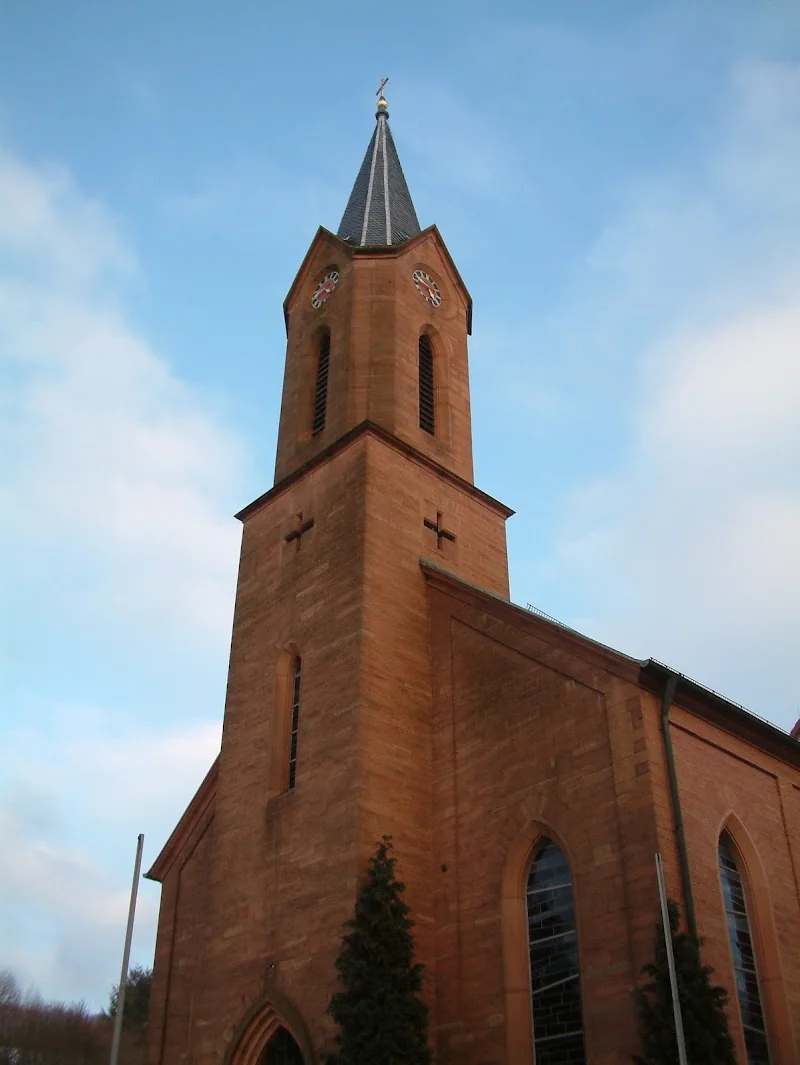
St. Johannes Nepomuk in Weibersbrunn is not a classic event venue, but a defining parish church with a strong local connection and an unusually well-documented history. The current church building stands in the heart of the Hochspessart at a location that was originally shaped by the glass production of Kurmainz. The glassworks gave rise to Weibersbrunn; the site of the factory later became the location of the parish church, which was consecrated in 1864. Thus, the church tells not only of the faith of a community but also of work, change, and new beginnings in a place that has developed from an industrial settlement. Today, it is part of the parish community of St. Hubertus in the Spessart and remains visible and vibrant as a village center to this day. Therefore, when someone searches for St. Johannes Nepomuk, they are not just referring to a church building in Weibersbrunn but to a piece of local history that continues to shape the everyday life of the community. ([weibersbrunn.de](https://www.weibersbrunn.de/gemeinde-weibersbrunn/geschichte))
History of the Parish Church and the Glassworks Village
The roots of Weibersbrunn date back to 1706 when the Kurmainz mirror factory established another glassworks here. The community explicitly describes Weibersbrunn as a relatively young community, whose foundation is closely linked to glass production in the Spessart. With the glassworks came workers, families, and craftsmen to the area; thus, the settlement grew rapidly and soon needed its own structures such as a school, pastoral care, and a church. Initially, the parish of Rothenbuch took care of the residents, but already in 1764, Weibersbrunn became its own parish. The rectory was allowed to be built, and the pastor was also responsible for Lichtenau and Rohrbrunn. This early independence is important because it shows how quickly a factory settlement became an independent ecclesiastical center. The current parish church is not coincidentally located in the village, but at a place that makes the transition from glass production to the ecclesiastical village center visible. ([weibersbrunn.de](https://www.weibersbrunn.de/gemeinde-weibersbrunn/geschichte))
The direct predecessor of the current church location is also well documented. In 1862, the last owner sold the site of the former glassworks to the church administration so that a new church could be built. Construction began immediately, and in 1864, the new parish church St. Johannes Nepomuk was consecrated. The Spessart project explicitly states that the church was built on the site of the glassworks and took over its role as the village center. The historical memory of prominent visitors is also particularly vivid: Since the end of the 19th century, it is said that Prince Regent Luitpold visited the church during his annual stays in the Spessart when he came to church on Sundays. This made the church significant not only for the village but also for the regional self-understanding. The renovation of 1965 and the interior design mentioned in local reports by Pastor Wilhelm Hefner between 1917 and 1926 also show that St. Johannes Nepomuk has been repeatedly adapted to the needs of the community. ([spessartprojekt.de](https://www.spessartprojekt.de/wordpress/wp-content/uploads/2015/03/KW-Weibersbrunn-Taf-07.pdf))
The understanding of the church patron also fits into this history. In Weibersbrunn, Johannes Nepomuk was not just any name, but a deliberately chosen patron saint. A contribution from the Abbey of Münsterschwarzach reports that the community had a new Gospel book designed in 2014 with motifs that specifically refer to this local identity: Nepomuk on the bridge, the coat of arms of the Mainz bishop, historical glasses, and oaks as symbols of the Spessart. The same contribution emphasizes that Saint Nepomuk symbolizes protection over the community. This connection of patron, local history, and material culture is typical for Weibersbrunn. The church name thus not only stands above the entrance door but is deeply embedded in the memory of the glassworks, the Mainz era, and village development. Therefore, understanding the history of the parish church also means understanding a good piece of Weibersbrunn itself. ([abtei-muensterschwarzach.de](https://www.abtei-muensterschwarzach.de/arbeiten/goldschmiede/goldschmiede-aktuelles/evangeliar-aus-der-gold-silberschmiede-der-abtei-fuer-die-gemeinde-in-weibersbrunn-e0b5f29))
Services, Parish Office, and Current Contacts
Those searching for St. Johannes Nepomuk in Weibersbrunn often want very practical information: When is the service, where is the parish office, and who is responsible? The official website of the community and the websites of the parish community provide clear answers to this. Weibersbrunn belongs to the parish community of St. Hubertus in the Spessart, which also includes Rothenbuch and Waldaschaff. The head of the parish community is Pastor Augustin Parambakathu, who has been in office since September 2013, according to the official contact page. For the community, the parish office in Weibersbrunn can be reached at Hauptstraße 59; the opening hours are Monday from 9:00 AM to 1:00 PM. There, mass orders, sacramental matters, and other pastoral questions can be clarified. This is important for visitors because the church does not stand isolated but is integrated into an active pastoral structure. Therefore, those looking for current programs, baptisms, first communions, or confessions will find the community not in a mere showcase but in a lively parish organization. ([pg-hubertus.de](https://www.pg-hubertus.de/kontakte_alle/kontakte))
Particularly helpful are the online service information available. On the website of the parish community of St. Hubertus in the Spessart, current service schedules are provided as PDFs. This is useful for people from Weibersbrunn as well as for guests who are planning only a short stop while traveling through the Spessart. Instead of relying on assumptions, one can inform themselves in advance about the service schedule and plan their visit accordingly. For SEO-relevant search queries such as service, parish office, or parish church, this is the crucial benefit: The church is not only a historical object but a place with clear contacts and current times. The information structure is simple but practical. It fits a community that consciously organizes its ecclesiastical affairs in a network while still maintaining a local presence. ([pg-johannes-nepomuk.de](https://pg-johannes-nepomuk.de/aktuelles/gottesdienste/))
The community of Weibersbrunn also refers to the ecclesiastical connection. On the official page Church & Parish Office, the Catholic parish office St. Johannes Nepomuk is listed with address, office hours, and contacts. The same page also mentions the Protestant Peter's Church as another ecclesiastical institution in Weibersbrunn, which shows the place as a small but differentiated community landscape. For visitors, this means: Those who visit the church do not encounter an anonymous building but a clearly located parish community with fixed responsibilities. This organizational transparency is valuable, especially for families, baptism guests, weddings, or church holidays. It also shows that the church in Weibersbrunn functions not only as a monument but as a reliable ecclesiastical point of contact. ([weibersbrunn.de](https://www.weibersbrunn.de/leben-wohnen/kirche-pfarramt))
Access, Location, and Bus Stop Church in Weibersbrunn
The location of St. Johannes Nepomuk is one of its greatest advantages. According to the community's website, Weibersbrunn is located in the heart of the Hochspessart along the A3, thus on an important axis between Frankfurt and Würzburg. The church itself is located at Hauptstraße 80 and is clearly embedded in the village center. Therefore, those traveling by car can reach the place without complicated detours, and the geographical situation makes it understandable why the church has been perceived as the center of the village for generations. The character of the place is not that of a large urban church district but that of a village where church, history, and everyday paths are closely intertwined. This proximity is pleasant for many visitors: One does not enter a distant museum but a visible piece of the village center. ([bizarchiv.de](https://www.bizarchiv.de/st-nepomuk_2w-06094-230?utm_source=openai))
Even without a separate tourism infrastructure, orientation is simple. The community indicates the church and parish areas on the local map, and the official train or bus logic of the region is tailored to the place. Particularly interesting is that in the current weekend schedule of the community, the stop Weibersbrunn, Church is explicitly mentioned. This is a good signal for all those who wish to arrive by public transport or are looking for a connection in the region. The designation of the bus stop shows how strongly the church is anchored in the local landscape: Not only the street but even the stop bears its name. For visitors, this means clear, intuitive accessibility. Therefore, those looking for access will not find complicated museum logic but a village structure in which the church is clearly identifiable. ([weibersbrunn.de](https://www.weibersbrunn.de/fileadmin/Dateien/Webseite/Dateien/47_Wochenendverkehr.pdf?utm_source=openai))
Weibersbrunn is also a place with a strong historical and scenic backdrop. The community describes itself as part of the Hochspessart, and in the banner area of the website, images such as a village view with church and references to the heart of the Hochspessart appear. This also supports orientation visually: The church is present in the local landscape and not a hidden side object. Those walking or driving along Hauptstraße cannot miss the place. For this reason, St. Johannes Nepomuk is well suited for visitors who are not only looking for a service but also want to make a brief cultural-historical stop on a trip through the Spessart. The location in Weibersbrunn is practical, easily findable, and closely connected to the identity of the village. ([weibersbrunn.de](https://www.weibersbrunn.de/gemeinde-weibersbrunn/geschichte))
Architecture, Expansion 1965, and Structural Features
The current parish church has been altered multiple times in its history. The basic structure was consecrated in 1864, but that did not end the development. A cultural path document about the village center describes that the church building was expanded in 1965 and that during this work, the foundations of the former glassworks were uncovered. Some remnants could be preserved. This information is particularly exciting because it makes the architectural continuity directly visible: Beneath the church space lies the memory of the industrial past of the place. The expansion was thus not only a construction measure but also an encounter with the history of the site. For architecture-interested visitors, this is an important point because the church can thus be read not only as a house of worship but also as a historically grown place. ([spessartprojekt.de](https://www.spessartprojekt.de/wordpress/wp-content/uploads/2015/03/KW-Weibersbrunn-Taf-07.pdf))
Additionally, there is the older prehistory with the cemetery chapel. The cultural path paper and the community history refer to the fact that a chapel already stood near the current cemetery, which was built in 1755. Shortly after the church was rebuilt, this old chapel was later demolished. In total, this shows a very typical but particularly well-documented development for Weibersbrunn: First a small chapel in the vicinity of the factory, then a new building on the factory site, and then an expansion in the second half of the 20th century. This sequence also explains why the term chapel repeatedly appears in connection with St. Johannes Nepomuk. Those searching for it do not encounter a separate chapel in today's sense but the historical precursor of the later parish church. ([weibersbrunn.de](https://www.weibersbrunn.de/gemeinde-weibersbrunn/geschichte))
The architectural memory in Weibersbrunn is not only documented in texts but also told museally. The local museum displays a model showing the situation of the 19th century with glassworks and the higher-placed chapel. Such representations vividly illustrate the development from glass production to the church center. It fits that the Spessart project explicitly describes the church as a new village center and reminds visitors that Weibersbrunn needed a new cultural and social focus after the end of glass production. The church fulfilled this role exactly. For today's guests, this is important because they understand that the building is not only externally present but also symbolically marks the center of the place. ([spessartprojekt.de](https://www.spessartprojekt.de/wordpress/wp-content/uploads/2015/03/KW-Weibersbrunn-Taf-07.pdf))
Photos, Reviews, and the First Impression on Site
In search queries about St. Johannes Nepomuk, photos and reviews play a significant role because many visitors want to see how the church looks first. The official community website already supports this impression visually: In the banner area, a village view with a church appears, and this image signal shows that the house of worship firmly belongs to the local landscape. Therefore, the first impression is not that of a monumental city church but that of a quietly embedded village church with a clear presence. This is precisely the appeal for many people. Upon arriving in Weibersbrunn, one does not experience an artificial event location but a place where faith, history, and everyday life intertwine. The church thus does not appear spectacular but authentic. ([weibersbrunn.de](https://www.weibersbrunn.de/gemeinde-weibersbrunn/geschichte))
The existing reviews also address this mixture. One visitor writes that even non-Catholics can find a visit worthwhile. Another feedback describes the church as beautiful but very cool. Yet another review refers to a personal baptism story and the role of a popular pastor. These short, concrete comments show what many small churches are about: They are not visited for a big show but for atmosphere, memory, and local connection. For an SEO-oriented page, this is important because searchers looking for photos or reviews usually want to know if a detour is worthwhile. The honest answer here is: Yes, if one appreciates architectural tranquility, local history, and a clear village identity. The church is not a loud tourist magnet but a quiet, credible place.
The view of the interior probably explains this effect. The historical renovation in 1965 and 1966, as well as the mention of the cool room in a review, suggest that the church is perceived as rather simple and down-to-earth than ornate. This can be an advantage if one is looking for photos with a calm atmosphere, clear lines, and a concentrated spatial impression. Because the church is located in a genuine village center, images not only show a building but also the social context around it. The special appeal lies less in a single spectacular facade than in the connection of church, street, and village center. Therefore, those searching for photos ultimately seek a piece of Weibersbrunn. ([spessartprojekt.de](https://www.spessartprojekt.de/wordpress/wp-content/uploads/2015/03/KW-Weibersbrunn-Taf-07.pdf))
Why St. Johannes Nepomuk is so Formative in Hochspessart
St. Johannes Nepomuk is far more than a church name for Weibersbrunn. The place itself emerged from the glassworks of 1706, became poor and economically burdened in the 19th century, but gained a new center with the church's reconstruction in 1864 and later regained dynamism with the highway connection. All this makes it understandable why the church is so strongly anchored in the local perception. It stands at the intersection of past and present: here the memory of glassmakers, chapel, and factory, there the current parish life with services, contacts, and community work. For visitors, this connection is precisely what is exciting because they experience not only a house of worship but a readable village history. ([weibersbrunn.de](https://www.weibersbrunn.de/gemeinde-weibersbrunn/geschichte))
Particularly characteristic is the cultural density surrounding the church in Weibersbrunn. The Gospel book created in 2014 by the community consciously incorporates local symbols: Nepomuk on the bridge, the Mainz wheel, historical glasses, and oaks. These elements show how strongly the church is still part of the regional self-representation. The name Johannes Nepomuk connects the place with protection, tradition, and memory without appearing artificial. This is precisely where the SEO strength of this location lies: Those searching for church, service, history, photos, or reviews find here a place that fulfills multiple search intentions simultaneously. The church is a liturgical space, a historical monument, and an identity-forming village center all in one. ([abtei-muensterschwarzach.de](https://www.abtei-muensterschwarzach.de/arbeiten/goldschmiede/goldschmiede-aktuelles/evangeliar-aus-der-gold-silberschmiede-der-abtei-fuer-die-gemeinde-in-weibersbrunn-e0b5f29))
This remains relevant for today's visit. The parish community of St. Hubertus in the Spessart ensures pastoral integration, the community provides addresses and opening hours, and the place itself is easily accessible via the A3 and the bus stop Weibersbrunn, Church. Thus, St. Johannes Nepomuk is a place where practical orientation and historical significance come together. Those looking for a quiet, authentic church in the Spessart will find it here. Those searching for church photos, local history, or a brief spiritual pause on their journey will also find it. And those simply wondering why a village church remains so strong in the collective memory will find a clear answer in Weibersbrunn: Because it once took the place of the glassworks and has since formed the center of the village. ([weibersbrunn.de](https://www.weibersbrunn.de/gemeinde-weibersbrunn/geschichte))
Sources:
Show moreShow less
St. Johannes Nepomuk Weibersbrunn | Church & Service
St. Johannes Nepomuk in Weibersbrunn is not a classic event venue, but a defining parish church with a strong local connection and an unusually well-documented history. The current church building stands in the heart of the Hochspessart at a location that was originally shaped by the glass production of Kurmainz. The glassworks gave rise to Weibersbrunn; the site of the factory later became the location of the parish church, which was consecrated in 1864. Thus, the church tells not only of the faith of a community but also of work, change, and new beginnings in a place that has developed from an industrial settlement. Today, it is part of the parish community of St. Hubertus in the Spessart and remains visible and vibrant as a village center to this day. Therefore, when someone searches for St. Johannes Nepomuk, they are not just referring to a church building in Weibersbrunn but to a piece of local history that continues to shape the everyday life of the community. ([weibersbrunn.de](https://www.weibersbrunn.de/gemeinde-weibersbrunn/geschichte))
History of the Parish Church and the Glassworks Village
The roots of Weibersbrunn date back to 1706 when the Kurmainz mirror factory established another glassworks here. The community explicitly describes Weibersbrunn as a relatively young community, whose foundation is closely linked to glass production in the Spessart. With the glassworks came workers, families, and craftsmen to the area; thus, the settlement grew rapidly and soon needed its own structures such as a school, pastoral care, and a church. Initially, the parish of Rothenbuch took care of the residents, but already in 1764, Weibersbrunn became its own parish. The rectory was allowed to be built, and the pastor was also responsible for Lichtenau and Rohrbrunn. This early independence is important because it shows how quickly a factory settlement became an independent ecclesiastical center. The current parish church is not coincidentally located in the village, but at a place that makes the transition from glass production to the ecclesiastical village center visible. ([weibersbrunn.de](https://www.weibersbrunn.de/gemeinde-weibersbrunn/geschichte))
The direct predecessor of the current church location is also well documented. In 1862, the last owner sold the site of the former glassworks to the church administration so that a new church could be built. Construction began immediately, and in 1864, the new parish church St. Johannes Nepomuk was consecrated. The Spessart project explicitly states that the church was built on the site of the glassworks and took over its role as the village center. The historical memory of prominent visitors is also particularly vivid: Since the end of the 19th century, it is said that Prince Regent Luitpold visited the church during his annual stays in the Spessart when he came to church on Sundays. This made the church significant not only for the village but also for the regional self-understanding. The renovation of 1965 and the interior design mentioned in local reports by Pastor Wilhelm Hefner between 1917 and 1926 also show that St. Johannes Nepomuk has been repeatedly adapted to the needs of the community. ([spessartprojekt.de](https://www.spessartprojekt.de/wordpress/wp-content/uploads/2015/03/KW-Weibersbrunn-Taf-07.pdf))
The understanding of the church patron also fits into this history. In Weibersbrunn, Johannes Nepomuk was not just any name, but a deliberately chosen patron saint. A contribution from the Abbey of Münsterschwarzach reports that the community had a new Gospel book designed in 2014 with motifs that specifically refer to this local identity: Nepomuk on the bridge, the coat of arms of the Mainz bishop, historical glasses, and oaks as symbols of the Spessart. The same contribution emphasizes that Saint Nepomuk symbolizes protection over the community. This connection of patron, local history, and material culture is typical for Weibersbrunn. The church name thus not only stands above the entrance door but is deeply embedded in the memory of the glassworks, the Mainz era, and village development. Therefore, understanding the history of the parish church also means understanding a good piece of Weibersbrunn itself. ([abtei-muensterschwarzach.de](https://www.abtei-muensterschwarzach.de/arbeiten/goldschmiede/goldschmiede-aktuelles/evangeliar-aus-der-gold-silberschmiede-der-abtei-fuer-die-gemeinde-in-weibersbrunn-e0b5f29))
Services, Parish Office, and Current Contacts
Those searching for St. Johannes Nepomuk in Weibersbrunn often want very practical information: When is the service, where is the parish office, and who is responsible? The official website of the community and the websites of the parish community provide clear answers to this. Weibersbrunn belongs to the parish community of St. Hubertus in the Spessart, which also includes Rothenbuch and Waldaschaff. The head of the parish community is Pastor Augustin Parambakathu, who has been in office since September 2013, according to the official contact page. For the community, the parish office in Weibersbrunn can be reached at Hauptstraße 59; the opening hours are Monday from 9:00 AM to 1:00 PM. There, mass orders, sacramental matters, and other pastoral questions can be clarified. This is important for visitors because the church does not stand isolated but is integrated into an active pastoral structure. Therefore, those looking for current programs, baptisms, first communions, or confessions will find the community not in a mere showcase but in a lively parish organization. ([pg-hubertus.de](https://www.pg-hubertus.de/kontakte_alle/kontakte))
Particularly helpful are the online service information available. On the website of the parish community of St. Hubertus in the Spessart, current service schedules are provided as PDFs. This is useful for people from Weibersbrunn as well as for guests who are planning only a short stop while traveling through the Spessart. Instead of relying on assumptions, one can inform themselves in advance about the service schedule and plan their visit accordingly. For SEO-relevant search queries such as service, parish office, or parish church, this is the crucial benefit: The church is not only a historical object but a place with clear contacts and current times. The information structure is simple but practical. It fits a community that consciously organizes its ecclesiastical affairs in a network while still maintaining a local presence. ([pg-johannes-nepomuk.de](https://pg-johannes-nepomuk.de/aktuelles/gottesdienste/))
The community of Weibersbrunn also refers to the ecclesiastical connection. On the official page Church & Parish Office, the Catholic parish office St. Johannes Nepomuk is listed with address, office hours, and contacts. The same page also mentions the Protestant Peter's Church as another ecclesiastical institution in Weibersbrunn, which shows the place as a small but differentiated community landscape. For visitors, this means: Those who visit the church do not encounter an anonymous building but a clearly located parish community with fixed responsibilities. This organizational transparency is valuable, especially for families, baptism guests, weddings, or church holidays. It also shows that the church in Weibersbrunn functions not only as a monument but as a reliable ecclesiastical point of contact. ([weibersbrunn.de](https://www.weibersbrunn.de/leben-wohnen/kirche-pfarramt))
Access, Location, and Bus Stop Church in Weibersbrunn
The location of St. Johannes Nepomuk is one of its greatest advantages. According to the community's website, Weibersbrunn is located in the heart of the Hochspessart along the A3, thus on an important axis between Frankfurt and Würzburg. The church itself is located at Hauptstraße 80 and is clearly embedded in the village center. Therefore, those traveling by car can reach the place without complicated detours, and the geographical situation makes it understandable why the church has been perceived as the center of the village for generations. The character of the place is not that of a large urban church district but that of a village where church, history, and everyday paths are closely intertwined. This proximity is pleasant for many visitors: One does not enter a distant museum but a visible piece of the village center. ([bizarchiv.de](https://www.bizarchiv.de/st-nepomuk_2w-06094-230?utm_source=openai))
Even without a separate tourism infrastructure, orientation is simple. The community indicates the church and parish areas on the local map, and the official train or bus logic of the region is tailored to the place. Particularly interesting is that in the current weekend schedule of the community, the stop Weibersbrunn, Church is explicitly mentioned. This is a good signal for all those who wish to arrive by public transport or are looking for a connection in the region. The designation of the bus stop shows how strongly the church is anchored in the local landscape: Not only the street but even the stop bears its name. For visitors, this means clear, intuitive accessibility. Therefore, those looking for access will not find complicated museum logic but a village structure in which the church is clearly identifiable. ([weibersbrunn.de](https://www.weibersbrunn.de/fileadmin/Dateien/Webseite/Dateien/47_Wochenendverkehr.pdf?utm_source=openai))
Weibersbrunn is also a place with a strong historical and scenic backdrop. The community describes itself as part of the Hochspessart, and in the banner area of the website, images such as a village view with church and references to the heart of the Hochspessart appear. This also supports orientation visually: The church is present in the local landscape and not a hidden side object. Those walking or driving along Hauptstraße cannot miss the place. For this reason, St. Johannes Nepomuk is well suited for visitors who are not only looking for a service but also want to make a brief cultural-historical stop on a trip through the Spessart. The location in Weibersbrunn is practical, easily findable, and closely connected to the identity of the village. ([weibersbrunn.de](https://www.weibersbrunn.de/gemeinde-weibersbrunn/geschichte))
Architecture, Expansion 1965, and Structural Features
The current parish church has been altered multiple times in its history. The basic structure was consecrated in 1864, but that did not end the development. A cultural path document about the village center describes that the church building was expanded in 1965 and that during this work, the foundations of the former glassworks were uncovered. Some remnants could be preserved. This information is particularly exciting because it makes the architectural continuity directly visible: Beneath the church space lies the memory of the industrial past of the place. The expansion was thus not only a construction measure but also an encounter with the history of the site. For architecture-interested visitors, this is an important point because the church can thus be read not only as a house of worship but also as a historically grown place. ([spessartprojekt.de](https://www.spessartprojekt.de/wordpress/wp-content/uploads/2015/03/KW-Weibersbrunn-Taf-07.pdf))
Additionally, there is the older prehistory with the cemetery chapel. The cultural path paper and the community history refer to the fact that a chapel already stood near the current cemetery, which was built in 1755. Shortly after the church was rebuilt, this old chapel was later demolished. In total, this shows a very typical but particularly well-documented development for Weibersbrunn: First a small chapel in the vicinity of the factory, then a new building on the factory site, and then an expansion in the second half of the 20th century. This sequence also explains why the term chapel repeatedly appears in connection with St. Johannes Nepomuk. Those searching for it do not encounter a separate chapel in today's sense but the historical precursor of the later parish church. ([weibersbrunn.de](https://www.weibersbrunn.de/gemeinde-weibersbrunn/geschichte))
The architectural memory in Weibersbrunn is not only documented in texts but also told museally. The local museum displays a model showing the situation of the 19th century with glassworks and the higher-placed chapel. Such representations vividly illustrate the development from glass production to the church center. It fits that the Spessart project explicitly describes the church as a new village center and reminds visitors that Weibersbrunn needed a new cultural and social focus after the end of glass production. The church fulfilled this role exactly. For today's guests, this is important because they understand that the building is not only externally present but also symbolically marks the center of the place. ([spessartprojekt.de](https://www.spessartprojekt.de/wordpress/wp-content/uploads/2015/03/KW-Weibersbrunn-Taf-07.pdf))
Photos, Reviews, and the First Impression on Site
In search queries about St. Johannes Nepomuk, photos and reviews play a significant role because many visitors want to see how the church looks first. The official community website already supports this impression visually: In the banner area, a village view with a church appears, and this image signal shows that the house of worship firmly belongs to the local landscape. Therefore, the first impression is not that of a monumental city church but that of a quietly embedded village church with a clear presence. This is precisely the appeal for many people. Upon arriving in Weibersbrunn, one does not experience an artificial event location but a place where faith, history, and everyday life intertwine. The church thus does not appear spectacular but authentic. ([weibersbrunn.de](https://www.weibersbrunn.de/gemeinde-weibersbrunn/geschichte))
The existing reviews also address this mixture. One visitor writes that even non-Catholics can find a visit worthwhile. Another feedback describes the church as beautiful but very cool. Yet another review refers to a personal baptism story and the role of a popular pastor. These short, concrete comments show what many small churches are about: They are not visited for a big show but for atmosphere, memory, and local connection. For an SEO-oriented page, this is important because searchers looking for photos or reviews usually want to know if a detour is worthwhile. The honest answer here is: Yes, if one appreciates architectural tranquility, local history, and a clear village identity. The church is not a loud tourist magnet but a quiet, credible place.
The view of the interior probably explains this effect. The historical renovation in 1965 and 1966, as well as the mention of the cool room in a review, suggest that the church is perceived as rather simple and down-to-earth than ornate. This can be an advantage if one is looking for photos with a calm atmosphere, clear lines, and a concentrated spatial impression. Because the church is located in a genuine village center, images not only show a building but also the social context around it. The special appeal lies less in a single spectacular facade than in the connection of church, street, and village center. Therefore, those searching for photos ultimately seek a piece of Weibersbrunn. ([spessartprojekt.de](https://www.spessartprojekt.de/wordpress/wp-content/uploads/2015/03/KW-Weibersbrunn-Taf-07.pdf))
Why St. Johannes Nepomuk is so Formative in Hochspessart
St. Johannes Nepomuk is far more than a church name for Weibersbrunn. The place itself emerged from the glassworks of 1706, became poor and economically burdened in the 19th century, but gained a new center with the church's reconstruction in 1864 and later regained dynamism with the highway connection. All this makes it understandable why the church is so strongly anchored in the local perception. It stands at the intersection of past and present: here the memory of glassmakers, chapel, and factory, there the current parish life with services, contacts, and community work. For visitors, this connection is precisely what is exciting because they experience not only a house of worship but a readable village history. ([weibersbrunn.de](https://www.weibersbrunn.de/gemeinde-weibersbrunn/geschichte))
Particularly characteristic is the cultural density surrounding the church in Weibersbrunn. The Gospel book created in 2014 by the community consciously incorporates local symbols: Nepomuk on the bridge, the Mainz wheel, historical glasses, and oaks. These elements show how strongly the church is still part of the regional self-representation. The name Johannes Nepomuk connects the place with protection, tradition, and memory without appearing artificial. This is precisely where the SEO strength of this location lies: Those searching for church, service, history, photos, or reviews find here a place that fulfills multiple search intentions simultaneously. The church is a liturgical space, a historical monument, and an identity-forming village center all in one. ([abtei-muensterschwarzach.de](https://www.abtei-muensterschwarzach.de/arbeiten/goldschmiede/goldschmiede-aktuelles/evangeliar-aus-der-gold-silberschmiede-der-abtei-fuer-die-gemeinde-in-weibersbrunn-e0b5f29))
This remains relevant for today's visit. The parish community of St. Hubertus in the Spessart ensures pastoral integration, the community provides addresses and opening hours, and the place itself is easily accessible via the A3 and the bus stop Weibersbrunn, Church. Thus, St. Johannes Nepomuk is a place where practical orientation and historical significance come together. Those looking for a quiet, authentic church in the Spessart will find it here. Those searching for church photos, local history, or a brief spiritual pause on their journey will also find it. And those simply wondering why a village church remains so strong in the collective memory will find a clear answer in Weibersbrunn: Because it once took the place of the glassworks and has since formed the center of the village. ([weibersbrunn.de](https://www.weibersbrunn.de/gemeinde-weibersbrunn/geschichte))
Sources:
St. Johannes Nepomuk Weibersbrunn | Church & Service
St. Johannes Nepomuk in Weibersbrunn is not a classic event venue, but a defining parish church with a strong local connection and an unusually well-documented history. The current church building stands in the heart of the Hochspessart at a location that was originally shaped by the glass production of Kurmainz. The glassworks gave rise to Weibersbrunn; the site of the factory later became the location of the parish church, which was consecrated in 1864. Thus, the church tells not only of the faith of a community but also of work, change, and new beginnings in a place that has developed from an industrial settlement. Today, it is part of the parish community of St. Hubertus in the Spessart and remains visible and vibrant as a village center to this day. Therefore, when someone searches for St. Johannes Nepomuk, they are not just referring to a church building in Weibersbrunn but to a piece of local history that continues to shape the everyday life of the community. ([weibersbrunn.de](https://www.weibersbrunn.de/gemeinde-weibersbrunn/geschichte))
History of the Parish Church and the Glassworks Village
The roots of Weibersbrunn date back to 1706 when the Kurmainz mirror factory established another glassworks here. The community explicitly describes Weibersbrunn as a relatively young community, whose foundation is closely linked to glass production in the Spessart. With the glassworks came workers, families, and craftsmen to the area; thus, the settlement grew rapidly and soon needed its own structures such as a school, pastoral care, and a church. Initially, the parish of Rothenbuch took care of the residents, but already in 1764, Weibersbrunn became its own parish. The rectory was allowed to be built, and the pastor was also responsible for Lichtenau and Rohrbrunn. This early independence is important because it shows how quickly a factory settlement became an independent ecclesiastical center. The current parish church is not coincidentally located in the village, but at a place that makes the transition from glass production to the ecclesiastical village center visible. ([weibersbrunn.de](https://www.weibersbrunn.de/gemeinde-weibersbrunn/geschichte))
The direct predecessor of the current church location is also well documented. In 1862, the last owner sold the site of the former glassworks to the church administration so that a new church could be built. Construction began immediately, and in 1864, the new parish church St. Johannes Nepomuk was consecrated. The Spessart project explicitly states that the church was built on the site of the glassworks and took over its role as the village center. The historical memory of prominent visitors is also particularly vivid: Since the end of the 19th century, it is said that Prince Regent Luitpold visited the church during his annual stays in the Spessart when he came to church on Sundays. This made the church significant not only for the village but also for the regional self-understanding. The renovation of 1965 and the interior design mentioned in local reports by Pastor Wilhelm Hefner between 1917 and 1926 also show that St. Johannes Nepomuk has been repeatedly adapted to the needs of the community. ([spessartprojekt.de](https://www.spessartprojekt.de/wordpress/wp-content/uploads/2015/03/KW-Weibersbrunn-Taf-07.pdf))
The understanding of the church patron also fits into this history. In Weibersbrunn, Johannes Nepomuk was not just any name, but a deliberately chosen patron saint. A contribution from the Abbey of Münsterschwarzach reports that the community had a new Gospel book designed in 2014 with motifs that specifically refer to this local identity: Nepomuk on the bridge, the coat of arms of the Mainz bishop, historical glasses, and oaks as symbols of the Spessart. The same contribution emphasizes that Saint Nepomuk symbolizes protection over the community. This connection of patron, local history, and material culture is typical for Weibersbrunn. The church name thus not only stands above the entrance door but is deeply embedded in the memory of the glassworks, the Mainz era, and village development. Therefore, understanding the history of the parish church also means understanding a good piece of Weibersbrunn itself. ([abtei-muensterschwarzach.de](https://www.abtei-muensterschwarzach.de/arbeiten/goldschmiede/goldschmiede-aktuelles/evangeliar-aus-der-gold-silberschmiede-der-abtei-fuer-die-gemeinde-in-weibersbrunn-e0b5f29))
Services, Parish Office, and Current Contacts
Those searching for St. Johannes Nepomuk in Weibersbrunn often want very practical information: When is the service, where is the parish office, and who is responsible? The official website of the community and the websites of the parish community provide clear answers to this. Weibersbrunn belongs to the parish community of St. Hubertus in the Spessart, which also includes Rothenbuch and Waldaschaff. The head of the parish community is Pastor Augustin Parambakathu, who has been in office since September 2013, according to the official contact page. For the community, the parish office in Weibersbrunn can be reached at Hauptstraße 59; the opening hours are Monday from 9:00 AM to 1:00 PM. There, mass orders, sacramental matters, and other pastoral questions can be clarified. This is important for visitors because the church does not stand isolated but is integrated into an active pastoral structure. Therefore, those looking for current programs, baptisms, first communions, or confessions will find the community not in a mere showcase but in a lively parish organization. ([pg-hubertus.de](https://www.pg-hubertus.de/kontakte_alle/kontakte))
Particularly helpful are the online service information available. On the website of the parish community of St. Hubertus in the Spessart, current service schedules are provided as PDFs. This is useful for people from Weibersbrunn as well as for guests who are planning only a short stop while traveling through the Spessart. Instead of relying on assumptions, one can inform themselves in advance about the service schedule and plan their visit accordingly. For SEO-relevant search queries such as service, parish office, or parish church, this is the crucial benefit: The church is not only a historical object but a place with clear contacts and current times. The information structure is simple but practical. It fits a community that consciously organizes its ecclesiastical affairs in a network while still maintaining a local presence. ([pg-johannes-nepomuk.de](https://pg-johannes-nepomuk.de/aktuelles/gottesdienste/))
The community of Weibersbrunn also refers to the ecclesiastical connection. On the official page Church & Parish Office, the Catholic parish office St. Johannes Nepomuk is listed with address, office hours, and contacts. The same page also mentions the Protestant Peter's Church as another ecclesiastical institution in Weibersbrunn, which shows the place as a small but differentiated community landscape. For visitors, this means: Those who visit the church do not encounter an anonymous building but a clearly located parish community with fixed responsibilities. This organizational transparency is valuable, especially for families, baptism guests, weddings, or church holidays. It also shows that the church in Weibersbrunn functions not only as a monument but as a reliable ecclesiastical point of contact. ([weibersbrunn.de](https://www.weibersbrunn.de/leben-wohnen/kirche-pfarramt))
Access, Location, and Bus Stop Church in Weibersbrunn
The location of St. Johannes Nepomuk is one of its greatest advantages. According to the community's website, Weibersbrunn is located in the heart of the Hochspessart along the A3, thus on an important axis between Frankfurt and Würzburg. The church itself is located at Hauptstraße 80 and is clearly embedded in the village center. Therefore, those traveling by car can reach the place without complicated detours, and the geographical situation makes it understandable why the church has been perceived as the center of the village for generations. The character of the place is not that of a large urban church district but that of a village where church, history, and everyday paths are closely intertwined. This proximity is pleasant for many visitors: One does not enter a distant museum but a visible piece of the village center. ([bizarchiv.de](https://www.bizarchiv.de/st-nepomuk_2w-06094-230?utm_source=openai))
Even without a separate tourism infrastructure, orientation is simple. The community indicates the church and parish areas on the local map, and the official train or bus logic of the region is tailored to the place. Particularly interesting is that in the current weekend schedule of the community, the stop Weibersbrunn, Church is explicitly mentioned. This is a good signal for all those who wish to arrive by public transport or are looking for a connection in the region. The designation of the bus stop shows how strongly the church is anchored in the local landscape: Not only the street but even the stop bears its name. For visitors, this means clear, intuitive accessibility. Therefore, those looking for access will not find complicated museum logic but a village structure in which the church is clearly identifiable. ([weibersbrunn.de](https://www.weibersbrunn.de/fileadmin/Dateien/Webseite/Dateien/47_Wochenendverkehr.pdf?utm_source=openai))
Weibersbrunn is also a place with a strong historical and scenic backdrop. The community describes itself as part of the Hochspessart, and in the banner area of the website, images such as a village view with church and references to the heart of the Hochspessart appear. This also supports orientation visually: The church is present in the local landscape and not a hidden side object. Those walking or driving along Hauptstraße cannot miss the place. For this reason, St. Johannes Nepomuk is well suited for visitors who are not only looking for a service but also want to make a brief cultural-historical stop on a trip through the Spessart. The location in Weibersbrunn is practical, easily findable, and closely connected to the identity of the village. ([weibersbrunn.de](https://www.weibersbrunn.de/gemeinde-weibersbrunn/geschichte))
Architecture, Expansion 1965, and Structural Features
The current parish church has been altered multiple times in its history. The basic structure was consecrated in 1864, but that did not end the development. A cultural path document about the village center describes that the church building was expanded in 1965 and that during this work, the foundations of the former glassworks were uncovered. Some remnants could be preserved. This information is particularly exciting because it makes the architectural continuity directly visible: Beneath the church space lies the memory of the industrial past of the place. The expansion was thus not only a construction measure but also an encounter with the history of the site. For architecture-interested visitors, this is an important point because the church can thus be read not only as a house of worship but also as a historically grown place. ([spessartprojekt.de](https://www.spessartprojekt.de/wordpress/wp-content/uploads/2015/03/KW-Weibersbrunn-Taf-07.pdf))
Additionally, there is the older prehistory with the cemetery chapel. The cultural path paper and the community history refer to the fact that a chapel already stood near the current cemetery, which was built in 1755. Shortly after the church was rebuilt, this old chapel was later demolished. In total, this shows a very typical but particularly well-documented development for Weibersbrunn: First a small chapel in the vicinity of the factory, then a new building on the factory site, and then an expansion in the second half of the 20th century. This sequence also explains why the term chapel repeatedly appears in connection with St. Johannes Nepomuk. Those searching for it do not encounter a separate chapel in today's sense but the historical precursor of the later parish church. ([weibersbrunn.de](https://www.weibersbrunn.de/gemeinde-weibersbrunn/geschichte))
The architectural memory in Weibersbrunn is not only documented in texts but also told museally. The local museum displays a model showing the situation of the 19th century with glassworks and the higher-placed chapel. Such representations vividly illustrate the development from glass production to the church center. It fits that the Spessart project explicitly describes the church as a new village center and reminds visitors that Weibersbrunn needed a new cultural and social focus after the end of glass production. The church fulfilled this role exactly. For today's guests, this is important because they understand that the building is not only externally present but also symbolically marks the center of the place. ([spessartprojekt.de](https://www.spessartprojekt.de/wordpress/wp-content/uploads/2015/03/KW-Weibersbrunn-Taf-07.pdf))
Photos, Reviews, and the First Impression on Site
In search queries about St. Johannes Nepomuk, photos and reviews play a significant role because many visitors want to see how the church looks first. The official community website already supports this impression visually: In the banner area, a village view with a church appears, and this image signal shows that the house of worship firmly belongs to the local landscape. Therefore, the first impression is not that of a monumental city church but that of a quietly embedded village church with a clear presence. This is precisely the appeal for many people. Upon arriving in Weibersbrunn, one does not experience an artificial event location but a place where faith, history, and everyday life intertwine. The church thus does not appear spectacular but authentic. ([weibersbrunn.de](https://www.weibersbrunn.de/gemeinde-weibersbrunn/geschichte))
The existing reviews also address this mixture. One visitor writes that even non-Catholics can find a visit worthwhile. Another feedback describes the church as beautiful but very cool. Yet another review refers to a personal baptism story and the role of a popular pastor. These short, concrete comments show what many small churches are about: They are not visited for a big show but for atmosphere, memory, and local connection. For an SEO-oriented page, this is important because searchers looking for photos or reviews usually want to know if a detour is worthwhile. The honest answer here is: Yes, if one appreciates architectural tranquility, local history, and a clear village identity. The church is not a loud tourist magnet but a quiet, credible place.
The view of the interior probably explains this effect. The historical renovation in 1965 and 1966, as well as the mention of the cool room in a review, suggest that the church is perceived as rather simple and down-to-earth than ornate. This can be an advantage if one is looking for photos with a calm atmosphere, clear lines, and a concentrated spatial impression. Because the church is located in a genuine village center, images not only show a building but also the social context around it. The special appeal lies less in a single spectacular facade than in the connection of church, street, and village center. Therefore, those searching for photos ultimately seek a piece of Weibersbrunn. ([spessartprojekt.de](https://www.spessartprojekt.de/wordpress/wp-content/uploads/2015/03/KW-Weibersbrunn-Taf-07.pdf))
Why St. Johannes Nepomuk is so Formative in Hochspessart
St. Johannes Nepomuk is far more than a church name for Weibersbrunn. The place itself emerged from the glassworks of 1706, became poor and economically burdened in the 19th century, but gained a new center with the church's reconstruction in 1864 and later regained dynamism with the highway connection. All this makes it understandable why the church is so strongly anchored in the local perception. It stands at the intersection of past and present: here the memory of glassmakers, chapel, and factory, there the current parish life with services, contacts, and community work. For visitors, this connection is precisely what is exciting because they experience not only a house of worship but a readable village history. ([weibersbrunn.de](https://www.weibersbrunn.de/gemeinde-weibersbrunn/geschichte))
Particularly characteristic is the cultural density surrounding the church in Weibersbrunn. The Gospel book created in 2014 by the community consciously incorporates local symbols: Nepomuk on the bridge, the Mainz wheel, historical glasses, and oaks. These elements show how strongly the church is still part of the regional self-representation. The name Johannes Nepomuk connects the place with protection, tradition, and memory without appearing artificial. This is precisely where the SEO strength of this location lies: Those searching for church, service, history, photos, or reviews find here a place that fulfills multiple search intentions simultaneously. The church is a liturgical space, a historical monument, and an identity-forming village center all in one. ([abtei-muensterschwarzach.de](https://www.abtei-muensterschwarzach.de/arbeiten/goldschmiede/goldschmiede-aktuelles/evangeliar-aus-der-gold-silberschmiede-der-abtei-fuer-die-gemeinde-in-weibersbrunn-e0b5f29))
This remains relevant for today's visit. The parish community of St. Hubertus in the Spessart ensures pastoral integration, the community provides addresses and opening hours, and the place itself is easily accessible via the A3 and the bus stop Weibersbrunn, Church. Thus, St. Johannes Nepomuk is a place where practical orientation and historical significance come together. Those looking for a quiet, authentic church in the Spessart will find it here. Those searching for church photos, local history, or a brief spiritual pause on their journey will also find it. And those simply wondering why a village church remains so strong in the collective memory will find a clear answer in Weibersbrunn: Because it once took the place of the glassworks and has since formed the center of the village. ([weibersbrunn.de](https://www.weibersbrunn.de/gemeinde-weibersbrunn/geschichte))
Sources:
Upcoming Events
No events found
Frequently Asked Questions
Reviews
Emre Özenir
2. November 2025
I'm not Catholic 🙈😆 Nevertheless, it's worth a visit.
Klaus Bilz
20. September 2020
Lenny was baptized at St. Nepomuk by the best pastor Waldaschaff has ever had. Pastor Augustin is not only a clergyman but also a very good cook. His legendary videos can be seen on YouTube.
Martin D
15. March 2023
Beautiful church, unfortunately very chilly.
Naturprodukte Fees
4. May 2022
Beautiful, but unfortunately I was there at the wrong time.
Brigitte Roth
26. July 2021
There are more beautiful churches.