
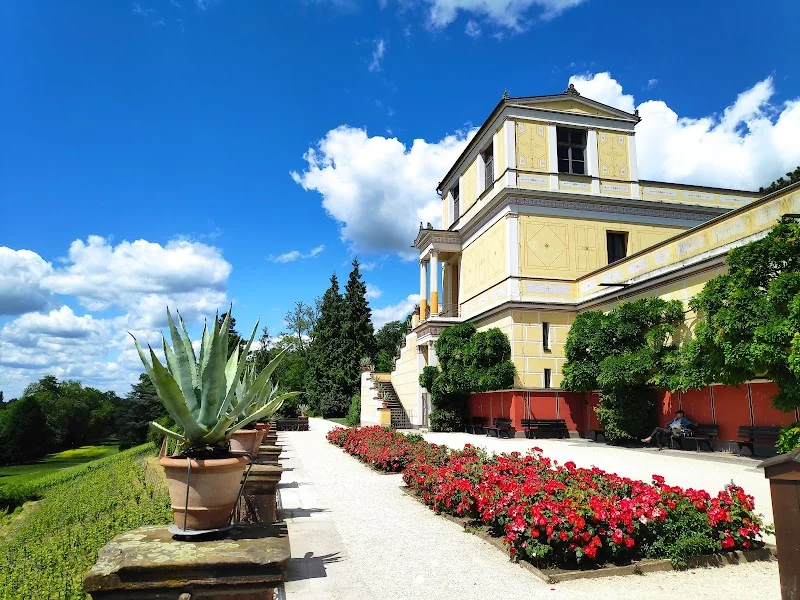
Aschaffenburg
Pompejanumstraße 5, 63739 Aschaffenburg, Deutschland
Pompejanum | Admission & Parking
The Pompejanum in Aschaffenburg is one of the most unusual cultural sites in Bavaria because it is not a classic castle and not merely a modern museum, but a walkable 1:1 replica of a Pompeian house. King Ludwig I commissioned this structure to be built by Friedrich von Gärtner between 1840 and 1848 after his trip to Italy and the excavations in Pompeii. The building was intentionally designed as an educational object, open to all people and not for private residential purposes. This is precisely what makes the location appealing: those who visit the Pompejanum do not experience an abstract antiquity behind glass, but a spatially tangible glimpse into Roman domestic culture. Its location on the high bank of the Main, directly in the castle garden of Aschaffenburg, further enhances this impression. One does not enter an isolated exhibition room, but a place where architecture, garden, and history merge into a very dense presentation. ([schloesser-aschaffenburg.de](https://www.schloesser-aschaffenburg.de/deutsch/pompejanum/index.htm))
Pompejanum Interior: Atrium, Viridarium, and Living Spaces
Those searching for Pompejanum interior are fundamentally asking how this building is spatially structured and what one can actually see. The tour is clearly oriented around a Roman house. At the center are two courtyards: the atrium with a water basin and the green viridarium in the rear part of the house. Surrounding these two courtyards on the ground floor are the reception and guest rooms, the kitchen, and the dining rooms. The visit thus does not take one through a neutral exhibition hall, but through a deliberately composed house that aims to vividly illustrate the daily life of an ancient upper class. Particularly exciting is that the rooms are not only architecturally but also thematically coordinated. This makes the tour very illustrative, even for people who are encountering Roman domestic culture for the first time. Precisely because the rooms are so clearly structured, the ancient world can be unusually well understood here. ([schloesser-aschaffenburg.de](https://www.schloesser-aschaffenburg.de/deutsch/pompejanum/rundgang.htm))
The interior also includes summer triclinium, winter triclinium, cella, and culina, which are the functions associated with a Roman house and were deliberately reconstructed in the Pompejanum. The splendid decoration of the rooms and the mosaic floors follow ancient models or are inspired by them. The functional objects made of bronze in the kitchen and the bronze chandeliers are casts of ancient originals from Pompeii and Herculaneum. Since 1994, the house has also displayed original Roman artworks from the collections of the State Collections of Antiquities and the Glyptothek in Munich. This transforms the building into more than just a historical model: it is also a museum of ancient domestic culture that connects architecture, decor, and original objects in a compact space. Among the most valuable pieces are Roman marble sculptures, small bronzes, functional objects of Roman domestic culture, and two marble thrones of the gods. ([schloesser-aschaffenburg.de](https://www.schloesser-aschaffenburg.de/deutsch/pompejanum/rundgang.htm))
Pompejanum Admission, Opening Hours, and Tickets
The question of Pompejanum admission is particularly important for planning a visit, as the house is not regularly open year-round. According to official visitor information, the Pompejanum is accessible from March 28 to March 31 from 10 AM to 4 PM, from April to October 3 from 9 AM to 6 PM, and from October 4 to October 31 from 10 AM to 4 PM. The house is closed on Mondays, with exceptions on Easter Monday, May 1, Whit Monday, August 15, and October 3. From November to March 27, the Pompejanum is in winter break. Therefore, anyone planning a visit should definitely pay attention to the season, as particularly outside the main season, short-term changes or closures are relevant. The official information is clear: the house can be visited without a guided tour, which facilitates spontaneous visits. At the same time, it is worthwhile to pay attention to current notices in advance, as special exhibitions and guided tours can enrich the visit further. ([schloesser-aschaffenburg.de](https://www.schloesser-aschaffenburg.de/deutsch/tourist/oeffnung.htm))
In terms of price, the Pompejanum is in the usual range for a significant cultural site: 7 euros regular and 6 euros reduced. Particularly practical for combination visitors is the combination ticket for Schloss Johannisburg and Pompejanum, which costs 10 euros regular and 8 euros reduced and is valid as a day ticket only on the day of purchase. Children and adolescents up to the age of 18 receive free admission. Those who wish to experience several Aschaffenburg attractions in one day can use this combination sensibly, as it connects the visit to the Pompejanum with the castle visit. Important for planning is also that no card payments are possible at the cash registers. Cash should therefore be brought along to avoid delays on site. This mix of moderate prices, free admission for young visitors, and a combination offer makes the Pompejanum particularly attractive for families, school groups, and cultural travelers. ([schloesser-aschaffenburg.de](https://www.schloesser-aschaffenburg.de/deutsch/tourist/eintritt.htm))
For current relevance, the special exhibition Ancient Troublemaker – Are the Hybrid Creatures Still Manageable? will take place in 2026. The exhibition will be on view at the Pompejanum from March 28 to October 31, 2026, and is included in the admission price. The focus is on hybrid creatures from ancient mythology such as Medusa, Chimera, Minotaur, Centaurs, and Sphinx. This is particularly appealing to visitors because the historical context of the house connects with a clearly defined exhibition theme. Thus, there is no mere walkthrough of a monument space, but added value for all those interested in ancient imagery. It is precisely this combination of a permanent experience and changing special exhibitions that makes the visit repeatable. Those who have been to the Pompejanum once can discover new content during a later visit. ([schloesser-aschaffenburg.de](https://www.schloesser-aschaffenburg.de/))
Parking and Accessing Pompejanum in Aschaffenburg
Parking at the Pompejanum is a topic that can be directly explained by the location of the house. The Bavarian Palace Administration describes the Pompejanum and Schloss Johannisburg as attractions in the city center of Aschaffenburg. Aschaffenburg is located on the A3 between Würzburg and Frankfurt, making it very accessible in the Rhine-Main area. Those arriving by train can reach the Pompejanum from the main train station by bus to the Stadthalle stop. This is convenient for day visitors as it allows access to the center without long walks. The official representation makes it clear that access is not complicated: the house is located in an urban area, yet in a landscape-dominated environment along the Main. Particularly for visitors who experience Aschaffenburg for only a few hours, the good combination of highway access, train, and bus is an important plus point. ([schloesser-aschaffenburg.de](https://www.schloesser-aschaffenburg.de/englisch/tourist/howtoget.htm))
Regarding parking, the Palace Administration refers to parking garages in the city center. This makes it clear that the Pompejanum itself is not intended as a large parking location but is integrated into the existing downtown infrastructure. This is typical for historical sites located in developed urban areas: the actual quality lies in reaching it on foot and in the interplay with other attractions, not in a drop-off directly at the entrance. At the same time, the location is not inconvenient for people with limited mobility, as the grounds of the western castle park around the Pompejanum up to the breakfast temple are accessible via gates on Pompejanumstraße and Ziegelbergstraße. The building itself is largely barrier-free on the ground floor, while the upper floor is only accessible by stairs. A mobile ramp can be provided at the entrance if needed, upon prior telephone registration. These details are important for realistically planning the visit, especially with strollers, wheelchairs, or larger groups. ([schloesser.bayern.de](https://www.schloesser.bayern.de/deutsch/schloss/objekte/as_pom.htm))
Pompejanum Children's Tours, Family Visits, and Guided Tours
In the search for Pompejanum Aschaffenburg children's tours, it quickly becomes clear that the house is deliberately designed to be family-friendly. The official visitor information explicitly states that the Pompejanum can be visited without a guided tour. At the same time, the VHS Aschaffenburg's guided tour network offers tours at requested times for groups, including children's tours and open family tours in several languages. This is very interesting for school classes, clubs, or family groups because it allows the visit to be adapted to different age levels. Particularly pleasant is that the house was not only designed for experts but as a learning place for a broad audience. This openness is inherent in the idea of the building: a walkable model of Roman domestic culture that aims to enable education and study of antiquity. Families therefore benefit from not only seeing an architectural monument but experiencing a vivid, spatially understandable ancient world. ([schloesser-aschaffenburg.de](https://www.schloesser-aschaffenburg.de/deutsch/tourist/oeffnung.htm))
For children, the free smartphone tour Per Smartphone into Antiquity, offered through museum.de, is also important. This makes the visit a small discovery tour even without a fixed group booking. Those coming with younger visitors can explore the interiors in a more playful manner and specifically target the most important rooms. The sequence of rooms with atrium, viridarium, summer and winter triclinium, kitchen, and living spaces is particularly well suited to explain ancient everyday culture. Additionally, there is the official age regulation of the Bavarian Palace Administration: children under 14 years of age are only allowed entry when accompanied by an adult supervisor. This is important information for families, school classes, and group leaders. In practice, this means: while the Pompejanum is well-suited for young visitors, it requires clear supervision and a minimum of organization. This mix makes the place so strong for educational visits, as it is both illustrative, authentic, and pedagogically meaningful. ([schloesser.bayern.de](https://www.schloesser.bayern.de/deutsch/schloss/objekte/as_pom.htm))
Pompejanum History, Architecture, and Special Exhibitions
The history of the Pompejanum begins with King Ludwig I's enthusiasm for antiquity. After his trip to Italy and inspired by the excavations of Pompeii, he wanted to create a structure that makes Roman domestic culture immediately tangible in Bavaria. Between 1840 and 1848, the ideal replica of a Pompeian house was thus created on the banks of the Main in Aschaffenburg. The architect Friedrich von Gärtner implemented the king's directive, who personally selected the construction site. The crucial idea behind the project is that the house should not be the representative property of a ruler, but a teaching piece for all those interested in antiquity. This educational claim is still palpable today, as the architecture is not only beautiful but also explanatory. Anyone observing the facility immediately sees that a Mediterranean world has been replicated here, which takes ancient models seriously while also reinterpreting them in the 19th century. ([schloesser-aschaffenburg.de](https://www.schloesser-aschaffenburg.de/deutsch/pompejanum/index.htm))
The later history is also remarkable. During World War II, the Pompejanum was severely damaged but has been restored and completed in several phases since 1960. By 1850, the house was already fully furnished; the current presentation thus goes back to a long phase of reconstruction and museum enhancement. Since 1994, original Roman artworks from the collections of the State Collections of Antiquities and the Glyptothek in Munich have enriched the rooms. This connects the Pompejanum's reconstruction and original in an unusually harmonious way. Particularly impressive are marble sculptures, small bronzes, glassware, functional objects of Roman domestic culture, and the marble thrones of the gods. For visitors, this means: the house is not just a historical quotation but a serious museum about ancient domestic and visual culture. This combination makes it significantly more valuable than mere thematic architecture. ([schloesser-aschaffenburg.de](https://www.schloesser-aschaffenburg.de/deutsch/pompejanum/rundgang.htm))
The environment of the Pompejanum is also part of the overall effect. Surrounding the house is a small garden area, established in the mid-19th century, which was intended to suggest a Mediterranean ideal landscape. Among others, figs, araucarias, almond trees, vines, poplars, and pines are mentioned. In the vicinity of the Aschaffenburg castle garden, an ensemble was created that makes the Rhine-Main region appear almost southern. In the English description of the Palace Administration, there is even mention of an idealized Mediterranean landscape that King Ludwig I particularly appreciated and referred to as his Bavarian Nice. This is precisely why the Pompejanum is not only architecturally interesting but also strongly scenic. Those interested in Pompejanum Aschaffenburg images are usually looking for this contrast: a neoclassical building, Mediterranean plants, and the view of the Main. In 2026, the special exhibition Ancient Troublemaker will also introduce a new theme that connects the ancient imagery of the house with myths and hybrid creatures, thus creating an additional reason to visit. ([schloesser-aschaffenburg.de](https://www.schloesser.bayern.de/englisch/garden/objects/as_pom.htm))
Sources:
Show moreShow less
Pompejanum | Admission & Parking
The Pompejanum in Aschaffenburg is one of the most unusual cultural sites in Bavaria because it is not a classic castle and not merely a modern museum, but a walkable 1:1 replica of a Pompeian house. King Ludwig I commissioned this structure to be built by Friedrich von Gärtner between 1840 and 1848 after his trip to Italy and the excavations in Pompeii. The building was intentionally designed as an educational object, open to all people and not for private residential purposes. This is precisely what makes the location appealing: those who visit the Pompejanum do not experience an abstract antiquity behind glass, but a spatially tangible glimpse into Roman domestic culture. Its location on the high bank of the Main, directly in the castle garden of Aschaffenburg, further enhances this impression. One does not enter an isolated exhibition room, but a place where architecture, garden, and history merge into a very dense presentation. ([schloesser-aschaffenburg.de](https://www.schloesser-aschaffenburg.de/deutsch/pompejanum/index.htm))
Pompejanum Interior: Atrium, Viridarium, and Living Spaces
Those searching for Pompejanum interior are fundamentally asking how this building is spatially structured and what one can actually see. The tour is clearly oriented around a Roman house. At the center are two courtyards: the atrium with a water basin and the green viridarium in the rear part of the house. Surrounding these two courtyards on the ground floor are the reception and guest rooms, the kitchen, and the dining rooms. The visit thus does not take one through a neutral exhibition hall, but through a deliberately composed house that aims to vividly illustrate the daily life of an ancient upper class. Particularly exciting is that the rooms are not only architecturally but also thematically coordinated. This makes the tour very illustrative, even for people who are encountering Roman domestic culture for the first time. Precisely because the rooms are so clearly structured, the ancient world can be unusually well understood here. ([schloesser-aschaffenburg.de](https://www.schloesser-aschaffenburg.de/deutsch/pompejanum/rundgang.htm))
The interior also includes summer triclinium, winter triclinium, cella, and culina, which are the functions associated with a Roman house and were deliberately reconstructed in the Pompejanum. The splendid decoration of the rooms and the mosaic floors follow ancient models or are inspired by them. The functional objects made of bronze in the kitchen and the bronze chandeliers are casts of ancient originals from Pompeii and Herculaneum. Since 1994, the house has also displayed original Roman artworks from the collections of the State Collections of Antiquities and the Glyptothek in Munich. This transforms the building into more than just a historical model: it is also a museum of ancient domestic culture that connects architecture, decor, and original objects in a compact space. Among the most valuable pieces are Roman marble sculptures, small bronzes, functional objects of Roman domestic culture, and two marble thrones of the gods. ([schloesser-aschaffenburg.de](https://www.schloesser-aschaffenburg.de/deutsch/pompejanum/rundgang.htm))
Pompejanum Admission, Opening Hours, and Tickets
The question of Pompejanum admission is particularly important for planning a visit, as the house is not regularly open year-round. According to official visitor information, the Pompejanum is accessible from March 28 to March 31 from 10 AM to 4 PM, from April to October 3 from 9 AM to 6 PM, and from October 4 to October 31 from 10 AM to 4 PM. The house is closed on Mondays, with exceptions on Easter Monday, May 1, Whit Monday, August 15, and October 3. From November to March 27, the Pompejanum is in winter break. Therefore, anyone planning a visit should definitely pay attention to the season, as particularly outside the main season, short-term changes or closures are relevant. The official information is clear: the house can be visited without a guided tour, which facilitates spontaneous visits. At the same time, it is worthwhile to pay attention to current notices in advance, as special exhibitions and guided tours can enrich the visit further. ([schloesser-aschaffenburg.de](https://www.schloesser-aschaffenburg.de/deutsch/tourist/oeffnung.htm))
In terms of price, the Pompejanum is in the usual range for a significant cultural site: 7 euros regular and 6 euros reduced. Particularly practical for combination visitors is the combination ticket for Schloss Johannisburg and Pompejanum, which costs 10 euros regular and 8 euros reduced and is valid as a day ticket only on the day of purchase. Children and adolescents up to the age of 18 receive free admission. Those who wish to experience several Aschaffenburg attractions in one day can use this combination sensibly, as it connects the visit to the Pompejanum with the castle visit. Important for planning is also that no card payments are possible at the cash registers. Cash should therefore be brought along to avoid delays on site. This mix of moderate prices, free admission for young visitors, and a combination offer makes the Pompejanum particularly attractive for families, school groups, and cultural travelers. ([schloesser-aschaffenburg.de](https://www.schloesser-aschaffenburg.de/deutsch/tourist/eintritt.htm))
For current relevance, the special exhibition Ancient Troublemaker – Are the Hybrid Creatures Still Manageable? will take place in 2026. The exhibition will be on view at the Pompejanum from March 28 to October 31, 2026, and is included in the admission price. The focus is on hybrid creatures from ancient mythology such as Medusa, Chimera, Minotaur, Centaurs, and Sphinx. This is particularly appealing to visitors because the historical context of the house connects with a clearly defined exhibition theme. Thus, there is no mere walkthrough of a monument space, but added value for all those interested in ancient imagery. It is precisely this combination of a permanent experience and changing special exhibitions that makes the visit repeatable. Those who have been to the Pompejanum once can discover new content during a later visit. ([schloesser-aschaffenburg.de](https://www.schloesser-aschaffenburg.de/))
Parking and Accessing Pompejanum in Aschaffenburg
Parking at the Pompejanum is a topic that can be directly explained by the location of the house. The Bavarian Palace Administration describes the Pompejanum and Schloss Johannisburg as attractions in the city center of Aschaffenburg. Aschaffenburg is located on the A3 between Würzburg and Frankfurt, making it very accessible in the Rhine-Main area. Those arriving by train can reach the Pompejanum from the main train station by bus to the Stadthalle stop. This is convenient for day visitors as it allows access to the center without long walks. The official representation makes it clear that access is not complicated: the house is located in an urban area, yet in a landscape-dominated environment along the Main. Particularly for visitors who experience Aschaffenburg for only a few hours, the good combination of highway access, train, and bus is an important plus point. ([schloesser-aschaffenburg.de](https://www.schloesser-aschaffenburg.de/englisch/tourist/howtoget.htm))
Regarding parking, the Palace Administration refers to parking garages in the city center. This makes it clear that the Pompejanum itself is not intended as a large parking location but is integrated into the existing downtown infrastructure. This is typical for historical sites located in developed urban areas: the actual quality lies in reaching it on foot and in the interplay with other attractions, not in a drop-off directly at the entrance. At the same time, the location is not inconvenient for people with limited mobility, as the grounds of the western castle park around the Pompejanum up to the breakfast temple are accessible via gates on Pompejanumstraße and Ziegelbergstraße. The building itself is largely barrier-free on the ground floor, while the upper floor is only accessible by stairs. A mobile ramp can be provided at the entrance if needed, upon prior telephone registration. These details are important for realistically planning the visit, especially with strollers, wheelchairs, or larger groups. ([schloesser.bayern.de](https://www.schloesser.bayern.de/deutsch/schloss/objekte/as_pom.htm))
Pompejanum Children's Tours, Family Visits, and Guided Tours
In the search for Pompejanum Aschaffenburg children's tours, it quickly becomes clear that the house is deliberately designed to be family-friendly. The official visitor information explicitly states that the Pompejanum can be visited without a guided tour. At the same time, the VHS Aschaffenburg's guided tour network offers tours at requested times for groups, including children's tours and open family tours in several languages. This is very interesting for school classes, clubs, or family groups because it allows the visit to be adapted to different age levels. Particularly pleasant is that the house was not only designed for experts but as a learning place for a broad audience. This openness is inherent in the idea of the building: a walkable model of Roman domestic culture that aims to enable education and study of antiquity. Families therefore benefit from not only seeing an architectural monument but experiencing a vivid, spatially understandable ancient world. ([schloesser-aschaffenburg.de](https://www.schloesser-aschaffenburg.de/deutsch/tourist/oeffnung.htm))
For children, the free smartphone tour Per Smartphone into Antiquity, offered through museum.de, is also important. This makes the visit a small discovery tour even without a fixed group booking. Those coming with younger visitors can explore the interiors in a more playful manner and specifically target the most important rooms. The sequence of rooms with atrium, viridarium, summer and winter triclinium, kitchen, and living spaces is particularly well suited to explain ancient everyday culture. Additionally, there is the official age regulation of the Bavarian Palace Administration: children under 14 years of age are only allowed entry when accompanied by an adult supervisor. This is important information for families, school classes, and group leaders. In practice, this means: while the Pompejanum is well-suited for young visitors, it requires clear supervision and a minimum of organization. This mix makes the place so strong for educational visits, as it is both illustrative, authentic, and pedagogically meaningful. ([schloesser.bayern.de](https://www.schloesser.bayern.de/deutsch/schloss/objekte/as_pom.htm))
Pompejanum History, Architecture, and Special Exhibitions
The history of the Pompejanum begins with King Ludwig I's enthusiasm for antiquity. After his trip to Italy and inspired by the excavations of Pompeii, he wanted to create a structure that makes Roman domestic culture immediately tangible in Bavaria. Between 1840 and 1848, the ideal replica of a Pompeian house was thus created on the banks of the Main in Aschaffenburg. The architect Friedrich von Gärtner implemented the king's directive, who personally selected the construction site. The crucial idea behind the project is that the house should not be the representative property of a ruler, but a teaching piece for all those interested in antiquity. This educational claim is still palpable today, as the architecture is not only beautiful but also explanatory. Anyone observing the facility immediately sees that a Mediterranean world has been replicated here, which takes ancient models seriously while also reinterpreting them in the 19th century. ([schloesser-aschaffenburg.de](https://www.schloesser-aschaffenburg.de/deutsch/pompejanum/index.htm))
The later history is also remarkable. During World War II, the Pompejanum was severely damaged but has been restored and completed in several phases since 1960. By 1850, the house was already fully furnished; the current presentation thus goes back to a long phase of reconstruction and museum enhancement. Since 1994, original Roman artworks from the collections of the State Collections of Antiquities and the Glyptothek in Munich have enriched the rooms. This connects the Pompejanum's reconstruction and original in an unusually harmonious way. Particularly impressive are marble sculptures, small bronzes, glassware, functional objects of Roman domestic culture, and the marble thrones of the gods. For visitors, this means: the house is not just a historical quotation but a serious museum about ancient domestic and visual culture. This combination makes it significantly more valuable than mere thematic architecture. ([schloesser-aschaffenburg.de](https://www.schloesser-aschaffenburg.de/deutsch/pompejanum/rundgang.htm))
The environment of the Pompejanum is also part of the overall effect. Surrounding the house is a small garden area, established in the mid-19th century, which was intended to suggest a Mediterranean ideal landscape. Among others, figs, araucarias, almond trees, vines, poplars, and pines are mentioned. In the vicinity of the Aschaffenburg castle garden, an ensemble was created that makes the Rhine-Main region appear almost southern. In the English description of the Palace Administration, there is even mention of an idealized Mediterranean landscape that King Ludwig I particularly appreciated and referred to as his Bavarian Nice. This is precisely why the Pompejanum is not only architecturally interesting but also strongly scenic. Those interested in Pompejanum Aschaffenburg images are usually looking for this contrast: a neoclassical building, Mediterranean plants, and the view of the Main. In 2026, the special exhibition Ancient Troublemaker will also introduce a new theme that connects the ancient imagery of the house with myths and hybrid creatures, thus creating an additional reason to visit. ([schloesser-aschaffenburg.de](https://www.schloesser.bayern.de/englisch/garden/objects/as_pom.htm))
Sources:
Pompejanum | Admission & Parking
The Pompejanum in Aschaffenburg is one of the most unusual cultural sites in Bavaria because it is not a classic castle and not merely a modern museum, but a walkable 1:1 replica of a Pompeian house. King Ludwig I commissioned this structure to be built by Friedrich von Gärtner between 1840 and 1848 after his trip to Italy and the excavations in Pompeii. The building was intentionally designed as an educational object, open to all people and not for private residential purposes. This is precisely what makes the location appealing: those who visit the Pompejanum do not experience an abstract antiquity behind glass, but a spatially tangible glimpse into Roman domestic culture. Its location on the high bank of the Main, directly in the castle garden of Aschaffenburg, further enhances this impression. One does not enter an isolated exhibition room, but a place where architecture, garden, and history merge into a very dense presentation. ([schloesser-aschaffenburg.de](https://www.schloesser-aschaffenburg.de/deutsch/pompejanum/index.htm))
Pompejanum Interior: Atrium, Viridarium, and Living Spaces
Those searching for Pompejanum interior are fundamentally asking how this building is spatially structured and what one can actually see. The tour is clearly oriented around a Roman house. At the center are two courtyards: the atrium with a water basin and the green viridarium in the rear part of the house. Surrounding these two courtyards on the ground floor are the reception and guest rooms, the kitchen, and the dining rooms. The visit thus does not take one through a neutral exhibition hall, but through a deliberately composed house that aims to vividly illustrate the daily life of an ancient upper class. Particularly exciting is that the rooms are not only architecturally but also thematically coordinated. This makes the tour very illustrative, even for people who are encountering Roman domestic culture for the first time. Precisely because the rooms are so clearly structured, the ancient world can be unusually well understood here. ([schloesser-aschaffenburg.de](https://www.schloesser-aschaffenburg.de/deutsch/pompejanum/rundgang.htm))
The interior also includes summer triclinium, winter triclinium, cella, and culina, which are the functions associated with a Roman house and were deliberately reconstructed in the Pompejanum. The splendid decoration of the rooms and the mosaic floors follow ancient models or are inspired by them. The functional objects made of bronze in the kitchen and the bronze chandeliers are casts of ancient originals from Pompeii and Herculaneum. Since 1994, the house has also displayed original Roman artworks from the collections of the State Collections of Antiquities and the Glyptothek in Munich. This transforms the building into more than just a historical model: it is also a museum of ancient domestic culture that connects architecture, decor, and original objects in a compact space. Among the most valuable pieces are Roman marble sculptures, small bronzes, functional objects of Roman domestic culture, and two marble thrones of the gods. ([schloesser-aschaffenburg.de](https://www.schloesser-aschaffenburg.de/deutsch/pompejanum/rundgang.htm))
Pompejanum Admission, Opening Hours, and Tickets
The question of Pompejanum admission is particularly important for planning a visit, as the house is not regularly open year-round. According to official visitor information, the Pompejanum is accessible from March 28 to March 31 from 10 AM to 4 PM, from April to October 3 from 9 AM to 6 PM, and from October 4 to October 31 from 10 AM to 4 PM. The house is closed on Mondays, with exceptions on Easter Monday, May 1, Whit Monday, August 15, and October 3. From November to March 27, the Pompejanum is in winter break. Therefore, anyone planning a visit should definitely pay attention to the season, as particularly outside the main season, short-term changes or closures are relevant. The official information is clear: the house can be visited without a guided tour, which facilitates spontaneous visits. At the same time, it is worthwhile to pay attention to current notices in advance, as special exhibitions and guided tours can enrich the visit further. ([schloesser-aschaffenburg.de](https://www.schloesser-aschaffenburg.de/deutsch/tourist/oeffnung.htm))
In terms of price, the Pompejanum is in the usual range for a significant cultural site: 7 euros regular and 6 euros reduced. Particularly practical for combination visitors is the combination ticket for Schloss Johannisburg and Pompejanum, which costs 10 euros regular and 8 euros reduced and is valid as a day ticket only on the day of purchase. Children and adolescents up to the age of 18 receive free admission. Those who wish to experience several Aschaffenburg attractions in one day can use this combination sensibly, as it connects the visit to the Pompejanum with the castle visit. Important for planning is also that no card payments are possible at the cash registers. Cash should therefore be brought along to avoid delays on site. This mix of moderate prices, free admission for young visitors, and a combination offer makes the Pompejanum particularly attractive for families, school groups, and cultural travelers. ([schloesser-aschaffenburg.de](https://www.schloesser-aschaffenburg.de/deutsch/tourist/eintritt.htm))
For current relevance, the special exhibition Ancient Troublemaker – Are the Hybrid Creatures Still Manageable? will take place in 2026. The exhibition will be on view at the Pompejanum from March 28 to October 31, 2026, and is included in the admission price. The focus is on hybrid creatures from ancient mythology such as Medusa, Chimera, Minotaur, Centaurs, and Sphinx. This is particularly appealing to visitors because the historical context of the house connects with a clearly defined exhibition theme. Thus, there is no mere walkthrough of a monument space, but added value for all those interested in ancient imagery. It is precisely this combination of a permanent experience and changing special exhibitions that makes the visit repeatable. Those who have been to the Pompejanum once can discover new content during a later visit. ([schloesser-aschaffenburg.de](https://www.schloesser-aschaffenburg.de/))
Parking and Accessing Pompejanum in Aschaffenburg
Parking at the Pompejanum is a topic that can be directly explained by the location of the house. The Bavarian Palace Administration describes the Pompejanum and Schloss Johannisburg as attractions in the city center of Aschaffenburg. Aschaffenburg is located on the A3 between Würzburg and Frankfurt, making it very accessible in the Rhine-Main area. Those arriving by train can reach the Pompejanum from the main train station by bus to the Stadthalle stop. This is convenient for day visitors as it allows access to the center without long walks. The official representation makes it clear that access is not complicated: the house is located in an urban area, yet in a landscape-dominated environment along the Main. Particularly for visitors who experience Aschaffenburg for only a few hours, the good combination of highway access, train, and bus is an important plus point. ([schloesser-aschaffenburg.de](https://www.schloesser-aschaffenburg.de/englisch/tourist/howtoget.htm))
Regarding parking, the Palace Administration refers to parking garages in the city center. This makes it clear that the Pompejanum itself is not intended as a large parking location but is integrated into the existing downtown infrastructure. This is typical for historical sites located in developed urban areas: the actual quality lies in reaching it on foot and in the interplay with other attractions, not in a drop-off directly at the entrance. At the same time, the location is not inconvenient for people with limited mobility, as the grounds of the western castle park around the Pompejanum up to the breakfast temple are accessible via gates on Pompejanumstraße and Ziegelbergstraße. The building itself is largely barrier-free on the ground floor, while the upper floor is only accessible by stairs. A mobile ramp can be provided at the entrance if needed, upon prior telephone registration. These details are important for realistically planning the visit, especially with strollers, wheelchairs, or larger groups. ([schloesser.bayern.de](https://www.schloesser.bayern.de/deutsch/schloss/objekte/as_pom.htm))
Pompejanum Children's Tours, Family Visits, and Guided Tours
In the search for Pompejanum Aschaffenburg children's tours, it quickly becomes clear that the house is deliberately designed to be family-friendly. The official visitor information explicitly states that the Pompejanum can be visited without a guided tour. At the same time, the VHS Aschaffenburg's guided tour network offers tours at requested times for groups, including children's tours and open family tours in several languages. This is very interesting for school classes, clubs, or family groups because it allows the visit to be adapted to different age levels. Particularly pleasant is that the house was not only designed for experts but as a learning place for a broad audience. This openness is inherent in the idea of the building: a walkable model of Roman domestic culture that aims to enable education and study of antiquity. Families therefore benefit from not only seeing an architectural monument but experiencing a vivid, spatially understandable ancient world. ([schloesser-aschaffenburg.de](https://www.schloesser-aschaffenburg.de/deutsch/tourist/oeffnung.htm))
For children, the free smartphone tour Per Smartphone into Antiquity, offered through museum.de, is also important. This makes the visit a small discovery tour even without a fixed group booking. Those coming with younger visitors can explore the interiors in a more playful manner and specifically target the most important rooms. The sequence of rooms with atrium, viridarium, summer and winter triclinium, kitchen, and living spaces is particularly well suited to explain ancient everyday culture. Additionally, there is the official age regulation of the Bavarian Palace Administration: children under 14 years of age are only allowed entry when accompanied by an adult supervisor. This is important information for families, school classes, and group leaders. In practice, this means: while the Pompejanum is well-suited for young visitors, it requires clear supervision and a minimum of organization. This mix makes the place so strong for educational visits, as it is both illustrative, authentic, and pedagogically meaningful. ([schloesser.bayern.de](https://www.schloesser.bayern.de/deutsch/schloss/objekte/as_pom.htm))
Pompejanum History, Architecture, and Special Exhibitions
The history of the Pompejanum begins with King Ludwig I's enthusiasm for antiquity. After his trip to Italy and inspired by the excavations of Pompeii, he wanted to create a structure that makes Roman domestic culture immediately tangible in Bavaria. Between 1840 and 1848, the ideal replica of a Pompeian house was thus created on the banks of the Main in Aschaffenburg. The architect Friedrich von Gärtner implemented the king's directive, who personally selected the construction site. The crucial idea behind the project is that the house should not be the representative property of a ruler, but a teaching piece for all those interested in antiquity. This educational claim is still palpable today, as the architecture is not only beautiful but also explanatory. Anyone observing the facility immediately sees that a Mediterranean world has been replicated here, which takes ancient models seriously while also reinterpreting them in the 19th century. ([schloesser-aschaffenburg.de](https://www.schloesser-aschaffenburg.de/deutsch/pompejanum/index.htm))
The later history is also remarkable. During World War II, the Pompejanum was severely damaged but has been restored and completed in several phases since 1960. By 1850, the house was already fully furnished; the current presentation thus goes back to a long phase of reconstruction and museum enhancement. Since 1994, original Roman artworks from the collections of the State Collections of Antiquities and the Glyptothek in Munich have enriched the rooms. This connects the Pompejanum's reconstruction and original in an unusually harmonious way. Particularly impressive are marble sculptures, small bronzes, glassware, functional objects of Roman domestic culture, and the marble thrones of the gods. For visitors, this means: the house is not just a historical quotation but a serious museum about ancient domestic and visual culture. This combination makes it significantly more valuable than mere thematic architecture. ([schloesser-aschaffenburg.de](https://www.schloesser-aschaffenburg.de/deutsch/pompejanum/rundgang.htm))
The environment of the Pompejanum is also part of the overall effect. Surrounding the house is a small garden area, established in the mid-19th century, which was intended to suggest a Mediterranean ideal landscape. Among others, figs, araucarias, almond trees, vines, poplars, and pines are mentioned. In the vicinity of the Aschaffenburg castle garden, an ensemble was created that makes the Rhine-Main region appear almost southern. In the English description of the Palace Administration, there is even mention of an idealized Mediterranean landscape that King Ludwig I particularly appreciated and referred to as his Bavarian Nice. This is precisely why the Pompejanum is not only architecturally interesting but also strongly scenic. Those interested in Pompejanum Aschaffenburg images are usually looking for this contrast: a neoclassical building, Mediterranean plants, and the view of the Main. In 2026, the special exhibition Ancient Troublemaker will also introduce a new theme that connects the ancient imagery of the house with myths and hybrid creatures, thus creating an additional reason to visit. ([schloesser-aschaffenburg.de](https://www.schloesser.bayern.de/englisch/garden/objects/as_pom.htm))
Sources:
Upcoming Events
Ancient Troublemakers
Experience the exciting hybrid creatures of antiquity in the exhibition at the Pompejanum Aschaffenburg.
27. Aschaffenburg Cultural Days - Museum Night
Visit the Museum Night of the Aschaffenburg Cultural Days on July 11, 2026. An evening full of art and culture awaits you!
Museums Night in Aschaffenburg
Dive into the world of museums at the Museums Night in Aschaffenburg. A cultural highlight on July 11.
Frequently Asked Questions
Reviews
Sergio Arganda Gomez
19. April 2025
Very interesting place, worth visiting for sure. Especially if you get the combined ticket for this and Johannisburg castle for 9 EUR. Additionally, the view of the castle and the river from this point are amazing.
Ben Artee
10. June 2025
Fabulous replica of a Pompejanumstraße town villa. Built here because the microclimate is most akin to southern Italy, including lemon trees blossoming. Note that the location is inside the borders of the Roman Empire- so there’s more to see only short distances away.
V M
1. September 2024
Nice place in Aschaffenburg. interesting insights into Roman times and culture. Great views of Aschaffenburg. Great view of the river Main and the castle.
Anh Lan
7. August 2025
A unique place that brings ancient Rome to Bavaria. The interior details are fascinating and well-preserved. Ideal for culture and history lovers.
Mary L
8. July 2023
This place was built as a replica of a Roman Pompeian Villa. It was commissioned by Ludwig I for the art lovers to enjoy architecture. As if today it is a very peaceful place to visit. Especially in the summer the flowers are beautiful and the view over the Main River is spectacular. Make sure to take a walk from here to the Johannisburg palace and then the old city.