
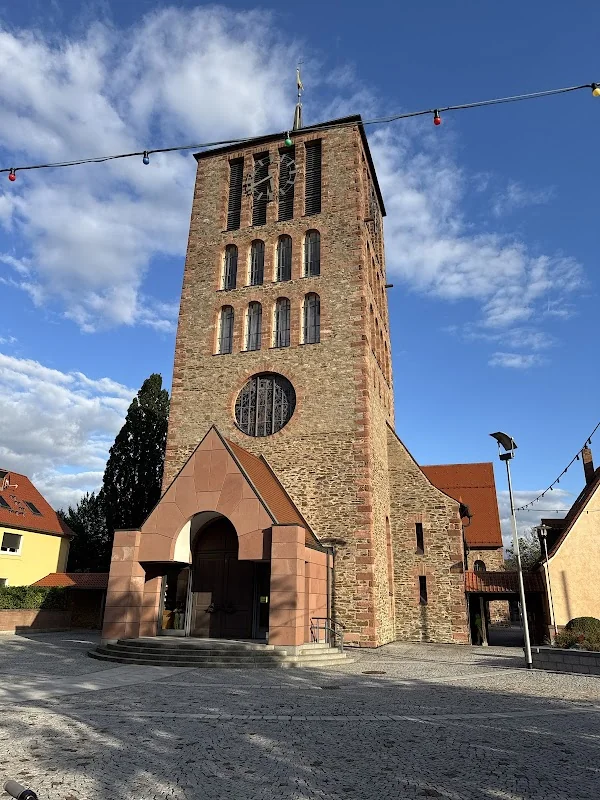
Kleinostheim
Kirchplatz 2, 63801 Kleinostheim, Deutschland
Parish St. Laurentius, Rectory | Contact & Opening Hours
The search queries related to the Parish St. Laurentius in Kleinostheim show a very clear pattern: primarily searched are the rectory, the parish office, the address at the church square, the opening hours, and the general parish with its contact details. This makes the location highly relevant for seekers, as the rectory is not only an administrative address but also an organizational hub for pastoral care, community life, and information. The official website of the parish lists the administrative address at Kirchplatz 2 in 63801 Kleinostheim; furthermore, the community refers to a wide network of facilities, initiatives, and current events. The community of Kleinostheim also visibly places St. Laurentius in the local landscape, as both the St. Laurentius Church and the church square appear as clearly named reference points on the local map. ([sankt-laurentius-kleinostheim.de](https://www.sankt-laurentius-kleinostheim.de/kontakte/))
Contact, Opening Hours, and Accessibility at Kirchplatz
Those looking for the St. Laurentius rectory will find a very direct and practical accessibility on the official contact page. The St. Laurentius rectory is listed at Kirchplatz 2 in 63801 Kleinostheim with the phone number 06027 461216 and the email addresses simone.buettner@bistum-wuerzburg.de and pfarrhaus@sankt-laurentius-kleinostheim.de. The website also specifies concrete times when the rectory is accessible: Monday from 08:00 to 12:00 and 14:30 to 17:00, Tuesday from 14:30 to 17:00, Wednesday from 08:00 to 12:00, Thursday from 14:30 to 18:00, and Friday from 08:00 to 12:00. This clearly positions the rectory as an accessible point of contact for community concerns, inquiries, and organizational matters. Especially for a parish, this form of open contact structure is important, as many issues arise not only on Sundays but during the week: baptism registrations, pastoral questions, appointment arrangements, information about services, or orientation in community life. The official page emphasizes multiple times that the rectory is not merely an office but part of a vibrant pastoral everyday life. ([sankt-laurentius-kleinostheim.de](https://www.sankt-laurentius-kleinostheim.de/kontakte/))
For search queries regarding the term parish office, the assignment is also clear. In the pages of the parish, the parish office or the rectory appears as the central administrative and contact point of the Laurentius community. The combination of address, phone, email, and accessibility times is particularly user-friendly, as it facilitates quick contact and simultaneously underscores the role of the location as a pastoral hub. From a content and SEO perspective, this is particularly interesting: the most common search terms do not indicate classic event or ticket inquiries but rather pragmatic information searches. People want to know when the office is open, how to reach the responsible parties, and where to turn with a concern. The St. Laurentius rectory thus fulfills a typical role of church locations in the town center: it is the first point of contact, administrative address, and communicative link between the community, pastoral team, and the many offerings on site. ([sankt-laurentius-kleinostheim.de](https://www.sankt-laurentius-kleinostheim.de/kontakte/))
Kirchplatz 2 in Kleinostheim: Location in the Town Center and Orientation
The location at Kirchplatz is central to the perception of the site. On the local map of the Kleinostheim community, both the St. Laurentius Church and the church square are explicitly marked, making the location a clear reference point in the town center. Additionally, the municipal flyer for Kleinostheim shows that St. Laurentius at the church square is located in the heart of a place situated at the foot of the Spessart and along the banks of the Main, while also looking back on over a thousand years of history. This creates a very characteristic image for visitors: a church-influenced district that is firmly anchored in the center of the town and is also embedded in a landscape and historically shaped environment. This embedding is important for the search intent because people looking for a parish are not only searching for an address but for a clearly readable place in the community. The location at Kirchplatz fulfills exactly that. It makes the parish visible, easily classifiable, and functionally accessible. ([kleinostheim.de](https://www.kleinostheim.de/ortsplan/?utm_source=openai))
For search engine relevance, the town center, church square, and Laurentius Church are therefore strong signals. Those searching for Parish St. Laurentius, Rectory Kleinostheim, or Kirchplatz 2 primarily expect a precise location assignment. The community itself addresses this need by listing St. Laurentius as a fixed point on the local map and highlighting the location at Kirchplatz in the flyer. From this clear location, a practical conclusion can be drawn that visitors can find the site via the church square and the adjacent inner-town paths; this is a straightforward but consciously formulated orientation, as the official pages do not publish a dedicated directions page with detailed information. This is precisely what is SEO-relevant: the best information page for this location must be precise, local, and trustworthy, without claiming details that are not substantiated on the official website. Therefore, the combination of address, local map, and municipal location reference is so valuable. It presents the parish as a central, historically rooted place within the fabric of Kleinostheim. ([sankt-laurentius-kleinostheim.de](https://www.sankt-laurentius-kleinostheim.de/kontakte/))
Pastoral Area Aschaffenburg-West and Community Team
The Parish St. Laurentius is today not to be viewed in isolation but as part of a larger pastoral context. On the contact page, the community explains that in January 2022, the Pastoral Area Aschaffenburg-West was formed from the parishes in Großostheim, Kleinostheim, Mainaschaff, and Stockstadt, as well as the parish community Rainbow in Bachgau. The goal of this merger is explicitly the collaboration of independent communities in a spirit of solidarity. This makes it clear that the St. Laurentius rectory is not only a local address but also a location within a connected church structure. For visitors and community members, this means more transparency: those with concerns encounter a parish that has modernized its organizational structure while maintaining its independence. The website also states that the pastoral team accompanies and supports the communities and that vibrant communities, innovative places for faith experience, and the accessibility of the church in everyday life are central goals. ([sankt-laurentius-kleinostheim.de](https://www.sankt-laurentius-kleinostheim.de/kontakte/))
In this context, the community team and church administration are also important. The parish explains that the community team is elected every four years, shares responsibility for pastoral care and ministry with the pastor and the full-time pastoral workers, and meets publicly at least once a month. The church administration is elected every six years and is responsible for legal representation, finances, investments, and the material prerequisites for pastoral work. This makes the parish visible as a well-structured organization that takes both spiritual and practical tasks seriously. The contact page also lists Pastor Heribert Kaufmann with his biographical introduction; similarly, community referent Simone Büttner is mentioned, who has her office in the rectory in Kleinostheim. This personnel and structural information makes the rectory a true administrative and meeting center. For seekers, this is particularly helpful, as they can recognize whom to contact, which committees hold responsibility, and how the community is organized on site. ([sankt-laurentius-kleinostheim.de](https://www.sankt-laurentius-kleinostheim.de/kontakte/))
The parish links this structure with a very open communication culture. The pages contain references to current events, calendars, downloads, initiatives, sacraments, and contact options. This is important because church-related search queries often do not just mean an address but the entry into a whole system of information: service schedules, contact persons, children’s and family offerings, social projects, or festivals throughout the year. Exactly here, the clear structure of the pastoral area helps, as it embeds the St. Laurentius location into a larger network of communities and offerings. For the SEO analysis, it is therefore important to note: the strongest keywords relate to the rectory, parish office, address, and opening hours, but the content depth only arises through the pastoral context. It gives the location relevance beyond the mere contact page. ([sankt-laurentius-kleinostheim.de](https://www.sankt-laurentius-kleinostheim.de/alle-einrichtungen/))
History of the Laurentius Tradition in Kleinostheim
The history of St. Laurentius in Kleinostheim goes back significantly further than the current administrative seat in the rectory. The community of Kleinostheim describes the old Laurentius Church as a place whose roots are mentioned before the year 1000. In the municipal representation, it is described as an earlier church outside the town, which was closely linked to the historical development of the cemetery and the local history. The cultural path of the community complements this picture and refers to the old church as a so-called mother church in the field, i.e., as an early shaped sacred place outside the then settlement core. These early references make it understandable why the name Laurentius still holds such strong significance in Kleinostheim today. It is not just a church name but a historical identity anchor of the place. ([kleinostheim.de](https://www.kleinostheim.de/wp-content/uploads/2020/02/Kleinostheim_gr_10_16_tc.pdf?utm_source=openai))
The official parish history of the parish deepens this tradition with concrete architectural stations. It narrates the history of the old St. Laurentius Church through the earlier Hubertus Chapel, which dates back to 1489. In 1708, an expansion of the chapel began, which was essentially equivalent to a new building, as large parts of the structure were newly constructed. Such historical stations show that the Laurentius tradition in Kleinostheim has developed over centuries and has been spatially and communally renewed time and again. For a contemporary SEO description, this is valuable because seekers expect not only a current point of contact but also want to understand the cultural background of a place. The rectory at the church square stands in a long line of church locations that have shaped the history of Kleinostheim. The official website makes this continuity visible by providing not only current dates but also historical documents and a specific history of the old church. ([sankt-laurentius-kleinostheim.de](https://www.sankt-laurentius-kleinostheim.de/download/12/downloads/2006/geschichte-die-alte-st-laurentiuskirche-in-kleinostheim.pdf?utm_source=openai))
Additionally, the parish actively maintains its history. The website features archive topics, exhibitions, and contributions that connect the past and present. Thus, history is not treated as an abstract memory but as a living part of community life. The references to the festival program for the 75th anniversary also show that the community consciously reflects on its own development and makes it publicly visible. This blend of historical depth, archival work, and current community communication is particularly strong for a parish. It builds trust because it shows that the place is not only managed but also culturally and spiritually supported. Those searching for Parish St. Laurentius, rectory, or Laurentius Church often unconsciously seek this long line: from the early church through the Hubertus Chapel to the current rectory at the church square. ([sankt-laurentius-kleinostheim.de](https://www.sankt-laurentius-kleinostheim.de/sterbebildausstellung-in-der-maingauhalle-wurde-viel-gelobt/?utm_source=openai))
Services, Festivals, and Vibrant Community Work
The official website clearly shows that St. Laurentius is not just an administrative address but a place with diverse community life. On the start and article page, there are references to the festival program “Building the Future Together 75 Years of St. Laurentius Kleinostheim,” to house services, and to dates in the church year. In addition, concrete forms of church life become visible, such as family services at the church square, toddler services, blessing services for couples, or services for special festivals. The church square is used not only as an address but as a vibrant event space. This shows how closely liturgy, encounter, and local community are connected in Kleinostheim. For the search intent, this is particularly important because many people do not just search for contact details but for a place where faith and everyday life are actually lived. St. Laurentius reflects this on the website. ([sankt-laurentius-kleinostheim.de](https://www.sankt-laurentius-kleinostheim.de/alle-einrichtungen/))
Especially prominent are the large recurring festivals. The parish reports on the Laurenti festival weekend with an evening concert at the church square and a festive service outdoors, the Martin’s procession with children and family participation, as well as other events such as the Grobirn festival or the 7-church bicycle pilgrimage in the pastoral area. Such events showcase a community that brings together liturgy, music, family work, and volunteerism. This is important not only for pastoral identity but also for user experience: those visiting the website quickly recognize that here, not only is administration taking place but also invitation, celebration, and networking. The parish communicates this through its initiatives such as Women in St. Laurentius, Church in One World, Jacob's Pilgrimage, and Church Choir. This creates a multifaceted picture of community that goes far beyond the classic image of a parish office. ([sankt-laurentius-kleinostheim.de](https://www.sankt-laurentius-kleinostheim.de/gut-dass-wir-ihn-haben-unseren-schutzpatron-den-heiligen-laurentius/?utm_source=openai))
Social and diaconal institutions around the parish also belong to this vibrant picture. The official overview mentions, among other things, the Kleinostheim library, the volunteer center Unbezahlbar, the Louise von Marillac House, the St. Vincent de Paul House, and the St. Laurentius Kindergarten. These institutions show that the parish is embedded in a broader network of education, care, volunteerism, and social responsibility. This makes the rectory an address where not only sacramental and pastoral questions are clarified but also the proximity to childcare, social engagement, and community projects becomes visible. For seekers, this is a strong signal: the parish is present in the everyday life of the community and offers more than mere administration. It is a place of encounter, tradition, and practical help. ([sankt-laurentius-kleinostheim.de](https://www.sankt-laurentius-kleinostheim.de/alle-einrichtungen/))
Why the St. Laurentius Rectory is Relevant for Visitors and Seekers
At its core, the St. Laurentius rectory is the right address for anyone needing quick and reliable information about the parish in Kleinostheim. Those searching for rectory, parish office, opening hours, contact, parish, or Laurentius Church do not expect abstract promotional texts but clear facts, local classification, and a comprehensible access to community life. Exactly that is provided by the official website: it connects address, accessibility, pastoral area, community team, church administration, current dates, historical backgrounds, and social institutions. This makes the rectory visible not just as a building but as a communication center. This combination is also strong from an SEO perspective, as it serves various search intents simultaneously: quick contact, local orientation, historical information, and insight into active community life. ([sankt-laurentius-kleinostheim.de](https://www.sankt-laurentius-kleinostheim.de/kontakte/))
Particularly important is the local anchoring. Kleinostheim is described on municipal pages as a place with a long history, located on the Main and at the Spessart, and with visible church tradition. St. Laurentius at Kirchplatz is part of this identity. Therefore, the rectory stands for more than just office hours: it is part of a place where faith, history, and community come together. Those who call up a clear, well-structured information page here usually want to know immediately where to call, when the office is open, what current dates are, and what offerings are taking place on site. The best content for this search profile is therefore precise, trustworthy, and rich in local context. In this sense, St. Laurentius Kleinostheim is a location with high relevance for users seeking church orientation, community contact, and historical classification in a single place. ([kleinostheim.de](https://www.kleinostheim.de/wp-content/uploads/2020/03/Flyer-KleinostheimNaturpark_Spessart_2013-144-dpi-1.pdf?utm_source=openai))
Sources:
- Parish St. Laurentius Kleinostheim - Contacts
- Parish St. Laurentius Kleinostheim - All Institutions
- Parish St. Laurentius Kleinostheim - History of the Old St. Laurentius Church
- Community Kleinostheim - Nature Park Spessart Flyer
- Community Kleinostheim - Local Map
- Community Kleinostheim - European Cultural Path Kleinostheim
Mehr anzeigenWeniger anzeigen
Parish St. Laurentius, Rectory | Contact & Opening Hours
The search queries related to the Parish St. Laurentius in Kleinostheim show a very clear pattern: primarily searched are the rectory, the parish office, the address at the church square, the opening hours, and the general parish with its contact details. This makes the location highly relevant for seekers, as the rectory is not only an administrative address but also an organizational hub for pastoral care, community life, and information. The official website of the parish lists the administrative address at Kirchplatz 2 in 63801 Kleinostheim; furthermore, the community refers to a wide network of facilities, initiatives, and current events. The community of Kleinostheim also visibly places St. Laurentius in the local landscape, as both the St. Laurentius Church and the church square appear as clearly named reference points on the local map. ([sankt-laurentius-kleinostheim.de](https://www.sankt-laurentius-kleinostheim.de/kontakte/))
Contact, Opening Hours, and Accessibility at Kirchplatz
Those looking for the St. Laurentius rectory will find a very direct and practical accessibility on the official contact page. The St. Laurentius rectory is listed at Kirchplatz 2 in 63801 Kleinostheim with the phone number 06027 461216 and the email addresses simone.buettner@bistum-wuerzburg.de and pfarrhaus@sankt-laurentius-kleinostheim.de. The website also specifies concrete times when the rectory is accessible: Monday from 08:00 to 12:00 and 14:30 to 17:00, Tuesday from 14:30 to 17:00, Wednesday from 08:00 to 12:00, Thursday from 14:30 to 18:00, and Friday from 08:00 to 12:00. This clearly positions the rectory as an accessible point of contact for community concerns, inquiries, and organizational matters. Especially for a parish, this form of open contact structure is important, as many issues arise not only on Sundays but during the week: baptism registrations, pastoral questions, appointment arrangements, information about services, or orientation in community life. The official page emphasizes multiple times that the rectory is not merely an office but part of a vibrant pastoral everyday life. ([sankt-laurentius-kleinostheim.de](https://www.sankt-laurentius-kleinostheim.de/kontakte/))
For search queries regarding the term parish office, the assignment is also clear. In the pages of the parish, the parish office or the rectory appears as the central administrative and contact point of the Laurentius community. The combination of address, phone, email, and accessibility times is particularly user-friendly, as it facilitates quick contact and simultaneously underscores the role of the location as a pastoral hub. From a content and SEO perspective, this is particularly interesting: the most common search terms do not indicate classic event or ticket inquiries but rather pragmatic information searches. People want to know when the office is open, how to reach the responsible parties, and where to turn with a concern. The St. Laurentius rectory thus fulfills a typical role of church locations in the town center: it is the first point of contact, administrative address, and communicative link between the community, pastoral team, and the many offerings on site. ([sankt-laurentius-kleinostheim.de](https://www.sankt-laurentius-kleinostheim.de/kontakte/))
Kirchplatz 2 in Kleinostheim: Location in the Town Center and Orientation
The location at Kirchplatz is central to the perception of the site. On the local map of the Kleinostheim community, both the St. Laurentius Church and the church square are explicitly marked, making the location a clear reference point in the town center. Additionally, the municipal flyer for Kleinostheim shows that St. Laurentius at the church square is located in the heart of a place situated at the foot of the Spessart and along the banks of the Main, while also looking back on over a thousand years of history. This creates a very characteristic image for visitors: a church-influenced district that is firmly anchored in the center of the town and is also embedded in a landscape and historically shaped environment. This embedding is important for the search intent because people looking for a parish are not only searching for an address but for a clearly readable place in the community. The location at Kirchplatz fulfills exactly that. It makes the parish visible, easily classifiable, and functionally accessible. ([kleinostheim.de](https://www.kleinostheim.de/ortsplan/?utm_source=openai))
For search engine relevance, the town center, church square, and Laurentius Church are therefore strong signals. Those searching for Parish St. Laurentius, Rectory Kleinostheim, or Kirchplatz 2 primarily expect a precise location assignment. The community itself addresses this need by listing St. Laurentius as a fixed point on the local map and highlighting the location at Kirchplatz in the flyer. From this clear location, a practical conclusion can be drawn that visitors can find the site via the church square and the adjacent inner-town paths; this is a straightforward but consciously formulated orientation, as the official pages do not publish a dedicated directions page with detailed information. This is precisely what is SEO-relevant: the best information page for this location must be precise, local, and trustworthy, without claiming details that are not substantiated on the official website. Therefore, the combination of address, local map, and municipal location reference is so valuable. It presents the parish as a central, historically rooted place within the fabric of Kleinostheim. ([sankt-laurentius-kleinostheim.de](https://www.sankt-laurentius-kleinostheim.de/kontakte/))
Pastoral Area Aschaffenburg-West and Community Team
The Parish St. Laurentius is today not to be viewed in isolation but as part of a larger pastoral context. On the contact page, the community explains that in January 2022, the Pastoral Area Aschaffenburg-West was formed from the parishes in Großostheim, Kleinostheim, Mainaschaff, and Stockstadt, as well as the parish community Rainbow in Bachgau. The goal of this merger is explicitly the collaboration of independent communities in a spirit of solidarity. This makes it clear that the St. Laurentius rectory is not only a local address but also a location within a connected church structure. For visitors and community members, this means more transparency: those with concerns encounter a parish that has modernized its organizational structure while maintaining its independence. The website also states that the pastoral team accompanies and supports the communities and that vibrant communities, innovative places for faith experience, and the accessibility of the church in everyday life are central goals. ([sankt-laurentius-kleinostheim.de](https://www.sankt-laurentius-kleinostheim.de/kontakte/))
In this context, the community team and church administration are also important. The parish explains that the community team is elected every four years, shares responsibility for pastoral care and ministry with the pastor and the full-time pastoral workers, and meets publicly at least once a month. The church administration is elected every six years and is responsible for legal representation, finances, investments, and the material prerequisites for pastoral work. This makes the parish visible as a well-structured organization that takes both spiritual and practical tasks seriously. The contact page also lists Pastor Heribert Kaufmann with his biographical introduction; similarly, community referent Simone Büttner is mentioned, who has her office in the rectory in Kleinostheim. This personnel and structural information makes the rectory a true administrative and meeting center. For seekers, this is particularly helpful, as they can recognize whom to contact, which committees hold responsibility, and how the community is organized on site. ([sankt-laurentius-kleinostheim.de](https://www.sankt-laurentius-kleinostheim.de/kontakte/))
The parish links this structure with a very open communication culture. The pages contain references to current events, calendars, downloads, initiatives, sacraments, and contact options. This is important because church-related search queries often do not just mean an address but the entry into a whole system of information: service schedules, contact persons, children’s and family offerings, social projects, or festivals throughout the year. Exactly here, the clear structure of the pastoral area helps, as it embeds the St. Laurentius location into a larger network of communities and offerings. For the SEO analysis, it is therefore important to note: the strongest keywords relate to the rectory, parish office, address, and opening hours, but the content depth only arises through the pastoral context. It gives the location relevance beyond the mere contact page. ([sankt-laurentius-kleinostheim.de](https://www.sankt-laurentius-kleinostheim.de/alle-einrichtungen/))
History of the Laurentius Tradition in Kleinostheim
The history of St. Laurentius in Kleinostheim goes back significantly further than the current administrative seat in the rectory. The community of Kleinostheim describes the old Laurentius Church as a place whose roots are mentioned before the year 1000. In the municipal representation, it is described as an earlier church outside the town, which was closely linked to the historical development of the cemetery and the local history. The cultural path of the community complements this picture and refers to the old church as a so-called mother church in the field, i.e., as an early shaped sacred place outside the then settlement core. These early references make it understandable why the name Laurentius still holds such strong significance in Kleinostheim today. It is not just a church name but a historical identity anchor of the place. ([kleinostheim.de](https://www.kleinostheim.de/wp-content/uploads/2020/02/Kleinostheim_gr_10_16_tc.pdf?utm_source=openai))
The official parish history of the parish deepens this tradition with concrete architectural stations. It narrates the history of the old St. Laurentius Church through the earlier Hubertus Chapel, which dates back to 1489. In 1708, an expansion of the chapel began, which was essentially equivalent to a new building, as large parts of the structure were newly constructed. Such historical stations show that the Laurentius tradition in Kleinostheim has developed over centuries and has been spatially and communally renewed time and again. For a contemporary SEO description, this is valuable because seekers expect not only a current point of contact but also want to understand the cultural background of a place. The rectory at the church square stands in a long line of church locations that have shaped the history of Kleinostheim. The official website makes this continuity visible by providing not only current dates but also historical documents and a specific history of the old church. ([sankt-laurentius-kleinostheim.de](https://www.sankt-laurentius-kleinostheim.de/download/12/downloads/2006/geschichte-die-alte-st-laurentiuskirche-in-kleinostheim.pdf?utm_source=openai))
Additionally, the parish actively maintains its history. The website features archive topics, exhibitions, and contributions that connect the past and present. Thus, history is not treated as an abstract memory but as a living part of community life. The references to the festival program for the 75th anniversary also show that the community consciously reflects on its own development and makes it publicly visible. This blend of historical depth, archival work, and current community communication is particularly strong for a parish. It builds trust because it shows that the place is not only managed but also culturally and spiritually supported. Those searching for Parish St. Laurentius, rectory, or Laurentius Church often unconsciously seek this long line: from the early church through the Hubertus Chapel to the current rectory at the church square. ([sankt-laurentius-kleinostheim.de](https://www.sankt-laurentius-kleinostheim.de/sterbebildausstellung-in-der-maingauhalle-wurde-viel-gelobt/?utm_source=openai))
Services, Festivals, and Vibrant Community Work
The official website clearly shows that St. Laurentius is not just an administrative address but a place with diverse community life. On the start and article page, there are references to the festival program “Building the Future Together 75 Years of St. Laurentius Kleinostheim,” to house services, and to dates in the church year. In addition, concrete forms of church life become visible, such as family services at the church square, toddler services, blessing services for couples, or services for special festivals. The church square is used not only as an address but as a vibrant event space. This shows how closely liturgy, encounter, and local community are connected in Kleinostheim. For the search intent, this is particularly important because many people do not just search for contact details but for a place where faith and everyday life are actually lived. St. Laurentius reflects this on the website. ([sankt-laurentius-kleinostheim.de](https://www.sankt-laurentius-kleinostheim.de/alle-einrichtungen/))
Especially prominent are the large recurring festivals. The parish reports on the Laurenti festival weekend with an evening concert at the church square and a festive service outdoors, the Martin’s procession with children and family participation, as well as other events such as the Grobirn festival or the 7-church bicycle pilgrimage in the pastoral area. Such events showcase a community that brings together liturgy, music, family work, and volunteerism. This is important not only for pastoral identity but also for user experience: those visiting the website quickly recognize that here, not only is administration taking place but also invitation, celebration, and networking. The parish communicates this through its initiatives such as Women in St. Laurentius, Church in One World, Jacob's Pilgrimage, and Church Choir. This creates a multifaceted picture of community that goes far beyond the classic image of a parish office. ([sankt-laurentius-kleinostheim.de](https://www.sankt-laurentius-kleinostheim.de/gut-dass-wir-ihn-haben-unseren-schutzpatron-den-heiligen-laurentius/?utm_source=openai))
Social and diaconal institutions around the parish also belong to this vibrant picture. The official overview mentions, among other things, the Kleinostheim library, the volunteer center Unbezahlbar, the Louise von Marillac House, the St. Vincent de Paul House, and the St. Laurentius Kindergarten. These institutions show that the parish is embedded in a broader network of education, care, volunteerism, and social responsibility. This makes the rectory an address where not only sacramental and pastoral questions are clarified but also the proximity to childcare, social engagement, and community projects becomes visible. For seekers, this is a strong signal: the parish is present in the everyday life of the community and offers more than mere administration. It is a place of encounter, tradition, and practical help. ([sankt-laurentius-kleinostheim.de](https://www.sankt-laurentius-kleinostheim.de/alle-einrichtungen/))
Why the St. Laurentius Rectory is Relevant for Visitors and Seekers
At its core, the St. Laurentius rectory is the right address for anyone needing quick and reliable information about the parish in Kleinostheim. Those searching for rectory, parish office, opening hours, contact, parish, or Laurentius Church do not expect abstract promotional texts but clear facts, local classification, and a comprehensible access to community life. Exactly that is provided by the official website: it connects address, accessibility, pastoral area, community team, church administration, current dates, historical backgrounds, and social institutions. This makes the rectory visible not just as a building but as a communication center. This combination is also strong from an SEO perspective, as it serves various search intents simultaneously: quick contact, local orientation, historical information, and insight into active community life. ([sankt-laurentius-kleinostheim.de](https://www.sankt-laurentius-kleinostheim.de/kontakte/))
Particularly important is the local anchoring. Kleinostheim is described on municipal pages as a place with a long history, located on the Main and at the Spessart, and with visible church tradition. St. Laurentius at Kirchplatz is part of this identity. Therefore, the rectory stands for more than just office hours: it is part of a place where faith, history, and community come together. Those who call up a clear, well-structured information page here usually want to know immediately where to call, when the office is open, what current dates are, and what offerings are taking place on site. The best content for this search profile is therefore precise, trustworthy, and rich in local context. In this sense, St. Laurentius Kleinostheim is a location with high relevance for users seeking church orientation, community contact, and historical classification in a single place. ([kleinostheim.de](https://www.kleinostheim.de/wp-content/uploads/2020/03/Flyer-KleinostheimNaturpark_Spessart_2013-144-dpi-1.pdf?utm_source=openai))
Sources:
- Parish St. Laurentius Kleinostheim - Contacts
- Parish St. Laurentius Kleinostheim - All Institutions
- Parish St. Laurentius Kleinostheim - History of the Old St. Laurentius Church
- Community Kleinostheim - Nature Park Spessart Flyer
- Community Kleinostheim - Local Map
- Community Kleinostheim - European Cultural Path Kleinostheim
Parish St. Laurentius, Rectory | Contact & Opening Hours
The search queries related to the Parish St. Laurentius in Kleinostheim show a very clear pattern: primarily searched are the rectory, the parish office, the address at the church square, the opening hours, and the general parish with its contact details. This makes the location highly relevant for seekers, as the rectory is not only an administrative address but also an organizational hub for pastoral care, community life, and information. The official website of the parish lists the administrative address at Kirchplatz 2 in 63801 Kleinostheim; furthermore, the community refers to a wide network of facilities, initiatives, and current events. The community of Kleinostheim also visibly places St. Laurentius in the local landscape, as both the St. Laurentius Church and the church square appear as clearly named reference points on the local map. ([sankt-laurentius-kleinostheim.de](https://www.sankt-laurentius-kleinostheim.de/kontakte/))
Contact, Opening Hours, and Accessibility at Kirchplatz
Those looking for the St. Laurentius rectory will find a very direct and practical accessibility on the official contact page. The St. Laurentius rectory is listed at Kirchplatz 2 in 63801 Kleinostheim with the phone number 06027 461216 and the email addresses simone.buettner@bistum-wuerzburg.de and pfarrhaus@sankt-laurentius-kleinostheim.de. The website also specifies concrete times when the rectory is accessible: Monday from 08:00 to 12:00 and 14:30 to 17:00, Tuesday from 14:30 to 17:00, Wednesday from 08:00 to 12:00, Thursday from 14:30 to 18:00, and Friday from 08:00 to 12:00. This clearly positions the rectory as an accessible point of contact for community concerns, inquiries, and organizational matters. Especially for a parish, this form of open contact structure is important, as many issues arise not only on Sundays but during the week: baptism registrations, pastoral questions, appointment arrangements, information about services, or orientation in community life. The official page emphasizes multiple times that the rectory is not merely an office but part of a vibrant pastoral everyday life. ([sankt-laurentius-kleinostheim.de](https://www.sankt-laurentius-kleinostheim.de/kontakte/))
For search queries regarding the term parish office, the assignment is also clear. In the pages of the parish, the parish office or the rectory appears as the central administrative and contact point of the Laurentius community. The combination of address, phone, email, and accessibility times is particularly user-friendly, as it facilitates quick contact and simultaneously underscores the role of the location as a pastoral hub. From a content and SEO perspective, this is particularly interesting: the most common search terms do not indicate classic event or ticket inquiries but rather pragmatic information searches. People want to know when the office is open, how to reach the responsible parties, and where to turn with a concern. The St. Laurentius rectory thus fulfills a typical role of church locations in the town center: it is the first point of contact, administrative address, and communicative link between the community, pastoral team, and the many offerings on site. ([sankt-laurentius-kleinostheim.de](https://www.sankt-laurentius-kleinostheim.de/kontakte/))
Kirchplatz 2 in Kleinostheim: Location in the Town Center and Orientation
The location at Kirchplatz is central to the perception of the site. On the local map of the Kleinostheim community, both the St. Laurentius Church and the church square are explicitly marked, making the location a clear reference point in the town center. Additionally, the municipal flyer for Kleinostheim shows that St. Laurentius at the church square is located in the heart of a place situated at the foot of the Spessart and along the banks of the Main, while also looking back on over a thousand years of history. This creates a very characteristic image for visitors: a church-influenced district that is firmly anchored in the center of the town and is also embedded in a landscape and historically shaped environment. This embedding is important for the search intent because people looking for a parish are not only searching for an address but for a clearly readable place in the community. The location at Kirchplatz fulfills exactly that. It makes the parish visible, easily classifiable, and functionally accessible. ([kleinostheim.de](https://www.kleinostheim.de/ortsplan/?utm_source=openai))
For search engine relevance, the town center, church square, and Laurentius Church are therefore strong signals. Those searching for Parish St. Laurentius, Rectory Kleinostheim, or Kirchplatz 2 primarily expect a precise location assignment. The community itself addresses this need by listing St. Laurentius as a fixed point on the local map and highlighting the location at Kirchplatz in the flyer. From this clear location, a practical conclusion can be drawn that visitors can find the site via the church square and the adjacent inner-town paths; this is a straightforward but consciously formulated orientation, as the official pages do not publish a dedicated directions page with detailed information. This is precisely what is SEO-relevant: the best information page for this location must be precise, local, and trustworthy, without claiming details that are not substantiated on the official website. Therefore, the combination of address, local map, and municipal location reference is so valuable. It presents the parish as a central, historically rooted place within the fabric of Kleinostheim. ([sankt-laurentius-kleinostheim.de](https://www.sankt-laurentius-kleinostheim.de/kontakte/))
Pastoral Area Aschaffenburg-West and Community Team
The Parish St. Laurentius is today not to be viewed in isolation but as part of a larger pastoral context. On the contact page, the community explains that in January 2022, the Pastoral Area Aschaffenburg-West was formed from the parishes in Großostheim, Kleinostheim, Mainaschaff, and Stockstadt, as well as the parish community Rainbow in Bachgau. The goal of this merger is explicitly the collaboration of independent communities in a spirit of solidarity. This makes it clear that the St. Laurentius rectory is not only a local address but also a location within a connected church structure. For visitors and community members, this means more transparency: those with concerns encounter a parish that has modernized its organizational structure while maintaining its independence. The website also states that the pastoral team accompanies and supports the communities and that vibrant communities, innovative places for faith experience, and the accessibility of the church in everyday life are central goals. ([sankt-laurentius-kleinostheim.de](https://www.sankt-laurentius-kleinostheim.de/kontakte/))
In this context, the community team and church administration are also important. The parish explains that the community team is elected every four years, shares responsibility for pastoral care and ministry with the pastor and the full-time pastoral workers, and meets publicly at least once a month. The church administration is elected every six years and is responsible for legal representation, finances, investments, and the material prerequisites for pastoral work. This makes the parish visible as a well-structured organization that takes both spiritual and practical tasks seriously. The contact page also lists Pastor Heribert Kaufmann with his biographical introduction; similarly, community referent Simone Büttner is mentioned, who has her office in the rectory in Kleinostheim. This personnel and structural information makes the rectory a true administrative and meeting center. For seekers, this is particularly helpful, as they can recognize whom to contact, which committees hold responsibility, and how the community is organized on site. ([sankt-laurentius-kleinostheim.de](https://www.sankt-laurentius-kleinostheim.de/kontakte/))
The parish links this structure with a very open communication culture. The pages contain references to current events, calendars, downloads, initiatives, sacraments, and contact options. This is important because church-related search queries often do not just mean an address but the entry into a whole system of information: service schedules, contact persons, children’s and family offerings, social projects, or festivals throughout the year. Exactly here, the clear structure of the pastoral area helps, as it embeds the St. Laurentius location into a larger network of communities and offerings. For the SEO analysis, it is therefore important to note: the strongest keywords relate to the rectory, parish office, address, and opening hours, but the content depth only arises through the pastoral context. It gives the location relevance beyond the mere contact page. ([sankt-laurentius-kleinostheim.de](https://www.sankt-laurentius-kleinostheim.de/alle-einrichtungen/))
History of the Laurentius Tradition in Kleinostheim
The history of St. Laurentius in Kleinostheim goes back significantly further than the current administrative seat in the rectory. The community of Kleinostheim describes the old Laurentius Church as a place whose roots are mentioned before the year 1000. In the municipal representation, it is described as an earlier church outside the town, which was closely linked to the historical development of the cemetery and the local history. The cultural path of the community complements this picture and refers to the old church as a so-called mother church in the field, i.e., as an early shaped sacred place outside the then settlement core. These early references make it understandable why the name Laurentius still holds such strong significance in Kleinostheim today. It is not just a church name but a historical identity anchor of the place. ([kleinostheim.de](https://www.kleinostheim.de/wp-content/uploads/2020/02/Kleinostheim_gr_10_16_tc.pdf?utm_source=openai))
The official parish history of the parish deepens this tradition with concrete architectural stations. It narrates the history of the old St. Laurentius Church through the earlier Hubertus Chapel, which dates back to 1489. In 1708, an expansion of the chapel began, which was essentially equivalent to a new building, as large parts of the structure were newly constructed. Such historical stations show that the Laurentius tradition in Kleinostheim has developed over centuries and has been spatially and communally renewed time and again. For a contemporary SEO description, this is valuable because seekers expect not only a current point of contact but also want to understand the cultural background of a place. The rectory at the church square stands in a long line of church locations that have shaped the history of Kleinostheim. The official website makes this continuity visible by providing not only current dates but also historical documents and a specific history of the old church. ([sankt-laurentius-kleinostheim.de](https://www.sankt-laurentius-kleinostheim.de/download/12/downloads/2006/geschichte-die-alte-st-laurentiuskirche-in-kleinostheim.pdf?utm_source=openai))
Additionally, the parish actively maintains its history. The website features archive topics, exhibitions, and contributions that connect the past and present. Thus, history is not treated as an abstract memory but as a living part of community life. The references to the festival program for the 75th anniversary also show that the community consciously reflects on its own development and makes it publicly visible. This blend of historical depth, archival work, and current community communication is particularly strong for a parish. It builds trust because it shows that the place is not only managed but also culturally and spiritually supported. Those searching for Parish St. Laurentius, rectory, or Laurentius Church often unconsciously seek this long line: from the early church through the Hubertus Chapel to the current rectory at the church square. ([sankt-laurentius-kleinostheim.de](https://www.sankt-laurentius-kleinostheim.de/sterbebildausstellung-in-der-maingauhalle-wurde-viel-gelobt/?utm_source=openai))
Services, Festivals, and Vibrant Community Work
The official website clearly shows that St. Laurentius is not just an administrative address but a place with diverse community life. On the start and article page, there are references to the festival program “Building the Future Together 75 Years of St. Laurentius Kleinostheim,” to house services, and to dates in the church year. In addition, concrete forms of church life become visible, such as family services at the church square, toddler services, blessing services for couples, or services for special festivals. The church square is used not only as an address but as a vibrant event space. This shows how closely liturgy, encounter, and local community are connected in Kleinostheim. For the search intent, this is particularly important because many people do not just search for contact details but for a place where faith and everyday life are actually lived. St. Laurentius reflects this on the website. ([sankt-laurentius-kleinostheim.de](https://www.sankt-laurentius-kleinostheim.de/alle-einrichtungen/))
Especially prominent are the large recurring festivals. The parish reports on the Laurenti festival weekend with an evening concert at the church square and a festive service outdoors, the Martin’s procession with children and family participation, as well as other events such as the Grobirn festival or the 7-church bicycle pilgrimage in the pastoral area. Such events showcase a community that brings together liturgy, music, family work, and volunteerism. This is important not only for pastoral identity but also for user experience: those visiting the website quickly recognize that here, not only is administration taking place but also invitation, celebration, and networking. The parish communicates this through its initiatives such as Women in St. Laurentius, Church in One World, Jacob's Pilgrimage, and Church Choir. This creates a multifaceted picture of community that goes far beyond the classic image of a parish office. ([sankt-laurentius-kleinostheim.de](https://www.sankt-laurentius-kleinostheim.de/gut-dass-wir-ihn-haben-unseren-schutzpatron-den-heiligen-laurentius/?utm_source=openai))
Social and diaconal institutions around the parish also belong to this vibrant picture. The official overview mentions, among other things, the Kleinostheim library, the volunteer center Unbezahlbar, the Louise von Marillac House, the St. Vincent de Paul House, and the St. Laurentius Kindergarten. These institutions show that the parish is embedded in a broader network of education, care, volunteerism, and social responsibility. This makes the rectory an address where not only sacramental and pastoral questions are clarified but also the proximity to childcare, social engagement, and community projects becomes visible. For seekers, this is a strong signal: the parish is present in the everyday life of the community and offers more than mere administration. It is a place of encounter, tradition, and practical help. ([sankt-laurentius-kleinostheim.de](https://www.sankt-laurentius-kleinostheim.de/alle-einrichtungen/))
Why the St. Laurentius Rectory is Relevant for Visitors and Seekers
At its core, the St. Laurentius rectory is the right address for anyone needing quick and reliable information about the parish in Kleinostheim. Those searching for rectory, parish office, opening hours, contact, parish, or Laurentius Church do not expect abstract promotional texts but clear facts, local classification, and a comprehensible access to community life. Exactly that is provided by the official website: it connects address, accessibility, pastoral area, community team, church administration, current dates, historical backgrounds, and social institutions. This makes the rectory visible not just as a building but as a communication center. This combination is also strong from an SEO perspective, as it serves various search intents simultaneously: quick contact, local orientation, historical information, and insight into active community life. ([sankt-laurentius-kleinostheim.de](https://www.sankt-laurentius-kleinostheim.de/kontakte/))
Particularly important is the local anchoring. Kleinostheim is described on municipal pages as a place with a long history, located on the Main and at the Spessart, and with visible church tradition. St. Laurentius at Kirchplatz is part of this identity. Therefore, the rectory stands for more than just office hours: it is part of a place where faith, history, and community come together. Those who call up a clear, well-structured information page here usually want to know immediately where to call, when the office is open, what current dates are, and what offerings are taking place on site. The best content for this search profile is therefore precise, trustworthy, and rich in local context. In this sense, St. Laurentius Kleinostheim is a location with high relevance for users seeking church orientation, community contact, and historical classification in a single place. ([kleinostheim.de](https://www.kleinostheim.de/wp-content/uploads/2020/03/Flyer-KleinostheimNaturpark_Spessart_2013-144-dpi-1.pdf?utm_source=openai))
Sources:
- Parish St. Laurentius Kleinostheim - Contacts
- Parish St. Laurentius Kleinostheim - All Institutions
- Parish St. Laurentius Kleinostheim - History of the Old St. Laurentius Church
- Community Kleinostheim - Nature Park Spessart Flyer
- Community Kleinostheim - Local Map
- Community Kleinostheim - European Cultural Path Kleinostheim
Upcoming Events
No events found
Frequently Asked Questions
Reviews
Uwe Winter
1. December 2024
Charging 4.50 Euros for such a tarte flambée is pure cheek. A thin wooden board with nothing on it. I would be ashamed to serve something like this as a seller.
Przemo Widelski
14. September 2024
Very nice little church.
Joachim-Manfred Schneider
8. March 2022
The vigil was an impressive sign of solidarity for Ukraine. From Christians for Christians and against any kind of war.
ANIZEH
29. March 2019
Various events take place there! There's something for everyone!
Daniel Schlett
30. July 2023
Good