
Aschaffenburg
Pfaffengasse 26, 63739 Aschaffenburg, Deutschland
Kunsthalle Jesuitenkirche | Opening Hours & Exhibitions
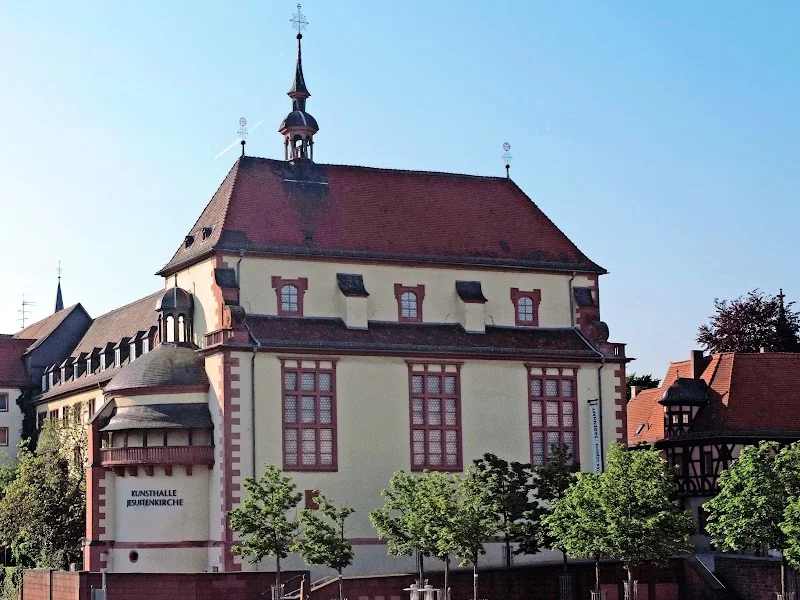
The Kunsthalle Jesuitenkirche at Pfaffengasse 26 is one of the distinctive cultural venues in Aschaffenburg. It combines a historically charged church space with a clear contemporary exhibition profile, making it much more than just a museum: Here, architecture, urban history, mediation, and changing art presentations come together. Since 1990, the Kunsthalle has been the exhibition house of the city of Aschaffenburg, and 2026 marks a special anniversary as the Kunsthalle celebrates its 50th anniversary. Together with the Christian Schad Museum, it forms a vibrant center for art and culture within the network of museums in the city of Aschaffenburg. For visitors, this means a place where historical depth and current art production do not overshadow each other but productively complement one another. Therefore, entering the Kunsthalle not only offers changing exhibitions but also a spatial and atmospheric quality that has transformed the former sacred building into something unique. The place is both regionally rooted and capable of connecting beyond the region, as it brings together classical modernism, contemporary art, and curatorial experiments under one roof. ([museen-aschaffenburg.de](https://www.museen-aschaffenburg.de/dokumente/Jahresprogramm2026-final_ansicht.pdf?utm_source=openai))
Opening Hours, Tickets, and Tours at the Kunsthalle Jesuitenkirche
For planning a visit, the current opening hours are particularly important. According to the annual program 2026, the Kunsthalle Jesuitenkirche is open on Tuesdays from 10 AM to 8 PM, Wednesdays to Sundays, and on public holidays from 10 AM to 6 PM. The house is usually closed on Mondays; additionally, there are specific closing days such as December 24, 25, and 31, January 1, and Shrove Tuesday. This regulation is pleasantly clear for visitors, as it offers a long Tuesday evening for those who want to see art after work, while also providing ample space for a relaxed museum visit on weekends. The same official material lists the admission prices at 5 euros for a single ticket and 3.50 euros reduced. Additionally, there are open tours that take place on Sundays at 11 AM and Tuesdays at 6 PM, which can be attended without prior registration. Furthermore, tours can be booked at a desired time. For public holidays, a quick look at current municipal notices is worthwhile, as they also mention opening hours for Easter or May 1, which confirm or specify the regular framework on certain days. Therefore, anyone planning a visit should ideally combine the time with an exhibition tour and a guided tour, as the combination of free tours, informative insights, and architectural experience makes the Kunsthalle so attractive. This is also a well-utilized model for families, art enthusiasts, and travel groups, as the visit can be flexibly adapted to different daily routines. ([museen-aschaffenburg.de](https://www.museen-aschaffenburg.de/dokumente/Jahresprogramm2026-final_ansicht.pdf?utm_source=openai))
Exhibitions and Program: Classical Modernism, Contemporary Art, and New Formats
The exhibition profile of the Kunsthalle Jesuitenkirche is intentionally designed for content diversity. Official documents describe the house as a place for special exhibitions on the art of classical modernism and contemporary art, with the program constantly oscillating between historical themes and contemporary questions. This mixture is typical for the Kunsthalle: it is not limited to a single subject but offers space for different perspectives, artistic signatures, and curatorial approaches. In the official materials, names such as Oskar Kokoschka, Man Ray, Markus Lüpertz, and Günther Uecker are mentioned as examples, showing that the range of the house extends from modernism to significant positions in post-war and contemporary art. The format of changing exhibitions is also important, as typically three to four exhibitions are created each year, continually providing new reasons to visit. Since summer 2025, another special element has been added: The Kunsthalle Jesuitenkirche and the Kornhäuschen Aschaffenburg will utilize a transparent glass house in the courtyard, which connects exhibition, process, and encounter in unusual ways. This creates an open space for artistic interventions, conversations, and actions, consciously expanding the classic museum situation. This is particularly relevant for search queries such as exhibition, program, or current Kunsthalle, as the place not only displays exhibits but also offers lively formats that go beyond normal museum logic. Those interested in changing art, experimental formats, and a dialogical approach will find here an exhibition space that continually provides new reasons for return visits. ([museen-aschaffenburg.de](https://www.museen-aschaffenburg.de/dokumente/MSA_Flyer_2019_web.pdf?utm_source=openai))
History of the Jesuitenkirche: From 1612 to the Kunsthalle of Today
The history of the Kunsthalle Jesuitenkirche begins long before its current use as an exhibition house. According to official documents, a Jesuit establishment was founded in Aschaffenburg in 1612 by the Archbishop of Mainz, Johann Schweikard von Kronberg; the construction of the church was promoted and completed in 1621. This created a church space that initially served as a place of worship for the Jesuits and soon after its completion was also used as a study church for the gymnasium operated by the order. In World War II, the building suffered severe damage as the bombing raids in November 1944 nearly completely destroyed the old town and also affected the Jesuitenkirche. In 1976, the space was then converted into a house for art exhibitions, marking the beginning of its modern cultural use. Since 1990, the Kunsthalle Jesuitenkirche has finally been the exhibition house of the city of Aschaffenburg, with a clear focus on classical modernism and contemporary art. The official brochure also emphasizes that the profaned sacred space, with its stucco elements, offers an impressive ambiance for modern art. This makes the history of the house so exciting: it is not just a sequence of construction and usage dates but an example of how a religious space can transform into a cultural venue with new significance after destruction and reconstruction. In 2019, this development was architecturally continued with a central entrance through the arcade courtyard, allowing the Kunsthalle and the Christian Schad Museum to be experienced as a unit. Thus, the historical Jesuitenkirche becomes a place where the past does not museally stagnate but is productively translated into the present. ([museen-aschaffenburg.de](https://www.museen-aschaffenburg.de/dokumente/KH_Jahresprogramm_2016.pdf?utm_source=openai))
Directions, Parking, and Barrier-Free Access to the Kunsthalle Jesuitenkirche
The Kunsthalle Jesuitenkirche is located in a very accessible city center location, which significantly eases arrival. Official documents state Pfaffengasse 26 as the address and indicate that the Kunsthalle is about a ten-minute walk from the main train station. Additionally, the connection via bus lines 1, 4, 6, and 10 is described, which stop at the Stadthalle station. For those arriving by car, the official materials mention the Stadthalle underground garage as a parking option; the current municipal parking notices also list the Stadthalle underground garage. Therefore, anyone looking for parking, directions, or a parking space finds a clearly named starting point for planning their visit. The architectural access through the arcade courtyard is particularly practical, as the Kunsthalle and the Christian Schad Museum share a central entrance since the opening of the joint ensemble. The official documents also indicate that barrier-free access is available, making the visit easier for different visitor groups. This combination of central location, public transport connection, urban parking options, and shared entrance situation is extremely comfortable for an art hall. For guests coming from the region, the arrival is therefore uncomplicated; for city travelers, the visit can be well combined with a walk through the city center. Thus, the search terms directions, parking, and Pfaffengasse Aschaffenburg are not only SEO-relevant but also reflect very concrete practical needs. Those planning a longer stay can also combine their museum visit with other cultural destinations in the vicinity, as the house is located right in the urban fabric of Aschaffenburg and fits excellently into a tour through the city center. ([museen-aschaffenburg.de](https://www.museen-aschaffenburg.de/dokumente/KH_Jahresprogramm_2018_Verlaengerung.pdf?utm_source=openai))
Friends of the Kunsthalle Jesuitenkirche and Mediation Offer for Visitors
An important part of the cultural identity of the Kunsthalle Jesuitenkirche is the Friends' Circle. Official documents describe it as an association that ideologically and financially supports the Kunsthalle, contributing to the possibility of exhibitions, mediation formats, and publications of this quality. Tours, artist talks, catalog productions, and the promotion of larger exhibitions are particularly highlighted. For members, there are benefits depending on the program, such as free admission, exclusive tours, and other discounts, while donations and sponsorships are also mentioned as important building blocks. This is culturally relevant as it shows that the Kunsthalle does not function in isolation but is embedded in a network of citizenship, city, and mediation. The museum education tour network of the adult education center is also mentioned in the documents and offers tours and workshops for adults, families, children, youth groups, and school classes. Thus, the Kunsthalle is not only a place to look at but also a place to understand. Especially in a location with a strong historical-architectural reference, this is an advantage, as the artworks, the space, and the history can be told together. Therefore, anyone searching for Friends' Circle, tours, or cultural participation will discover an offer that goes far beyond mere exhibition operations. This also adds depth for regular guests, as the relationship between the audience and the institution is not reduced to a one-time visit. Rather, a form of cultural community emerges, sustained by regular programs, personal mediation, and a shared interest in art. ([museen-aschaffenburg.de](https://www.museen-aschaffenburg.de/dokumente/KH_Jahresprogramm_2018_Verlaengerung.pdf?utm_source=openai))
Photos, Atmosphere, and the Unique Visitor Experience at the Kunsthalle Jesuitenkirche
Those searching for photos of the Kunsthalle Jesuitenkirche are usually looking for an impression of atmosphere, space, and special architecture. This is where the location showcases its strengths. The former sacred space with its stucco elements creates a calm yet impressive backdrop for modern art. Unlike in a neutral white cube, a tension arises here between baroque spatial effects and contemporary presentation, which is interesting for both museum visits and photographic motifs. Particularly characteristic is the connection of the historic interior, arcade courtyard, and the current glass house in the courtyard, which has served as an open stage for artistic encounters since summer 2025. This mixture of old and new creates images that do not appear artificially constructed but arise from the actual architecture and use of the house. The shared access of the Kunsthalle and the Christian Schad Museum also enhances this impression, as the visit does not end at a single facade view but continues through the courtyard and the interior. Therefore, for social media, editorial photo series, or simply the personal impression on a smartphone, the Kunsthalle offers a visually strong environment. At the same time, it is not merely a photo motif but a functioning art place with clear program logic, tours, and mediation. This double quality is what makes it appealing: One comes for the art, stays for the space, and ultimately takes away more than just a beautiful image. Therefore, anyone searching for Kunsthalle Jesuitenkirche photos or an exhibition in a special atmosphere will find a place where history and present seamlessly intertwine, making the visit memorable. ([museen-aschaffenburg.de](https://www.museen-aschaffenburg.de/dokumente/MSA_Flyer_2019_web.pdf?utm_source=openai))
Sources:
Show moreShow less
Kunsthalle Jesuitenkirche | Opening Hours & Exhibitions
The Kunsthalle Jesuitenkirche at Pfaffengasse 26 is one of the distinctive cultural venues in Aschaffenburg. It combines a historically charged church space with a clear contemporary exhibition profile, making it much more than just a museum: Here, architecture, urban history, mediation, and changing art presentations come together. Since 1990, the Kunsthalle has been the exhibition house of the city of Aschaffenburg, and 2026 marks a special anniversary as the Kunsthalle celebrates its 50th anniversary. Together with the Christian Schad Museum, it forms a vibrant center for art and culture within the network of museums in the city of Aschaffenburg. For visitors, this means a place where historical depth and current art production do not overshadow each other but productively complement one another. Therefore, entering the Kunsthalle not only offers changing exhibitions but also a spatial and atmospheric quality that has transformed the former sacred building into something unique. The place is both regionally rooted and capable of connecting beyond the region, as it brings together classical modernism, contemporary art, and curatorial experiments under one roof. ([museen-aschaffenburg.de](https://www.museen-aschaffenburg.de/dokumente/Jahresprogramm2026-final_ansicht.pdf?utm_source=openai))
Opening Hours, Tickets, and Tours at the Kunsthalle Jesuitenkirche
For planning a visit, the current opening hours are particularly important. According to the annual program 2026, the Kunsthalle Jesuitenkirche is open on Tuesdays from 10 AM to 8 PM, Wednesdays to Sundays, and on public holidays from 10 AM to 6 PM. The house is usually closed on Mondays; additionally, there are specific closing days such as December 24, 25, and 31, January 1, and Shrove Tuesday. This regulation is pleasantly clear for visitors, as it offers a long Tuesday evening for those who want to see art after work, while also providing ample space for a relaxed museum visit on weekends. The same official material lists the admission prices at 5 euros for a single ticket and 3.50 euros reduced. Additionally, there are open tours that take place on Sundays at 11 AM and Tuesdays at 6 PM, which can be attended without prior registration. Furthermore, tours can be booked at a desired time. For public holidays, a quick look at current municipal notices is worthwhile, as they also mention opening hours for Easter or May 1, which confirm or specify the regular framework on certain days. Therefore, anyone planning a visit should ideally combine the time with an exhibition tour and a guided tour, as the combination of free tours, informative insights, and architectural experience makes the Kunsthalle so attractive. This is also a well-utilized model for families, art enthusiasts, and travel groups, as the visit can be flexibly adapted to different daily routines. ([museen-aschaffenburg.de](https://www.museen-aschaffenburg.de/dokumente/Jahresprogramm2026-final_ansicht.pdf?utm_source=openai))
Exhibitions and Program: Classical Modernism, Contemporary Art, and New Formats
The exhibition profile of the Kunsthalle Jesuitenkirche is intentionally designed for content diversity. Official documents describe the house as a place for special exhibitions on the art of classical modernism and contemporary art, with the program constantly oscillating between historical themes and contemporary questions. This mixture is typical for the Kunsthalle: it is not limited to a single subject but offers space for different perspectives, artistic signatures, and curatorial approaches. In the official materials, names such as Oskar Kokoschka, Man Ray, Markus Lüpertz, and Günther Uecker are mentioned as examples, showing that the range of the house extends from modernism to significant positions in post-war and contemporary art. The format of changing exhibitions is also important, as typically three to four exhibitions are created each year, continually providing new reasons to visit. Since summer 2025, another special element has been added: The Kunsthalle Jesuitenkirche and the Kornhäuschen Aschaffenburg will utilize a transparent glass house in the courtyard, which connects exhibition, process, and encounter in unusual ways. This creates an open space for artistic interventions, conversations, and actions, consciously expanding the classic museum situation. This is particularly relevant for search queries such as exhibition, program, or current Kunsthalle, as the place not only displays exhibits but also offers lively formats that go beyond normal museum logic. Those interested in changing art, experimental formats, and a dialogical approach will find here an exhibition space that continually provides new reasons for return visits. ([museen-aschaffenburg.de](https://www.museen-aschaffenburg.de/dokumente/MSA_Flyer_2019_web.pdf?utm_source=openai))
History of the Jesuitenkirche: From 1612 to the Kunsthalle of Today
The history of the Kunsthalle Jesuitenkirche begins long before its current use as an exhibition house. According to official documents, a Jesuit establishment was founded in Aschaffenburg in 1612 by the Archbishop of Mainz, Johann Schweikard von Kronberg; the construction of the church was promoted and completed in 1621. This created a church space that initially served as a place of worship for the Jesuits and soon after its completion was also used as a study church for the gymnasium operated by the order. In World War II, the building suffered severe damage as the bombing raids in November 1944 nearly completely destroyed the old town and also affected the Jesuitenkirche. In 1976, the space was then converted into a house for art exhibitions, marking the beginning of its modern cultural use. Since 1990, the Kunsthalle Jesuitenkirche has finally been the exhibition house of the city of Aschaffenburg, with a clear focus on classical modernism and contemporary art. The official brochure also emphasizes that the profaned sacred space, with its stucco elements, offers an impressive ambiance for modern art. This makes the history of the house so exciting: it is not just a sequence of construction and usage dates but an example of how a religious space can transform into a cultural venue with new significance after destruction and reconstruction. In 2019, this development was architecturally continued with a central entrance through the arcade courtyard, allowing the Kunsthalle and the Christian Schad Museum to be experienced as a unit. Thus, the historical Jesuitenkirche becomes a place where the past does not museally stagnate but is productively translated into the present. ([museen-aschaffenburg.de](https://www.museen-aschaffenburg.de/dokumente/KH_Jahresprogramm_2016.pdf?utm_source=openai))
Directions, Parking, and Barrier-Free Access to the Kunsthalle Jesuitenkirche
The Kunsthalle Jesuitenkirche is located in a very accessible city center location, which significantly eases arrival. Official documents state Pfaffengasse 26 as the address and indicate that the Kunsthalle is about a ten-minute walk from the main train station. Additionally, the connection via bus lines 1, 4, 6, and 10 is described, which stop at the Stadthalle station. For those arriving by car, the official materials mention the Stadthalle underground garage as a parking option; the current municipal parking notices also list the Stadthalle underground garage. Therefore, anyone looking for parking, directions, or a parking space finds a clearly named starting point for planning their visit. The architectural access through the arcade courtyard is particularly practical, as the Kunsthalle and the Christian Schad Museum share a central entrance since the opening of the joint ensemble. The official documents also indicate that barrier-free access is available, making the visit easier for different visitor groups. This combination of central location, public transport connection, urban parking options, and shared entrance situation is extremely comfortable for an art hall. For guests coming from the region, the arrival is therefore uncomplicated; for city travelers, the visit can be well combined with a walk through the city center. Thus, the search terms directions, parking, and Pfaffengasse Aschaffenburg are not only SEO-relevant but also reflect very concrete practical needs. Those planning a longer stay can also combine their museum visit with other cultural destinations in the vicinity, as the house is located right in the urban fabric of Aschaffenburg and fits excellently into a tour through the city center. ([museen-aschaffenburg.de](https://www.museen-aschaffenburg.de/dokumente/KH_Jahresprogramm_2018_Verlaengerung.pdf?utm_source=openai))
Friends of the Kunsthalle Jesuitenkirche and Mediation Offer for Visitors
An important part of the cultural identity of the Kunsthalle Jesuitenkirche is the Friends' Circle. Official documents describe it as an association that ideologically and financially supports the Kunsthalle, contributing to the possibility of exhibitions, mediation formats, and publications of this quality. Tours, artist talks, catalog productions, and the promotion of larger exhibitions are particularly highlighted. For members, there are benefits depending on the program, such as free admission, exclusive tours, and other discounts, while donations and sponsorships are also mentioned as important building blocks. This is culturally relevant as it shows that the Kunsthalle does not function in isolation but is embedded in a network of citizenship, city, and mediation. The museum education tour network of the adult education center is also mentioned in the documents and offers tours and workshops for adults, families, children, youth groups, and school classes. Thus, the Kunsthalle is not only a place to look at but also a place to understand. Especially in a location with a strong historical-architectural reference, this is an advantage, as the artworks, the space, and the history can be told together. Therefore, anyone searching for Friends' Circle, tours, or cultural participation will discover an offer that goes far beyond mere exhibition operations. This also adds depth for regular guests, as the relationship between the audience and the institution is not reduced to a one-time visit. Rather, a form of cultural community emerges, sustained by regular programs, personal mediation, and a shared interest in art. ([museen-aschaffenburg.de](https://www.museen-aschaffenburg.de/dokumente/KH_Jahresprogramm_2018_Verlaengerung.pdf?utm_source=openai))
Photos, Atmosphere, and the Unique Visitor Experience at the Kunsthalle Jesuitenkirche
Those searching for photos of the Kunsthalle Jesuitenkirche are usually looking for an impression of atmosphere, space, and special architecture. This is where the location showcases its strengths. The former sacred space with its stucco elements creates a calm yet impressive backdrop for modern art. Unlike in a neutral white cube, a tension arises here between baroque spatial effects and contemporary presentation, which is interesting for both museum visits and photographic motifs. Particularly characteristic is the connection of the historic interior, arcade courtyard, and the current glass house in the courtyard, which has served as an open stage for artistic encounters since summer 2025. This mixture of old and new creates images that do not appear artificially constructed but arise from the actual architecture and use of the house. The shared access of the Kunsthalle and the Christian Schad Museum also enhances this impression, as the visit does not end at a single facade view but continues through the courtyard and the interior. Therefore, for social media, editorial photo series, or simply the personal impression on a smartphone, the Kunsthalle offers a visually strong environment. At the same time, it is not merely a photo motif but a functioning art place with clear program logic, tours, and mediation. This double quality is what makes it appealing: One comes for the art, stays for the space, and ultimately takes away more than just a beautiful image. Therefore, anyone searching for Kunsthalle Jesuitenkirche photos or an exhibition in a special atmosphere will find a place where history and present seamlessly intertwine, making the visit memorable. ([museen-aschaffenburg.de](https://www.museen-aschaffenburg.de/dokumente/MSA_Flyer_2019_web.pdf?utm_source=openai))
Sources:
Kunsthalle Jesuitenkirche | Opening Hours & Exhibitions
The Kunsthalle Jesuitenkirche at Pfaffengasse 26 is one of the distinctive cultural venues in Aschaffenburg. It combines a historically charged church space with a clear contemporary exhibition profile, making it much more than just a museum: Here, architecture, urban history, mediation, and changing art presentations come together. Since 1990, the Kunsthalle has been the exhibition house of the city of Aschaffenburg, and 2026 marks a special anniversary as the Kunsthalle celebrates its 50th anniversary. Together with the Christian Schad Museum, it forms a vibrant center for art and culture within the network of museums in the city of Aschaffenburg. For visitors, this means a place where historical depth and current art production do not overshadow each other but productively complement one another. Therefore, entering the Kunsthalle not only offers changing exhibitions but also a spatial and atmospheric quality that has transformed the former sacred building into something unique. The place is both regionally rooted and capable of connecting beyond the region, as it brings together classical modernism, contemporary art, and curatorial experiments under one roof. ([museen-aschaffenburg.de](https://www.museen-aschaffenburg.de/dokumente/Jahresprogramm2026-final_ansicht.pdf?utm_source=openai))
Opening Hours, Tickets, and Tours at the Kunsthalle Jesuitenkirche
For planning a visit, the current opening hours are particularly important. According to the annual program 2026, the Kunsthalle Jesuitenkirche is open on Tuesdays from 10 AM to 8 PM, Wednesdays to Sundays, and on public holidays from 10 AM to 6 PM. The house is usually closed on Mondays; additionally, there are specific closing days such as December 24, 25, and 31, January 1, and Shrove Tuesday. This regulation is pleasantly clear for visitors, as it offers a long Tuesday evening for those who want to see art after work, while also providing ample space for a relaxed museum visit on weekends. The same official material lists the admission prices at 5 euros for a single ticket and 3.50 euros reduced. Additionally, there are open tours that take place on Sundays at 11 AM and Tuesdays at 6 PM, which can be attended without prior registration. Furthermore, tours can be booked at a desired time. For public holidays, a quick look at current municipal notices is worthwhile, as they also mention opening hours for Easter or May 1, which confirm or specify the regular framework on certain days. Therefore, anyone planning a visit should ideally combine the time with an exhibition tour and a guided tour, as the combination of free tours, informative insights, and architectural experience makes the Kunsthalle so attractive. This is also a well-utilized model for families, art enthusiasts, and travel groups, as the visit can be flexibly adapted to different daily routines. ([museen-aschaffenburg.de](https://www.museen-aschaffenburg.de/dokumente/Jahresprogramm2026-final_ansicht.pdf?utm_source=openai))
Exhibitions and Program: Classical Modernism, Contemporary Art, and New Formats
The exhibition profile of the Kunsthalle Jesuitenkirche is intentionally designed for content diversity. Official documents describe the house as a place for special exhibitions on the art of classical modernism and contemporary art, with the program constantly oscillating between historical themes and contemporary questions. This mixture is typical for the Kunsthalle: it is not limited to a single subject but offers space for different perspectives, artistic signatures, and curatorial approaches. In the official materials, names such as Oskar Kokoschka, Man Ray, Markus Lüpertz, and Günther Uecker are mentioned as examples, showing that the range of the house extends from modernism to significant positions in post-war and contemporary art. The format of changing exhibitions is also important, as typically three to four exhibitions are created each year, continually providing new reasons to visit. Since summer 2025, another special element has been added: The Kunsthalle Jesuitenkirche and the Kornhäuschen Aschaffenburg will utilize a transparent glass house in the courtyard, which connects exhibition, process, and encounter in unusual ways. This creates an open space for artistic interventions, conversations, and actions, consciously expanding the classic museum situation. This is particularly relevant for search queries such as exhibition, program, or current Kunsthalle, as the place not only displays exhibits but also offers lively formats that go beyond normal museum logic. Those interested in changing art, experimental formats, and a dialogical approach will find here an exhibition space that continually provides new reasons for return visits. ([museen-aschaffenburg.de](https://www.museen-aschaffenburg.de/dokumente/MSA_Flyer_2019_web.pdf?utm_source=openai))
History of the Jesuitenkirche: From 1612 to the Kunsthalle of Today
The history of the Kunsthalle Jesuitenkirche begins long before its current use as an exhibition house. According to official documents, a Jesuit establishment was founded in Aschaffenburg in 1612 by the Archbishop of Mainz, Johann Schweikard von Kronberg; the construction of the church was promoted and completed in 1621. This created a church space that initially served as a place of worship for the Jesuits and soon after its completion was also used as a study church for the gymnasium operated by the order. In World War II, the building suffered severe damage as the bombing raids in November 1944 nearly completely destroyed the old town and also affected the Jesuitenkirche. In 1976, the space was then converted into a house for art exhibitions, marking the beginning of its modern cultural use. Since 1990, the Kunsthalle Jesuitenkirche has finally been the exhibition house of the city of Aschaffenburg, with a clear focus on classical modernism and contemporary art. The official brochure also emphasizes that the profaned sacred space, with its stucco elements, offers an impressive ambiance for modern art. This makes the history of the house so exciting: it is not just a sequence of construction and usage dates but an example of how a religious space can transform into a cultural venue with new significance after destruction and reconstruction. In 2019, this development was architecturally continued with a central entrance through the arcade courtyard, allowing the Kunsthalle and the Christian Schad Museum to be experienced as a unit. Thus, the historical Jesuitenkirche becomes a place where the past does not museally stagnate but is productively translated into the present. ([museen-aschaffenburg.de](https://www.museen-aschaffenburg.de/dokumente/KH_Jahresprogramm_2016.pdf?utm_source=openai))
Directions, Parking, and Barrier-Free Access to the Kunsthalle Jesuitenkirche
The Kunsthalle Jesuitenkirche is located in a very accessible city center location, which significantly eases arrival. Official documents state Pfaffengasse 26 as the address and indicate that the Kunsthalle is about a ten-minute walk from the main train station. Additionally, the connection via bus lines 1, 4, 6, and 10 is described, which stop at the Stadthalle station. For those arriving by car, the official materials mention the Stadthalle underground garage as a parking option; the current municipal parking notices also list the Stadthalle underground garage. Therefore, anyone looking for parking, directions, or a parking space finds a clearly named starting point for planning their visit. The architectural access through the arcade courtyard is particularly practical, as the Kunsthalle and the Christian Schad Museum share a central entrance since the opening of the joint ensemble. The official documents also indicate that barrier-free access is available, making the visit easier for different visitor groups. This combination of central location, public transport connection, urban parking options, and shared entrance situation is extremely comfortable for an art hall. For guests coming from the region, the arrival is therefore uncomplicated; for city travelers, the visit can be well combined with a walk through the city center. Thus, the search terms directions, parking, and Pfaffengasse Aschaffenburg are not only SEO-relevant but also reflect very concrete practical needs. Those planning a longer stay can also combine their museum visit with other cultural destinations in the vicinity, as the house is located right in the urban fabric of Aschaffenburg and fits excellently into a tour through the city center. ([museen-aschaffenburg.de](https://www.museen-aschaffenburg.de/dokumente/KH_Jahresprogramm_2018_Verlaengerung.pdf?utm_source=openai))
Friends of the Kunsthalle Jesuitenkirche and Mediation Offer for Visitors
An important part of the cultural identity of the Kunsthalle Jesuitenkirche is the Friends' Circle. Official documents describe it as an association that ideologically and financially supports the Kunsthalle, contributing to the possibility of exhibitions, mediation formats, and publications of this quality. Tours, artist talks, catalog productions, and the promotion of larger exhibitions are particularly highlighted. For members, there are benefits depending on the program, such as free admission, exclusive tours, and other discounts, while donations and sponsorships are also mentioned as important building blocks. This is culturally relevant as it shows that the Kunsthalle does not function in isolation but is embedded in a network of citizenship, city, and mediation. The museum education tour network of the adult education center is also mentioned in the documents and offers tours and workshops for adults, families, children, youth groups, and school classes. Thus, the Kunsthalle is not only a place to look at but also a place to understand. Especially in a location with a strong historical-architectural reference, this is an advantage, as the artworks, the space, and the history can be told together. Therefore, anyone searching for Friends' Circle, tours, or cultural participation will discover an offer that goes far beyond mere exhibition operations. This also adds depth for regular guests, as the relationship between the audience and the institution is not reduced to a one-time visit. Rather, a form of cultural community emerges, sustained by regular programs, personal mediation, and a shared interest in art. ([museen-aschaffenburg.de](https://www.museen-aschaffenburg.de/dokumente/KH_Jahresprogramm_2018_Verlaengerung.pdf?utm_source=openai))
Photos, Atmosphere, and the Unique Visitor Experience at the Kunsthalle Jesuitenkirche
Those searching for photos of the Kunsthalle Jesuitenkirche are usually looking for an impression of atmosphere, space, and special architecture. This is where the location showcases its strengths. The former sacred space with its stucco elements creates a calm yet impressive backdrop for modern art. Unlike in a neutral white cube, a tension arises here between baroque spatial effects and contemporary presentation, which is interesting for both museum visits and photographic motifs. Particularly characteristic is the connection of the historic interior, arcade courtyard, and the current glass house in the courtyard, which has served as an open stage for artistic encounters since summer 2025. This mixture of old and new creates images that do not appear artificially constructed but arise from the actual architecture and use of the house. The shared access of the Kunsthalle and the Christian Schad Museum also enhances this impression, as the visit does not end at a single facade view but continues through the courtyard and the interior. Therefore, for social media, editorial photo series, or simply the personal impression on a smartphone, the Kunsthalle offers a visually strong environment. At the same time, it is not merely a photo motif but a functioning art place with clear program logic, tours, and mediation. This double quality is what makes it appealing: One comes for the art, stays for the space, and ultimately takes away more than just a beautiful image. Therefore, anyone searching for Kunsthalle Jesuitenkirche photos or an exhibition in a special atmosphere will find a place where history and present seamlessly intertwine, making the visit memorable. ([museen-aschaffenburg.de](https://www.museen-aschaffenburg.de/dokumente/MSA_Flyer_2019_web.pdf?utm_source=openai))
Sources:
Frequently Asked Questions
Reviews
Isla Rylee
16. November 2025
Do you need a review
Eugenia K
16. March 2025
Art gallery in the building of the Jesuit church in Aschaffenburg. In 1944, the church building was seriously damaged during air raids. In 1976, the city acquired the church building and organized an art space here.
Carlitos Holzinger
19. January 2026
We made a short visit since it was being renovated. The staff was very friendly and explained everything to us in detail. Only part of it was open, but it was explained very well. We will come back after the renovation. We are already looking forward to it.
Philip
4. June 2022
Always worth seeing exhibitions, although in a small space. The special thing about the art hall is the space itself, the former Jesuit church. You don't have to have been there, but if you have a little time in Aschaffenburg, you might just get lucky with a noteworthy and rarely crowded exhibition.
Techtex Kalender
4. February 2026
Great location. Perfect for exhibition, meeting, or presentation