
Aschaffenburg
Schloßgasse 26, 63739 Aschaffenburg, Deutschland
Aschaffenburg Old Town | Photos & Reviews
The Aschaffenburg Old Town is not a place to just pass through quickly, but a historic urban space that unfolds its full effect while walking, looking, and discovering. Official city and tourism sources describe the area as a romantic old town on the Stiftsberg, extending around the town hall to the Johannisburg Castle. At the same time, the upper town is the original old town core on a triangular plateau between the Main, Löhergraben, Landing, and Schloßberggraben. It is precisely this location that creates its special charm: short distances, clear axes, winding alleys, historic buildings, and an urban life that moves between culture, gastronomy, and everyday life. Those searching for photos, images, or reviews of Aschaffenburg Old Town are often looking for the same mix of atmosphere, history, and good accessibility. The old town is particularly suitable for this because it offers both the major landmarks of the city and many small details that catch the eye and appear even stronger in pictures. ([aschaffenburg.de](https://www.aschaffenburg.de/PDF/Text.PDF?Ext=PDF&ObjID=1745&ObjLa=1&ObjSvrID=4173&WTR=1&_ts=1761639684))
Photos and Images of Aschaffenburg Old Town
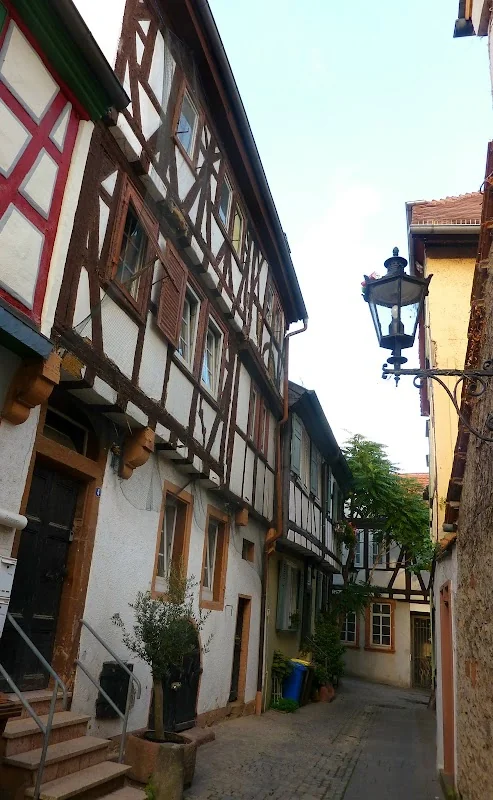
Those searching for images of Aschaffenburg Old Town primarily find a backdrop of half-timbered houses, sandstone, quiet squares, and clear sightlines. The city itself describes the old town as a place with dreamy alleys, historic half-timbered houses, and numerous pubs and bistros on Dalbergstraße; it invites walking, photographing, and dining. For the visual language of the old town, this mix is crucial: it is not a pure museum space, but a vibrant urban core with historic character. Particularly striking are the areas around Schloßgasse, Pfaffengasse, Stiftsplatz, and Dalbergstraße, as sightlines open up between the castle, the collegiate church, and the surrounding alleys. Pfaffengasse forms a sightline between the collegiate church and Johannisburg Castle, which is a strong motif for photographers and visitors. The official reference to the old town as part of the attractions in Aschaffenburg also shows that this area is understood not just as a passageway, but as a central urban image motif. Therefore, those looking for authentic photos should not only capture the famous panorama but also details like cobblestones, facades, gables, house numbers, and the transitions between the small streets. ([aschaffenburg.de](https://www.aschaffenburg.de/Kultur-und-Tourismus/Stadtportrait/DE_index_3892.html?v_all=on&v_bis=&v_kal=01.04.2021&v_von=13.04.2021))
Particularly strong motifs arise where the old town shows its historic topography. The upper town is situated on a high plateau and is urbanistically shaped by the castle, town hall, and collegiate church. The ensemble of the upper town encompasses the area between the Main, Löhergraben, Landing, and Schloßberggraben; to the south lies the older ecclesiastical center with the collegiate church, and to the north the castle. This sequence makes the old town photographically exciting because a single image often brings together several layers of time: medieval structure, baroque and neoclassical elements, reconstruction after the destruction of World War II, and today's use with gastronomy and public spaces. In the official city texts, the old town is explicitly described as a historically grown but simultaneously modern-utilized center. This is important for images because the backdrop does not appear artificially staged but comes from real urban life. Those searching for motifs for social media, travel blogs, or Google reviews will therefore find not only iconic buildings but also quieter motifs: stairs, passages, small signs, shadows in the alleys, and the transition between open squares and narrower streets. ([aschaffenburg.de](https://www.aschaffenburg.de/PDF/Text.PDF?Ext=PDF&ObjID=1745&ObjLa=1&ObjSvrID=4173&WTR=1&_ts=1761639684))
Aschaffenburg Old Town Friends e.V. and Monument Protection
The Aschaffenburg Old Town Friends are closely connected to the topics of preservation, monument conservation, and urban image. In municipal sources, they are mentioned in connection with the monument award and initiatives for a harmonious urban image. This shows that the care of the old town in Aschaffenburg is not only an administrative task but is also supported by civic engagement. Especially for an old town with so many listed buildings, this is an important point, as the city describes the historic core as a finely structured medieval layout with a variety of preserved buildings. In the preparatory studies for the upper town, it is also emphasized that much has already been financed from private sources and that owners place great value on preserving the historical form. The Old Town Friends thus symbolize an attitude that understands the old town not just as a backdrop but as cultural heritage. For those searching for Aschaffenburg Old Town Friends e.V. or Old Town Friends Aschaffenburg, this is the central classification: it is about preserving the historical urban form and projects that leave visible traces in the urban space. ([aschaffenburg.de](https://www.aschaffenburg.de/PDF/Text.PDF?Ext=PDF&ObjID=1745&ObjLa=1&ObjSvrID=4173&WTR=1&_ts=1761639684&utm_source=openai))
A concrete example of this engagement is the reference to reconstruction and preservation initiatives in the Schönthal and city center areas. Municipal publications mention that the Aschaffenburg Old Town Friends and the History and Art Association provided suggestions for a reconstruction and participated financially in projects. Such references make it clear that the activities of the association go beyond mere historical work and include concrete urban image care. This is interesting for visitors because many of the fine details that are taken for granted today have only remained visible because local actors have advocated for them. This also fits with the official city description of the old town as an area with half-timbered houses, historic street scenes, and a strong connection to the city's history. Therefore, those visiting the old town with open eyes do not simply see old houses but a well-maintained, continuously discussed, and carefully developed ensemble. This is the background that should be kept in mind for search terms like Old Town Friends, monument protection, or urban image. ([aschaffenburg.de](https://www.aschaffenburg.de/dokumente/Aktuelles/Zeitungen-und-Broschueren/BueZ_201004.pdf?utm_source=openai))
Reviews, Atmosphere, and Historical Character
In reviews of Aschaffenburg Old Town, less hard data is typically in the foreground than the feeling that the place evokes. The official descriptions already provide the key terms: romantic old town, dreamy alleys, historic half-timbered houses, pubs, bistros, walking, photographing, and dining. Those looking for an old town with a special atmosphere find here a city center that is neither monumental nor sterile, but walkable, approachable, and diverse. The historic center is also located in the immediate vicinity of important urban functions such as the town hall and cultural institutions, allowing history and the present to overlap. This combination makes the place attractive for many visitors: one can take a short stroll through the city, deliberately take photos, grab a bite to eat in between, and then continue to other attractions. When someone searches for reviews, they usually want to know whether the old town is more touristy, cozy, photogenic, or lively. The municipal sources answer this indirectly very clearly: they emphasize walks, photographic motifs, and dining options and describe the old town as a place where historic ambiance and urban life complement each other meaningfully. ([aschaffenburg.de](https://www.aschaffenburg.de/Kultur-und-Tourismus/Stadtportrait/DE_index_3892.html?v_all=on&v_bis=&v_kal=01.04.2021&v_von=13.04.2021))
The historical character of the old town is not just a backdrop but a real urban quality. The upper town is referred to in official studies as the centerpiece of Aschaffenburg Old Town with its medieval structure. At the same time, it is described as a location for public institutions, living, working, and tourism. This is important for everyday perception because it preserves the old town from a purely event or postcard function. Such a balance is often positively received in reviews: one does not just want to see sights but also to orient oneself, pause, and gain an authentic impression of the city. The fact that the old town was largely restored and modernized after the destruction of World War II also explains why it does not appear historically overloaded or inaccessible. Visitors experience an urban space where old building substance, reconstruction, traffic, gastronomy, and administration stand in close proximity. This makes the old town interesting for different target groups: for history enthusiasts, photographers, walkers, families, and anyone looking for a well-maintained city image. ([aschaffenburg.de](https://www.aschaffenburg.de/PDF/Text.PDF?Ext=PDF&ObjID=1745&ObjLa=1&ObjSvrID=4173&WTR=1&_ts=1761639684))
Access and Parking in Aschaffenburg Old Town
The access to Aschaffenburg Old Town is clearly oriented towards its central location in the city center. The city describes Dalbergstraße as a collection street and main connection of the upper town; it leads from the Main through the old town to Freihofsplatz. At the same time, Schloßstraße and Pfaffengasse are mentioned as important access axes. For visitors, this means: the old town is generally very well accessible on foot, by bicycle, by car, and via public transport. Municipal studies also explicitly emphasize that the upper town is well reachable for visitors both by public transport and by their own car or on foot or by bike due to its location. Additionally, Dalbergstraße is partially reduced to 30 km/h and designated as a traffic-calmed area. This underscores that the old town is understood more as a pedestrian and recreational area than as a pure transit space. Therefore, those searching for access to Aschaffenburg Old Town should not only rely on the address but also consider the city-center traffic management: short distances but consciously calmed zones. ([aschaffenburg.de](https://www.aschaffenburg.de/loadDocument.phtml?Ext=PDF&FID=4173.1745.1))
When it comes to parking, the city mentions several concrete options in the vicinity of the upper town. The planning documents list the underground garage Theaterplatz with 186 parking spaces, the parking garage Löherstraße with 377 parking spaces, and the Suicardus parking lot with about 300 spaces. Additionally, disabled parking spaces are available in front of public facilities, and tour buses can park at Schlossplatz and Willigisbrücke. For visitors who are only aiming for a stroll or photos in the old town, these are well-utilizable anchor points because they provide access to the old town on foot without having to drive through the tightest historical core. According to the city, the underground garage Theaterplatz is particularly used by theater visitors due to its central location, while the parking garage Löhergraben regularly has available capacities. This mix of parking spaces, traffic-calmed streets, and a clear pedestrian network is crucial for those searching for parking in Aschaffenburg Old Town. It allows for a stress-free visit and makes the old town attractive even for shorter stays. ([aschaffenburg.de](https://www.aschaffenburg.de/loadDocument.phtml?Ext=PDF&FID=4173.1745.1))
Schloßgasse, Stiftsplatz, and the Historical Structure
The historical structure of Aschaffenburg Old Town becomes particularly clear when looking at Schloßgasse and the neighboring streets. Schloßgasse runs parallel to Pfaffengasse between Schloßplatz and Dalbergstraße and is a main artery on the elevation that accommodates the old town, the upper town. The city archive documentation explains that it, along with Pfaffengasse, belongs to the streets that were likely established in connection with an initial civic settlement around the parish of Our Lady. The name is explained by its location at the castle; previously, the street was called Große or Neue Webergasse because it once housed a quarter of textile craftsmen. This beautifully illustrates how closely city history, craftsmanship, and topography are connected in Aschaffenburg. For search queries like Schloßgasse Aschaffenburg or Stiftsplatz Aschaffenburg, this is the actual relevance: these places are not randomly famous street names but carry the urban development in their layout. ([aschaffenburgzweinull.stadtarchiv-digital.de](https://aschaffenburgzweinull.stadtarchiv-digital.de/schlossgasse/))
The larger contexts of the old town are also very clearly described in the official sources. The ensemble of the upper town encompasses the triangular plateau between the Main, Löhergraben, Landing, and Schloßberggraben; in the center rises the parish church of the Mother of God, to the north the castle, and to the south the collegiate church. This structure explains why the old town is so easily accessible on foot and why it appears so compact despite its historical character. Pfaffengasse connects Dalbergstraße with Schloßplatz and forms a sightline between the collegiate church and Johannisburg Castle. The Stiftsplatz, in turn, is described as a historic gathering space in front of the collegiate church, including the Stiftsbrunnen and the proximity to other cultural institutions. Therefore, anyone wanting to understand the old town should not only look at buildings but also read the axes between them: from the castle to the collegiate church, from Dalbergstraße into the alleys, from the historic core down to the Main. This readability makes the old town so valuable for walks, city tours, and photo tours. ([aschaffenburgzweinull.stadtarchiv-digital.de](https://aschaffenburgzweinull.stadtarchiv-digital.de/ensemble-oberstadt/))
Walks, Attractions, and Visitor Tips
A visit to Aschaffenburg Old Town is particularly worthwhile when planned as a walk rather than a mere transit. The official city description emphasizes that the romantic old town on the Stiftsberg extends around the town hall to Johannisburg Castle. The defining attractions include not only the alleys themselves but also Johannisburg Castle as the city's landmark, the collegiate church with its historic surroundings, and the cultural institutions around it. The city also points to its information offerings for tourists, city tours, and the digital city map of the app hallo aschaffenburg, which offers special places with images, short audio texts, and routes. This is practical for visitors because one can experience the old town both spontaneously and guided. Therefore, those searching for attractions in Aschaffenburg Old Town should not only target individual buildings but choose a small route that leads from the castle and Stiftsplatz through Dalbergstraße and Schloßgasse further into the alleys. ([aschaffenburg.de](https://www.aschaffenburg.de/Kultur-und-Tourismus/Stadtportrait/DE_index_3892.html?v_all=on&v_bis=&v_kal=01.04.2021&v_von=13.04.2021))
Visitor tips also arise from the mix of history and everyday life. According to the city and tourism site, the old town is a place for restaurants, pubs, and bistros, but also for city history and architecture. This makes it ideal for a visit in the late morning, afternoon, or early evening when light, movement, and gastronomy fit particularly well together. For photos, the quieter moments in the alleys are often the best, while the squares around the town hall, collegiate church, and Schloßgasse offer a lively urban scene. Those wanting to delve deeper into the background will find further information on the city’s history, the upper town ensemble, and individual streets and buildings in the municipal archives and tourism offerings. Thus, a simple stroll through the old town quickly turns into a very dense city tour: historic topography, restored building substance, visible sightlines, green islands, and current uses interconnect. This connection makes Aschaffenburg Old Town so interesting for travelers, locals, and anyone searching for authentic Aschaffenburg Old Town images or reviews. ([frankfurt-rhein-main.de](https://www.frankfurt-rhein-main.de/poi/altstadt-aschaffenburg))
Sources:
- City of Aschaffenburg – City Portrait, Culture and Tourism, City Center and Parking ([aschaffenburg.de](https://www.aschaffenburg.de/Kultur-und-Tourismus/Stadtportrait/DE_index_3892.html?v_all=on&v_bis=&v_kal=01.04.2021&v_von=13.04.2021))
- Aschaffenburg Digital City Archive – Schloßgasse, Upper Town Ensemble, Pfaffengasse, Stiftsbrunnen ([aschaffenburgzweinull.stadtarchiv-digital.de](https://aschaffenburgzweinull.stadtarchiv-digital.de/schlossgasse/))
- City of Aschaffenburg – Preparatory Studies ISEK Upper Town and Main River ([aschaffenburg.de](https://www.aschaffenburg.de/PDF/Text.PDF?Ext=PDF&ObjID=1745&ObjLa=1&ObjSvrID=4173&WTR=1&_ts=1761639684))
- Frankfurt Rhein-Main and municipal tourism information on Aschaffenburg Old Town ([frankfurt-rhein-main.de](https://www.frankfurt-rhein-main.de/poi/altstadt-aschaffenburg))
- City of Aschaffenburg – Information on Old Town Friends, Monument Award, and Urban Image Care ([aschaffenburg.de](https://www.aschaffenburg.de/dokumente/Aktuelles/Zeitungen-und-Broschueren/BueZ_201004.pdf?utm_source=openai))
Mehr anzeigenWeniger anzeigen
Aschaffenburg Old Town | Photos & Reviews
The Aschaffenburg Old Town is not a place to just pass through quickly, but a historic urban space that unfolds its full effect while walking, looking, and discovering. Official city and tourism sources describe the area as a romantic old town on the Stiftsberg, extending around the town hall to the Johannisburg Castle. At the same time, the upper town is the original old town core on a triangular plateau between the Main, Löhergraben, Landing, and Schloßberggraben. It is precisely this location that creates its special charm: short distances, clear axes, winding alleys, historic buildings, and an urban life that moves between culture, gastronomy, and everyday life. Those searching for photos, images, or reviews of Aschaffenburg Old Town are often looking for the same mix of atmosphere, history, and good accessibility. The old town is particularly suitable for this because it offers both the major landmarks of the city and many small details that catch the eye and appear even stronger in pictures. ([aschaffenburg.de](https://www.aschaffenburg.de/PDF/Text.PDF?Ext=PDF&ObjID=1745&ObjLa=1&ObjSvrID=4173&WTR=1&_ts=1761639684))
Photos and Images of Aschaffenburg Old Town
Those searching for images of Aschaffenburg Old Town primarily find a backdrop of half-timbered houses, sandstone, quiet squares, and clear sightlines. The city itself describes the old town as a place with dreamy alleys, historic half-timbered houses, and numerous pubs and bistros on Dalbergstraße; it invites walking, photographing, and dining. For the visual language of the old town, this mix is crucial: it is not a pure museum space, but a vibrant urban core with historic character. Particularly striking are the areas around Schloßgasse, Pfaffengasse, Stiftsplatz, and Dalbergstraße, as sightlines open up between the castle, the collegiate church, and the surrounding alleys. Pfaffengasse forms a sightline between the collegiate church and Johannisburg Castle, which is a strong motif for photographers and visitors. The official reference to the old town as part of the attractions in Aschaffenburg also shows that this area is understood not just as a passageway, but as a central urban image motif. Therefore, those looking for authentic photos should not only capture the famous panorama but also details like cobblestones, facades, gables, house numbers, and the transitions between the small streets. ([aschaffenburg.de](https://www.aschaffenburg.de/Kultur-und-Tourismus/Stadtportrait/DE_index_3892.html?v_all=on&v_bis=&v_kal=01.04.2021&v_von=13.04.2021))
Particularly strong motifs arise where the old town shows its historic topography. The upper town is situated on a high plateau and is urbanistically shaped by the castle, town hall, and collegiate church. The ensemble of the upper town encompasses the area between the Main, Löhergraben, Landing, and Schloßberggraben; to the south lies the older ecclesiastical center with the collegiate church, and to the north the castle. This sequence makes the old town photographically exciting because a single image often brings together several layers of time: medieval structure, baroque and neoclassical elements, reconstruction after the destruction of World War II, and today's use with gastronomy and public spaces. In the official city texts, the old town is explicitly described as a historically grown but simultaneously modern-utilized center. This is important for images because the backdrop does not appear artificially staged but comes from real urban life. Those searching for motifs for social media, travel blogs, or Google reviews will therefore find not only iconic buildings but also quieter motifs: stairs, passages, small signs, shadows in the alleys, and the transition between open squares and narrower streets. ([aschaffenburg.de](https://www.aschaffenburg.de/PDF/Text.PDF?Ext=PDF&ObjID=1745&ObjLa=1&ObjSvrID=4173&WTR=1&_ts=1761639684))
Aschaffenburg Old Town Friends e.V. and Monument Protection
The Aschaffenburg Old Town Friends are closely connected to the topics of preservation, monument conservation, and urban image. In municipal sources, they are mentioned in connection with the monument award and initiatives for a harmonious urban image. This shows that the care of the old town in Aschaffenburg is not only an administrative task but is also supported by civic engagement. Especially for an old town with so many listed buildings, this is an important point, as the city describes the historic core as a finely structured medieval layout with a variety of preserved buildings. In the preparatory studies for the upper town, it is also emphasized that much has already been financed from private sources and that owners place great value on preserving the historical form. The Old Town Friends thus symbolize an attitude that understands the old town not just as a backdrop but as cultural heritage. For those searching for Aschaffenburg Old Town Friends e.V. or Old Town Friends Aschaffenburg, this is the central classification: it is about preserving the historical urban form and projects that leave visible traces in the urban space. ([aschaffenburg.de](https://www.aschaffenburg.de/PDF/Text.PDF?Ext=PDF&ObjID=1745&ObjLa=1&ObjSvrID=4173&WTR=1&_ts=1761639684&utm_source=openai))
A concrete example of this engagement is the reference to reconstruction and preservation initiatives in the Schönthal and city center areas. Municipal publications mention that the Aschaffenburg Old Town Friends and the History and Art Association provided suggestions for a reconstruction and participated financially in projects. Such references make it clear that the activities of the association go beyond mere historical work and include concrete urban image care. This is interesting for visitors because many of the fine details that are taken for granted today have only remained visible because local actors have advocated for them. This also fits with the official city description of the old town as an area with half-timbered houses, historic street scenes, and a strong connection to the city's history. Therefore, those visiting the old town with open eyes do not simply see old houses but a well-maintained, continuously discussed, and carefully developed ensemble. This is the background that should be kept in mind for search terms like Old Town Friends, monument protection, or urban image. ([aschaffenburg.de](https://www.aschaffenburg.de/dokumente/Aktuelles/Zeitungen-und-Broschueren/BueZ_201004.pdf?utm_source=openai))
Reviews, Atmosphere, and Historical Character
In reviews of Aschaffenburg Old Town, less hard data is typically in the foreground than the feeling that the place evokes. The official descriptions already provide the key terms: romantic old town, dreamy alleys, historic half-timbered houses, pubs, bistros, walking, photographing, and dining. Those looking for an old town with a special atmosphere find here a city center that is neither monumental nor sterile, but walkable, approachable, and diverse. The historic center is also located in the immediate vicinity of important urban functions such as the town hall and cultural institutions, allowing history and the present to overlap. This combination makes the place attractive for many visitors: one can take a short stroll through the city, deliberately take photos, grab a bite to eat in between, and then continue to other attractions. When someone searches for reviews, they usually want to know whether the old town is more touristy, cozy, photogenic, or lively. The municipal sources answer this indirectly very clearly: they emphasize walks, photographic motifs, and dining options and describe the old town as a place where historic ambiance and urban life complement each other meaningfully. ([aschaffenburg.de](https://www.aschaffenburg.de/Kultur-und-Tourismus/Stadtportrait/DE_index_3892.html?v_all=on&v_bis=&v_kal=01.04.2021&v_von=13.04.2021))
The historical character of the old town is not just a backdrop but a real urban quality. The upper town is referred to in official studies as the centerpiece of Aschaffenburg Old Town with its medieval structure. At the same time, it is described as a location for public institutions, living, working, and tourism. This is important for everyday perception because it preserves the old town from a purely event or postcard function. Such a balance is often positively received in reviews: one does not just want to see sights but also to orient oneself, pause, and gain an authentic impression of the city. The fact that the old town was largely restored and modernized after the destruction of World War II also explains why it does not appear historically overloaded or inaccessible. Visitors experience an urban space where old building substance, reconstruction, traffic, gastronomy, and administration stand in close proximity. This makes the old town interesting for different target groups: for history enthusiasts, photographers, walkers, families, and anyone looking for a well-maintained city image. ([aschaffenburg.de](https://www.aschaffenburg.de/PDF/Text.PDF?Ext=PDF&ObjID=1745&ObjLa=1&ObjSvrID=4173&WTR=1&_ts=1761639684))
Access and Parking in Aschaffenburg Old Town
The access to Aschaffenburg Old Town is clearly oriented towards its central location in the city center. The city describes Dalbergstraße as a collection street and main connection of the upper town; it leads from the Main through the old town to Freihofsplatz. At the same time, Schloßstraße and Pfaffengasse are mentioned as important access axes. For visitors, this means: the old town is generally very well accessible on foot, by bicycle, by car, and via public transport. Municipal studies also explicitly emphasize that the upper town is well reachable for visitors both by public transport and by their own car or on foot or by bike due to its location. Additionally, Dalbergstraße is partially reduced to 30 km/h and designated as a traffic-calmed area. This underscores that the old town is understood more as a pedestrian and recreational area than as a pure transit space. Therefore, those searching for access to Aschaffenburg Old Town should not only rely on the address but also consider the city-center traffic management: short distances but consciously calmed zones. ([aschaffenburg.de](https://www.aschaffenburg.de/loadDocument.phtml?Ext=PDF&FID=4173.1745.1))
When it comes to parking, the city mentions several concrete options in the vicinity of the upper town. The planning documents list the underground garage Theaterplatz with 186 parking spaces, the parking garage Löherstraße with 377 parking spaces, and the Suicardus parking lot with about 300 spaces. Additionally, disabled parking spaces are available in front of public facilities, and tour buses can park at Schlossplatz and Willigisbrücke. For visitors who are only aiming for a stroll or photos in the old town, these are well-utilizable anchor points because they provide access to the old town on foot without having to drive through the tightest historical core. According to the city, the underground garage Theaterplatz is particularly used by theater visitors due to its central location, while the parking garage Löhergraben regularly has available capacities. This mix of parking spaces, traffic-calmed streets, and a clear pedestrian network is crucial for those searching for parking in Aschaffenburg Old Town. It allows for a stress-free visit and makes the old town attractive even for shorter stays. ([aschaffenburg.de](https://www.aschaffenburg.de/loadDocument.phtml?Ext=PDF&FID=4173.1745.1))
Schloßgasse, Stiftsplatz, and the Historical Structure
The historical structure of Aschaffenburg Old Town becomes particularly clear when looking at Schloßgasse and the neighboring streets. Schloßgasse runs parallel to Pfaffengasse between Schloßplatz and Dalbergstraße and is a main artery on the elevation that accommodates the old town, the upper town. The city archive documentation explains that it, along with Pfaffengasse, belongs to the streets that were likely established in connection with an initial civic settlement around the parish of Our Lady. The name is explained by its location at the castle; previously, the street was called Große or Neue Webergasse because it once housed a quarter of textile craftsmen. This beautifully illustrates how closely city history, craftsmanship, and topography are connected in Aschaffenburg. For search queries like Schloßgasse Aschaffenburg or Stiftsplatz Aschaffenburg, this is the actual relevance: these places are not randomly famous street names but carry the urban development in their layout. ([aschaffenburgzweinull.stadtarchiv-digital.de](https://aschaffenburgzweinull.stadtarchiv-digital.de/schlossgasse/))
The larger contexts of the old town are also very clearly described in the official sources. The ensemble of the upper town encompasses the triangular plateau between the Main, Löhergraben, Landing, and Schloßberggraben; in the center rises the parish church of the Mother of God, to the north the castle, and to the south the collegiate church. This structure explains why the old town is so easily accessible on foot and why it appears so compact despite its historical character. Pfaffengasse connects Dalbergstraße with Schloßplatz and forms a sightline between the collegiate church and Johannisburg Castle. The Stiftsplatz, in turn, is described as a historic gathering space in front of the collegiate church, including the Stiftsbrunnen and the proximity to other cultural institutions. Therefore, anyone wanting to understand the old town should not only look at buildings but also read the axes between them: from the castle to the collegiate church, from Dalbergstraße into the alleys, from the historic core down to the Main. This readability makes the old town so valuable for walks, city tours, and photo tours. ([aschaffenburgzweinull.stadtarchiv-digital.de](https://aschaffenburgzweinull.stadtarchiv-digital.de/ensemble-oberstadt/))
Walks, Attractions, and Visitor Tips
A visit to Aschaffenburg Old Town is particularly worthwhile when planned as a walk rather than a mere transit. The official city description emphasizes that the romantic old town on the Stiftsberg extends around the town hall to Johannisburg Castle. The defining attractions include not only the alleys themselves but also Johannisburg Castle as the city's landmark, the collegiate church with its historic surroundings, and the cultural institutions around it. The city also points to its information offerings for tourists, city tours, and the digital city map of the app hallo aschaffenburg, which offers special places with images, short audio texts, and routes. This is practical for visitors because one can experience the old town both spontaneously and guided. Therefore, those searching for attractions in Aschaffenburg Old Town should not only target individual buildings but choose a small route that leads from the castle and Stiftsplatz through Dalbergstraße and Schloßgasse further into the alleys. ([aschaffenburg.de](https://www.aschaffenburg.de/Kultur-und-Tourismus/Stadtportrait/DE_index_3892.html?v_all=on&v_bis=&v_kal=01.04.2021&v_von=13.04.2021))
Visitor tips also arise from the mix of history and everyday life. According to the city and tourism site, the old town is a place for restaurants, pubs, and bistros, but also for city history and architecture. This makes it ideal for a visit in the late morning, afternoon, or early evening when light, movement, and gastronomy fit particularly well together. For photos, the quieter moments in the alleys are often the best, while the squares around the town hall, collegiate church, and Schloßgasse offer a lively urban scene. Those wanting to delve deeper into the background will find further information on the city’s history, the upper town ensemble, and individual streets and buildings in the municipal archives and tourism offerings. Thus, a simple stroll through the old town quickly turns into a very dense city tour: historic topography, restored building substance, visible sightlines, green islands, and current uses interconnect. This connection makes Aschaffenburg Old Town so interesting for travelers, locals, and anyone searching for authentic Aschaffenburg Old Town images or reviews. ([frankfurt-rhein-main.de](https://www.frankfurt-rhein-main.de/poi/altstadt-aschaffenburg))
Sources:
- City of Aschaffenburg – City Portrait, Culture and Tourism, City Center and Parking ([aschaffenburg.de](https://www.aschaffenburg.de/Kultur-und-Tourismus/Stadtportrait/DE_index_3892.html?v_all=on&v_bis=&v_kal=01.04.2021&v_von=13.04.2021))
- Aschaffenburg Digital City Archive – Schloßgasse, Upper Town Ensemble, Pfaffengasse, Stiftsbrunnen ([aschaffenburgzweinull.stadtarchiv-digital.de](https://aschaffenburgzweinull.stadtarchiv-digital.de/schlossgasse/))
- City of Aschaffenburg – Preparatory Studies ISEK Upper Town and Main River ([aschaffenburg.de](https://www.aschaffenburg.de/PDF/Text.PDF?Ext=PDF&ObjID=1745&ObjLa=1&ObjSvrID=4173&WTR=1&_ts=1761639684))
- Frankfurt Rhein-Main and municipal tourism information on Aschaffenburg Old Town ([frankfurt-rhein-main.de](https://www.frankfurt-rhein-main.de/poi/altstadt-aschaffenburg))
- City of Aschaffenburg – Information on Old Town Friends, Monument Award, and Urban Image Care ([aschaffenburg.de](https://www.aschaffenburg.de/dokumente/Aktuelles/Zeitungen-und-Broschueren/BueZ_201004.pdf?utm_source=openai))
Aschaffenburg Old Town | Photos & Reviews
The Aschaffenburg Old Town is not a place to just pass through quickly, but a historic urban space that unfolds its full effect while walking, looking, and discovering. Official city and tourism sources describe the area as a romantic old town on the Stiftsberg, extending around the town hall to the Johannisburg Castle. At the same time, the upper town is the original old town core on a triangular plateau between the Main, Löhergraben, Landing, and Schloßberggraben. It is precisely this location that creates its special charm: short distances, clear axes, winding alleys, historic buildings, and an urban life that moves between culture, gastronomy, and everyday life. Those searching for photos, images, or reviews of Aschaffenburg Old Town are often looking for the same mix of atmosphere, history, and good accessibility. The old town is particularly suitable for this because it offers both the major landmarks of the city and many small details that catch the eye and appear even stronger in pictures. ([aschaffenburg.de](https://www.aschaffenburg.de/PDF/Text.PDF?Ext=PDF&ObjID=1745&ObjLa=1&ObjSvrID=4173&WTR=1&_ts=1761639684))
Photos and Images of Aschaffenburg Old Town
Those searching for images of Aschaffenburg Old Town primarily find a backdrop of half-timbered houses, sandstone, quiet squares, and clear sightlines. The city itself describes the old town as a place with dreamy alleys, historic half-timbered houses, and numerous pubs and bistros on Dalbergstraße; it invites walking, photographing, and dining. For the visual language of the old town, this mix is crucial: it is not a pure museum space, but a vibrant urban core with historic character. Particularly striking are the areas around Schloßgasse, Pfaffengasse, Stiftsplatz, and Dalbergstraße, as sightlines open up between the castle, the collegiate church, and the surrounding alleys. Pfaffengasse forms a sightline between the collegiate church and Johannisburg Castle, which is a strong motif for photographers and visitors. The official reference to the old town as part of the attractions in Aschaffenburg also shows that this area is understood not just as a passageway, but as a central urban image motif. Therefore, those looking for authentic photos should not only capture the famous panorama but also details like cobblestones, facades, gables, house numbers, and the transitions between the small streets. ([aschaffenburg.de](https://www.aschaffenburg.de/Kultur-und-Tourismus/Stadtportrait/DE_index_3892.html?v_all=on&v_bis=&v_kal=01.04.2021&v_von=13.04.2021))
Particularly strong motifs arise where the old town shows its historic topography. The upper town is situated on a high plateau and is urbanistically shaped by the castle, town hall, and collegiate church. The ensemble of the upper town encompasses the area between the Main, Löhergraben, Landing, and Schloßberggraben; to the south lies the older ecclesiastical center with the collegiate church, and to the north the castle. This sequence makes the old town photographically exciting because a single image often brings together several layers of time: medieval structure, baroque and neoclassical elements, reconstruction after the destruction of World War II, and today's use with gastronomy and public spaces. In the official city texts, the old town is explicitly described as a historically grown but simultaneously modern-utilized center. This is important for images because the backdrop does not appear artificially staged but comes from real urban life. Those searching for motifs for social media, travel blogs, or Google reviews will therefore find not only iconic buildings but also quieter motifs: stairs, passages, small signs, shadows in the alleys, and the transition between open squares and narrower streets. ([aschaffenburg.de](https://www.aschaffenburg.de/PDF/Text.PDF?Ext=PDF&ObjID=1745&ObjLa=1&ObjSvrID=4173&WTR=1&_ts=1761639684))
Aschaffenburg Old Town Friends e.V. and Monument Protection
The Aschaffenburg Old Town Friends are closely connected to the topics of preservation, monument conservation, and urban image. In municipal sources, they are mentioned in connection with the monument award and initiatives for a harmonious urban image. This shows that the care of the old town in Aschaffenburg is not only an administrative task but is also supported by civic engagement. Especially for an old town with so many listed buildings, this is an important point, as the city describes the historic core as a finely structured medieval layout with a variety of preserved buildings. In the preparatory studies for the upper town, it is also emphasized that much has already been financed from private sources and that owners place great value on preserving the historical form. The Old Town Friends thus symbolize an attitude that understands the old town not just as a backdrop but as cultural heritage. For those searching for Aschaffenburg Old Town Friends e.V. or Old Town Friends Aschaffenburg, this is the central classification: it is about preserving the historical urban form and projects that leave visible traces in the urban space. ([aschaffenburg.de](https://www.aschaffenburg.de/PDF/Text.PDF?Ext=PDF&ObjID=1745&ObjLa=1&ObjSvrID=4173&WTR=1&_ts=1761639684&utm_source=openai))
A concrete example of this engagement is the reference to reconstruction and preservation initiatives in the Schönthal and city center areas. Municipal publications mention that the Aschaffenburg Old Town Friends and the History and Art Association provided suggestions for a reconstruction and participated financially in projects. Such references make it clear that the activities of the association go beyond mere historical work and include concrete urban image care. This is interesting for visitors because many of the fine details that are taken for granted today have only remained visible because local actors have advocated for them. This also fits with the official city description of the old town as an area with half-timbered houses, historic street scenes, and a strong connection to the city's history. Therefore, those visiting the old town with open eyes do not simply see old houses but a well-maintained, continuously discussed, and carefully developed ensemble. This is the background that should be kept in mind for search terms like Old Town Friends, monument protection, or urban image. ([aschaffenburg.de](https://www.aschaffenburg.de/dokumente/Aktuelles/Zeitungen-und-Broschueren/BueZ_201004.pdf?utm_source=openai))
Reviews, Atmosphere, and Historical Character
In reviews of Aschaffenburg Old Town, less hard data is typically in the foreground than the feeling that the place evokes. The official descriptions already provide the key terms: romantic old town, dreamy alleys, historic half-timbered houses, pubs, bistros, walking, photographing, and dining. Those looking for an old town with a special atmosphere find here a city center that is neither monumental nor sterile, but walkable, approachable, and diverse. The historic center is also located in the immediate vicinity of important urban functions such as the town hall and cultural institutions, allowing history and the present to overlap. This combination makes the place attractive for many visitors: one can take a short stroll through the city, deliberately take photos, grab a bite to eat in between, and then continue to other attractions. When someone searches for reviews, they usually want to know whether the old town is more touristy, cozy, photogenic, or lively. The municipal sources answer this indirectly very clearly: they emphasize walks, photographic motifs, and dining options and describe the old town as a place where historic ambiance and urban life complement each other meaningfully. ([aschaffenburg.de](https://www.aschaffenburg.de/Kultur-und-Tourismus/Stadtportrait/DE_index_3892.html?v_all=on&v_bis=&v_kal=01.04.2021&v_von=13.04.2021))
The historical character of the old town is not just a backdrop but a real urban quality. The upper town is referred to in official studies as the centerpiece of Aschaffenburg Old Town with its medieval structure. At the same time, it is described as a location for public institutions, living, working, and tourism. This is important for everyday perception because it preserves the old town from a purely event or postcard function. Such a balance is often positively received in reviews: one does not just want to see sights but also to orient oneself, pause, and gain an authentic impression of the city. The fact that the old town was largely restored and modernized after the destruction of World War II also explains why it does not appear historically overloaded or inaccessible. Visitors experience an urban space where old building substance, reconstruction, traffic, gastronomy, and administration stand in close proximity. This makes the old town interesting for different target groups: for history enthusiasts, photographers, walkers, families, and anyone looking for a well-maintained city image. ([aschaffenburg.de](https://www.aschaffenburg.de/PDF/Text.PDF?Ext=PDF&ObjID=1745&ObjLa=1&ObjSvrID=4173&WTR=1&_ts=1761639684))
Access and Parking in Aschaffenburg Old Town
The access to Aschaffenburg Old Town is clearly oriented towards its central location in the city center. The city describes Dalbergstraße as a collection street and main connection of the upper town; it leads from the Main through the old town to Freihofsplatz. At the same time, Schloßstraße and Pfaffengasse are mentioned as important access axes. For visitors, this means: the old town is generally very well accessible on foot, by bicycle, by car, and via public transport. Municipal studies also explicitly emphasize that the upper town is well reachable for visitors both by public transport and by their own car or on foot or by bike due to its location. Additionally, Dalbergstraße is partially reduced to 30 km/h and designated as a traffic-calmed area. This underscores that the old town is understood more as a pedestrian and recreational area than as a pure transit space. Therefore, those searching for access to Aschaffenburg Old Town should not only rely on the address but also consider the city-center traffic management: short distances but consciously calmed zones. ([aschaffenburg.de](https://www.aschaffenburg.de/loadDocument.phtml?Ext=PDF&FID=4173.1745.1))
When it comes to parking, the city mentions several concrete options in the vicinity of the upper town. The planning documents list the underground garage Theaterplatz with 186 parking spaces, the parking garage Löherstraße with 377 parking spaces, and the Suicardus parking lot with about 300 spaces. Additionally, disabled parking spaces are available in front of public facilities, and tour buses can park at Schlossplatz and Willigisbrücke. For visitors who are only aiming for a stroll or photos in the old town, these are well-utilizable anchor points because they provide access to the old town on foot without having to drive through the tightest historical core. According to the city, the underground garage Theaterplatz is particularly used by theater visitors due to its central location, while the parking garage Löhergraben regularly has available capacities. This mix of parking spaces, traffic-calmed streets, and a clear pedestrian network is crucial for those searching for parking in Aschaffenburg Old Town. It allows for a stress-free visit and makes the old town attractive even for shorter stays. ([aschaffenburg.de](https://www.aschaffenburg.de/loadDocument.phtml?Ext=PDF&FID=4173.1745.1))
Schloßgasse, Stiftsplatz, and the Historical Structure
The historical structure of Aschaffenburg Old Town becomes particularly clear when looking at Schloßgasse and the neighboring streets. Schloßgasse runs parallel to Pfaffengasse between Schloßplatz and Dalbergstraße and is a main artery on the elevation that accommodates the old town, the upper town. The city archive documentation explains that it, along with Pfaffengasse, belongs to the streets that were likely established in connection with an initial civic settlement around the parish of Our Lady. The name is explained by its location at the castle; previously, the street was called Große or Neue Webergasse because it once housed a quarter of textile craftsmen. This beautifully illustrates how closely city history, craftsmanship, and topography are connected in Aschaffenburg. For search queries like Schloßgasse Aschaffenburg or Stiftsplatz Aschaffenburg, this is the actual relevance: these places are not randomly famous street names but carry the urban development in their layout. ([aschaffenburgzweinull.stadtarchiv-digital.de](https://aschaffenburgzweinull.stadtarchiv-digital.de/schlossgasse/))
The larger contexts of the old town are also very clearly described in the official sources. The ensemble of the upper town encompasses the triangular plateau between the Main, Löhergraben, Landing, and Schloßberggraben; in the center rises the parish church of the Mother of God, to the north the castle, and to the south the collegiate church. This structure explains why the old town is so easily accessible on foot and why it appears so compact despite its historical character. Pfaffengasse connects Dalbergstraße with Schloßplatz and forms a sightline between the collegiate church and Johannisburg Castle. The Stiftsplatz, in turn, is described as a historic gathering space in front of the collegiate church, including the Stiftsbrunnen and the proximity to other cultural institutions. Therefore, anyone wanting to understand the old town should not only look at buildings but also read the axes between them: from the castle to the collegiate church, from Dalbergstraße into the alleys, from the historic core down to the Main. This readability makes the old town so valuable for walks, city tours, and photo tours. ([aschaffenburgzweinull.stadtarchiv-digital.de](https://aschaffenburgzweinull.stadtarchiv-digital.de/ensemble-oberstadt/))
Walks, Attractions, and Visitor Tips
A visit to Aschaffenburg Old Town is particularly worthwhile when planned as a walk rather than a mere transit. The official city description emphasizes that the romantic old town on the Stiftsberg extends around the town hall to Johannisburg Castle. The defining attractions include not only the alleys themselves but also Johannisburg Castle as the city's landmark, the collegiate church with its historic surroundings, and the cultural institutions around it. The city also points to its information offerings for tourists, city tours, and the digital city map of the app hallo aschaffenburg, which offers special places with images, short audio texts, and routes. This is practical for visitors because one can experience the old town both spontaneously and guided. Therefore, those searching for attractions in Aschaffenburg Old Town should not only target individual buildings but choose a small route that leads from the castle and Stiftsplatz through Dalbergstraße and Schloßgasse further into the alleys. ([aschaffenburg.de](https://www.aschaffenburg.de/Kultur-und-Tourismus/Stadtportrait/DE_index_3892.html?v_all=on&v_bis=&v_kal=01.04.2021&v_von=13.04.2021))
Visitor tips also arise from the mix of history and everyday life. According to the city and tourism site, the old town is a place for restaurants, pubs, and bistros, but also for city history and architecture. This makes it ideal for a visit in the late morning, afternoon, or early evening when light, movement, and gastronomy fit particularly well together. For photos, the quieter moments in the alleys are often the best, while the squares around the town hall, collegiate church, and Schloßgasse offer a lively urban scene. Those wanting to delve deeper into the background will find further information on the city’s history, the upper town ensemble, and individual streets and buildings in the municipal archives and tourism offerings. Thus, a simple stroll through the old town quickly turns into a very dense city tour: historic topography, restored building substance, visible sightlines, green islands, and current uses interconnect. This connection makes Aschaffenburg Old Town so interesting for travelers, locals, and anyone searching for authentic Aschaffenburg Old Town images or reviews. ([frankfurt-rhein-main.de](https://www.frankfurt-rhein-main.de/poi/altstadt-aschaffenburg))
Sources:
- City of Aschaffenburg – City Portrait, Culture and Tourism, City Center and Parking ([aschaffenburg.de](https://www.aschaffenburg.de/Kultur-und-Tourismus/Stadtportrait/DE_index_3892.html?v_all=on&v_bis=&v_kal=01.04.2021&v_von=13.04.2021))
- Aschaffenburg Digital City Archive – Schloßgasse, Upper Town Ensemble, Pfaffengasse, Stiftsbrunnen ([aschaffenburgzweinull.stadtarchiv-digital.de](https://aschaffenburgzweinull.stadtarchiv-digital.de/schlossgasse/))
- City of Aschaffenburg – Preparatory Studies ISEK Upper Town and Main River ([aschaffenburg.de](https://www.aschaffenburg.de/PDF/Text.PDF?Ext=PDF&ObjID=1745&ObjLa=1&ObjSvrID=4173&WTR=1&_ts=1761639684))
- Frankfurt Rhein-Main and municipal tourism information on Aschaffenburg Old Town ([frankfurt-rhein-main.de](https://www.frankfurt-rhein-main.de/poi/altstadt-aschaffenburg))
- City of Aschaffenburg – Information on Old Town Friends, Monument Award, and Urban Image Care ([aschaffenburg.de](https://www.aschaffenburg.de/dokumente/Aktuelles/Zeitungen-und-Broschueren/BueZ_201004.pdf?utm_source=openai))
Upcoming Events
No events found
Frequently Asked Questions
Reviews
J.
16. July 2024
The old town of Aschaffenburg is a delightful blend of history, charm, and vibrant culture. Wandering through its narrow, cobbled streets feels like stepping back in time, with beautifully preserved buildings and historic landmarks at every turn. The architecture is a captivating mix of medieval, baroque, and Renaissance styles, providing a picturesque backdrop for a leisurely stroll. Notable sights like the stunning St. Peter and Alexander Collegiate Church and the quaint Schöntal Park add to the old town’s allure. One of the highlights of exploring the old town is discovering its array of charming shops, cafes, and restaurants. Each corner seems to offer something unique, from artisanal boutiques to cozy spots serving delicious local cuisine. The atmosphere is always lively, with friendly locals and a welcoming vibe that makes you feel right at home. The old town is also rich in cultural experiences. There are numerous museums and galleries that showcase Aschaffenburg's history and art. Additionally, the various squares and open spaces often host markets, festivals, and events that bring the community together and provide a lively atmosphere. Walking along the old town's well-maintained streets, you can also enjoy the scenic views of the Main River and the surrounding landscapes. It’s an ideal place for photography enthusiasts, with plenty of picturesque spots to capture. Overall, the old town of Aschaffenburg offers a perfect mix of historical charm, cultural richness, and modern amenities. It’s a must-visit for anyone looking to experience the heart and soul of this beautiful city. Highly recommended!
Sarmad Kheder
26. May 2025
A nice German Bavarian small old town. Worth to visit.
Geir R.
8. October 2025
Very nice altstadt.
ben abdallah salma
28. December 2024
I like it. Must see. Charming place. Mini germany.
Aigul H
4. March 2024
Cozy little downtown, beautiful park. Old houses, really nice.