
Aschaffenburg
63739 Aschaffenburg, Deutschland
Aschaffenburg Hauptbahnhof/ROB | Parking & Access
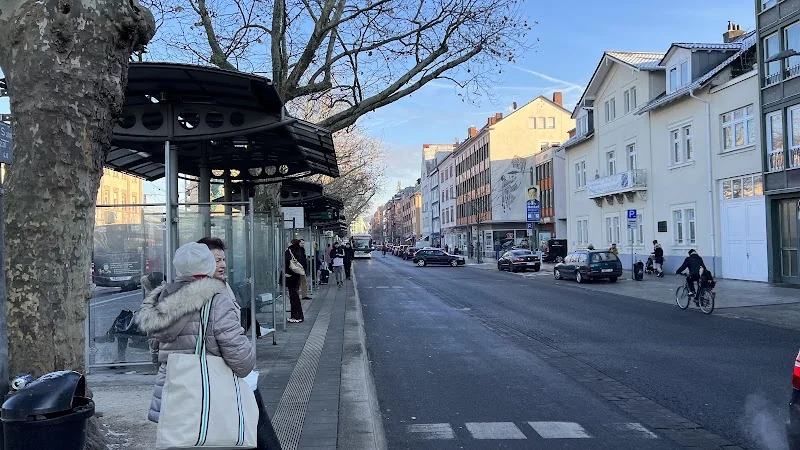
Aschaffenburg Hauptbahnhof/ROB is one of the most important landmarks in the city area because here train travel, city buses, regional buses, and the way to the city center converge closely. The main train station is located at Ludwigstraße 2-4, the Regional Bus Station at Ludwigstraße 8. Therefore, many inquiries about the location are not only about the station itself but also about the entire station district with transfers, parking, accessibility, and services. Those arriving here find a classic transportation hub designed for short distances, clear orientation, and good connections. On the station platform, DB provides information about live departures and arrivals, schedules, replacement services, elevators, and a site plan for the station and surrounding area. This combination makes the place relevant for travelers, commuters, visitors, and transfer passengers. ([bahnhof.de](https://www.bahnhof.de/aschaffenburg-hbf))
Access, Location, and Transfer between Train and ROB
The location on Ludwigstraße is the most significant practical advantage of the site. Aschaffenburg Hauptbahnhof is established as a central address for train travelers, while the ROB is integrated directly into the station district as a regional and urban hub. The city describes the city center as an area that was newly constructed in 2011 along with the main train station and the entire surrounding area. This not only modernized a single building but also reorganized a whole piece of urban space. For everyday life, it is crucial that the ROB is considered a particularly important traffic hub according to the municipal utilities, the paths to connecting buses are short, and no street crossing is necessary. Additionally, trains, rental bicycles, nearby parking lots and garages, as well as taxis and ASTflex are integrated into the surrounding area. This makes arriving from both the region and the city straightforward and direct. ([aschaffenburg.de](https://www.aschaffenburg.de/wahl/661000_000032/Innenstadt.html))
The connection is also well thought out for pedestrians. The city points out that the pedestrian tunnel at the main train station is barrier-free and that destinations can be reached within a few minutes on foot. For certain routes, the way through the Regional Bus Station and the Dämmer Steg is also described as an alternative, although this is not barrier-free. This is important for route planning, as different paths can be chosen depending on mobility, luggage, and destination. Those using the station as a transfer point also benefit from the digital travel information on bahnhof.de, such as current departures, schedules, and replacement services. Therefore, for inquiries like Aschaffenburg Hbf ROB or Hauptbahnhof ROB, not only the address is crucial, but especially the combination of train connections, bus hubs, footpaths, and wayfinding. ([bahnhof.de](https://www.bahnhof.de/aschaffenburg-hbf))
Parking at Aschaffenburg Hauptbahnhof: Parking Spaces, Rates, and Proximity
For drivers, the location offers several concrete parking options. Directly at the station, DB BahnPark lists the parking garage Aschaffenburg Hauptbahnhof as a covered parking option with a distance of less than 50 meters. There are 458 parking spaces available, including 5 barrier-free spaces. Additionally, DB BahnPark lists further parking options in the vicinity, including Aschaffenburg Hbf Am Hauptbahnhof with 470 parking spaces at Elisenstraße 24, Aschaffenburg Hbf Dämmer Tor with 400 parking spaces at Bert-Brecht-Straße 1, and the parking lot Aschaffenburg Kolbornstraße with 33 parking spaces. This variety is relevant for all those arriving by car and then wanting to switch to train or bus. DB also refers to an overview of parking facilities if further options are needed. ([bahnhof.de](https://www.bahnhof.de/aschaffenburg-hbf/parkplaetze))
The rates and conditions are also transparently displayed. In the parking garage Aschaffenburg Hauptbahnhof, hourly, daily, and monthly rates are mentioned, and there are also clearly named prices for other parking areas. This is practical for short-term parkers, day travelers, and commuters who only use the station for a transfer. It is also important to note the accessibility on the DB parking areas: People with a valid special parking permit can park for free for up to 24 hours in unbarriered facilities under certain conditions. Those wanting to plan the surrounding area more precisely can find further parking garages and underground garages in the station district and city center in the municipal overview. Thus, the topic of parking at Aschaffenburg Hbf becomes not just a mere search for a parking space but a planable arrival with several options near the station. ([bahnhof.de](https://www.bahnhof.de/aschaffenburg-hbf/parkplaetze))
Accessibility, Schedules, and On-Site Services
Aschaffenburg Hauptbahnhof is designed for barrier-free use. DB Bahnhof.de lists live departures and arrivals, schedules in PDF, replacement services, elevators, and an orientation plan for the station, platform, and surrounding area among the travel information. Accessibility, parking, lockers, and Wi-Fi are also listed under facilities. On-site, there are a bicycle parking garage, restrooms, bicycle parking spaces, and a taxi stand. This is important for guests with luggage, families, people with mobility restrictions, and all those using the station as a transfer point. The DB mobility page also describes that staff generally assist during the specified service hours with boarding, transferring, and alighting, and that for reliable support, registration through the mobility service center is recommended. ([bahnhof.de](https://www.bahnhof.de/aschaffenburg-hbf))
Personal service is also available. At the station, there is a DB Travel Center with fixed opening hours, mobile service staff, DB Information, a lost property service, and the station mission. The DB Travel Center provides advice on tickets, reservations, time cards, BahnCard offers, as well as national and international timetable and fare information. According to bahnhof.de, the mobile service staff are present daily from 10:00 AM to 6:00 PM, the mobility service center is reachable from 6:00 AM to 10:00 PM, and DB Information and lost property service are also available daily from 6:00 AM to 10:00 PM. This creates a service package that is particularly useful for a station with a high transfer passenger share. Therefore, those searching for Aschaffenburg Hbf timetable, Aschaffenburg Hbf barrier-free, or DB Travel Center Aschaffenburg will find here a concrete, everyday infrastructure with clear times and contact points. ([bahnhof.de](https://www.bahnhof.de/en/aschaffenburg-hbf/travelling/db-reisezentrum))
The New Building of 2011 and the History of the Station
The current form of the station is the result of a major renovation. The city of Aschaffenburg states that the main station and the entire surrounding area were newly constructed in 2011. An older municipal report describes this step in more detail: After extensive modernization of the platforms and the construction of a new tunnel structure, the reconstruction of Aschaffenburg Hauptbahnhof with an integrated parking garage began in 2008. The opening took place at the beginning of 2011, after a construction period of about one and a half years and with an investment volume of 44 million euros. The new building then connected a reception building, offices, shops, a medical center, a parking garage with around 400 spaces, and a bicycle station. Particularly striking is the distinctive flying roof, which today also makes the station an obvious urban entrance to the city. ([aschaffenburg.de](https://www.aschaffenburg.de/wahl/661000_000032/Innenstadt.html))
Historically, the site dates back much further. The municipal representation of the city center mentions Aschaffenburg's development around the first wooden Main Bridge and notes that the main station and the immediate surroundings were newly constructed in 2011. In another municipal report, it states that the construction of the first Aschaffenburg main station took place in 1853/1854, during the early connection to the Bavarian railway network. Thus, the place is not only a modern transfer point but also a transportation site with a long history. For inquiries like images of Hauptbahnhof ROB Aschaffenburg, this is interesting because the current impression arises from modern architecture, flying roof, and newly organized station surroundings, while in the background, a significantly older railway history stands. This connection of tradition and new construction shapes the character of the site to this day. ([aschaffenburg.de](https://www.aschaffenburg.de/dokumente/Aktuelles/Zeitungen-und-Broschueren/Buez_201107.pdf))
The Regional Bus Station as a Bus Hub in Aschaffenburg
The ROB is more than just a bus stop. The municipal utilities of Aschaffenburg describe the Regional Bus Station at Ludwigstraße 8 as one of the most important traffic hubs in Aschaffenburg. A progress report from the municipal utilities explicitly calls the ROB at Aschaffenburg Hauptbahnhof the mobility hub and states that it connects 15 city and 22 regional bus lines with the local and long-distance transport of Deutsche Bahn. According to the municipal utilities, up to 1000 buses and around 13,000 passengers are handled at this point daily. Additionally, the renovation of the ROB has been successfully completed, and the hub has been technically, digitally, and barrier-free further developed. For users, this means: Those arriving at the ROB do not move through a peripheral area but through a central, efficient traffic hub with a clear function in the urban and regional network. ([stwab.de](https://www.stwab.de/bussteiguebersicht?utm_source=openai))
The specific bus organization also shows how important the location is. In the bus stop overview of the municipal utilities, many lines are assigned to the individual stops, and the area is designed so that the paths remain short and the transfers are clear. Additionally, the ROB houses the customer center of the VAB, making the location relevant for information and services. For everyday life, it is also important that the city repeatedly points out during events that buses operate from or to ROB and that the area around the main station and ROB is intended as a jointly functioning mobility space. Thus, the term Hauptbahnhof ROB is also technically accurate: It is not about two separate places, but about a cohesive traffic hub where train, city bus, regional bus, and other mobility offers interconnect. ([stwab.de](https://www.stwab.de/Mobilitaet/OePNV-Fahrplaene-online-Auskunft/Stadtbus-Fahrplaene1/Stadtbus-Fahrplaene/bussteiguebersicht-rob-15-12-2024.pdf?utm_source=openai))
Bicycle, Taxi, and the Paths around the Station District
Around the station, bicycles play a larger role than it may seem at first glance. The city of Aschaffenburg mentions a bicycle station with 254 covered double-decker parking spaces on the south side of the main station near tracks 1 and 2. Additionally, there are further spaces at the ROB, in Ludwigstraße, and in Frohsinnstraße. On the north side at Dämmer Tor, according to the city, there are additional covered and camera-monitored parking spaces available. It fits that DB Bahnhof.de lists a bicycle parking garage, bicycle parking spaces, and a taxi stand at the station itself. For commuters, day guests, and visitors who want to combine bicycle and train, this presents a practical overall picture. Especially the northern and southern access to the station makes it clear that different forms of mobility have been consciously interconnected here. ([aschaffenburg.de](https://www.aschaffenburg.de/Service/index.php?FID=4173.9442.1&La=1&ModID=7&NavID=4173.7&object=tx%7C4173.5.1&utm_source=openai))
The surrounding area of the station is also designed for short distances. The municipal utilities explicitly mention rental bicycles, nearby parking lots, parking garages, taxis, and ASTflex as part of the mobility network around the ROB. At the same time, the station page shows that passenger orientation is not only limited to platforms but also includes lockers, Wi-Fi, restrooms, and a good information structure. Therefore, those searching for Aschaffenburg Hbf or ROB are often actually looking for a quick, clean, and easily readable solution for the next route in the city. This also explains why the location is relevant for many search intentions: Access, parking, timetable, accessibility, bicycle parking, and bus transfers are all interconnected here. The striking new building with a flying roof, the central location, and the densely networked environment make the station a well-recognizable place that is easy to use in everyday life and can be quickly found in the city. ([aschaffenburg.de](https://www.aschaffenburg.de/dokumente/Aktuelles/Zeitungen-und-Broschueren/Buez_201107.pdf))
Sources:
- DB Bahnhof.de – Aschaffenburg Hbf: Address, Facilities, Services, and Traveler Amenities. ([bahnhof.de](https://www.bahnhof.de/aschaffenburg-hbf))
- DB Bahnhof.de – Parking at Aschaffenburg Hbf: Parking Garages, Spaces, and Rates. ([bahnhof.de](https://www.bahnhof.de/aschaffenburg-hbf/parkplaetze))
- DB Bahnhof.de – Accessibility and Mobility Service at Aschaffenburg Hbf. ([bahnhof.de](https://www.bahnhof.de/en/aschaffenburg-hbf/accessibility-equipment?utm_source=openai))
- City of Aschaffenburg – City Center and City Portrait: New Construction of the Main Station 2011. ([aschaffenburg.de](https://www.aschaffenburg.de/wahl/661000_000032/Innenstadt.html))
- Municipal Utilities Aschaffenburg – Regional Bus Station: Location, Lines, and Mobility Hub. ([stwab.de](https://www.stwab.de/bussteiguebersicht?utm_source=openai))
- City of Aschaffenburg – Bicycle Traffic in Everyday Life: Bicycle Parking Spaces at Aschaffenburg Main Station. ([aschaffenburg.de](https://www.aschaffenburg.de/Service/index.php?FID=4173.9442.1&La=1&ModID=7&NavID=4173.7&object=tx%7C4173.5.1&utm_source=openai))
Mehr anzeigenWeniger anzeigen
Aschaffenburg Hauptbahnhof/ROB | Parking & Access
Aschaffenburg Hauptbahnhof/ROB is one of the most important landmarks in the city area because here train travel, city buses, regional buses, and the way to the city center converge closely. The main train station is located at Ludwigstraße 2-4, the Regional Bus Station at Ludwigstraße 8. Therefore, many inquiries about the location are not only about the station itself but also about the entire station district with transfers, parking, accessibility, and services. Those arriving here find a classic transportation hub designed for short distances, clear orientation, and good connections. On the station platform, DB provides information about live departures and arrivals, schedules, replacement services, elevators, and a site plan for the station and surrounding area. This combination makes the place relevant for travelers, commuters, visitors, and transfer passengers. ([bahnhof.de](https://www.bahnhof.de/aschaffenburg-hbf))
Access, Location, and Transfer between Train and ROB
The location on Ludwigstraße is the most significant practical advantage of the site. Aschaffenburg Hauptbahnhof is established as a central address for train travelers, while the ROB is integrated directly into the station district as a regional and urban hub. The city describes the city center as an area that was newly constructed in 2011 along with the main train station and the entire surrounding area. This not only modernized a single building but also reorganized a whole piece of urban space. For everyday life, it is crucial that the ROB is considered a particularly important traffic hub according to the municipal utilities, the paths to connecting buses are short, and no street crossing is necessary. Additionally, trains, rental bicycles, nearby parking lots and garages, as well as taxis and ASTflex are integrated into the surrounding area. This makes arriving from both the region and the city straightforward and direct. ([aschaffenburg.de](https://www.aschaffenburg.de/wahl/661000_000032/Innenstadt.html))
The connection is also well thought out for pedestrians. The city points out that the pedestrian tunnel at the main train station is barrier-free and that destinations can be reached within a few minutes on foot. For certain routes, the way through the Regional Bus Station and the Dämmer Steg is also described as an alternative, although this is not barrier-free. This is important for route planning, as different paths can be chosen depending on mobility, luggage, and destination. Those using the station as a transfer point also benefit from the digital travel information on bahnhof.de, such as current departures, schedules, and replacement services. Therefore, for inquiries like Aschaffenburg Hbf ROB or Hauptbahnhof ROB, not only the address is crucial, but especially the combination of train connections, bus hubs, footpaths, and wayfinding. ([bahnhof.de](https://www.bahnhof.de/aschaffenburg-hbf))
Parking at Aschaffenburg Hauptbahnhof: Parking Spaces, Rates, and Proximity
For drivers, the location offers several concrete parking options. Directly at the station, DB BahnPark lists the parking garage Aschaffenburg Hauptbahnhof as a covered parking option with a distance of less than 50 meters. There are 458 parking spaces available, including 5 barrier-free spaces. Additionally, DB BahnPark lists further parking options in the vicinity, including Aschaffenburg Hbf Am Hauptbahnhof with 470 parking spaces at Elisenstraße 24, Aschaffenburg Hbf Dämmer Tor with 400 parking spaces at Bert-Brecht-Straße 1, and the parking lot Aschaffenburg Kolbornstraße with 33 parking spaces. This variety is relevant for all those arriving by car and then wanting to switch to train or bus. DB also refers to an overview of parking facilities if further options are needed. ([bahnhof.de](https://www.bahnhof.de/aschaffenburg-hbf/parkplaetze))
The rates and conditions are also transparently displayed. In the parking garage Aschaffenburg Hauptbahnhof, hourly, daily, and monthly rates are mentioned, and there are also clearly named prices for other parking areas. This is practical for short-term parkers, day travelers, and commuters who only use the station for a transfer. It is also important to note the accessibility on the DB parking areas: People with a valid special parking permit can park for free for up to 24 hours in unbarriered facilities under certain conditions. Those wanting to plan the surrounding area more precisely can find further parking garages and underground garages in the station district and city center in the municipal overview. Thus, the topic of parking at Aschaffenburg Hbf becomes not just a mere search for a parking space but a planable arrival with several options near the station. ([bahnhof.de](https://www.bahnhof.de/aschaffenburg-hbf/parkplaetze))
Accessibility, Schedules, and On-Site Services
Aschaffenburg Hauptbahnhof is designed for barrier-free use. DB Bahnhof.de lists live departures and arrivals, schedules in PDF, replacement services, elevators, and an orientation plan for the station, platform, and surrounding area among the travel information. Accessibility, parking, lockers, and Wi-Fi are also listed under facilities. On-site, there are a bicycle parking garage, restrooms, bicycle parking spaces, and a taxi stand. This is important for guests with luggage, families, people with mobility restrictions, and all those using the station as a transfer point. The DB mobility page also describes that staff generally assist during the specified service hours with boarding, transferring, and alighting, and that for reliable support, registration through the mobility service center is recommended. ([bahnhof.de](https://www.bahnhof.de/aschaffenburg-hbf))
Personal service is also available. At the station, there is a DB Travel Center with fixed opening hours, mobile service staff, DB Information, a lost property service, and the station mission. The DB Travel Center provides advice on tickets, reservations, time cards, BahnCard offers, as well as national and international timetable and fare information. According to bahnhof.de, the mobile service staff are present daily from 10:00 AM to 6:00 PM, the mobility service center is reachable from 6:00 AM to 10:00 PM, and DB Information and lost property service are also available daily from 6:00 AM to 10:00 PM. This creates a service package that is particularly useful for a station with a high transfer passenger share. Therefore, those searching for Aschaffenburg Hbf timetable, Aschaffenburg Hbf barrier-free, or DB Travel Center Aschaffenburg will find here a concrete, everyday infrastructure with clear times and contact points. ([bahnhof.de](https://www.bahnhof.de/en/aschaffenburg-hbf/travelling/db-reisezentrum))
The New Building of 2011 and the History of the Station
The current form of the station is the result of a major renovation. The city of Aschaffenburg states that the main station and the entire surrounding area were newly constructed in 2011. An older municipal report describes this step in more detail: After extensive modernization of the platforms and the construction of a new tunnel structure, the reconstruction of Aschaffenburg Hauptbahnhof with an integrated parking garage began in 2008. The opening took place at the beginning of 2011, after a construction period of about one and a half years and with an investment volume of 44 million euros. The new building then connected a reception building, offices, shops, a medical center, a parking garage with around 400 spaces, and a bicycle station. Particularly striking is the distinctive flying roof, which today also makes the station an obvious urban entrance to the city. ([aschaffenburg.de](https://www.aschaffenburg.de/wahl/661000_000032/Innenstadt.html))
Historically, the site dates back much further. The municipal representation of the city center mentions Aschaffenburg's development around the first wooden Main Bridge and notes that the main station and the immediate surroundings were newly constructed in 2011. In another municipal report, it states that the construction of the first Aschaffenburg main station took place in 1853/1854, during the early connection to the Bavarian railway network. Thus, the place is not only a modern transfer point but also a transportation site with a long history. For inquiries like images of Hauptbahnhof ROB Aschaffenburg, this is interesting because the current impression arises from modern architecture, flying roof, and newly organized station surroundings, while in the background, a significantly older railway history stands. This connection of tradition and new construction shapes the character of the site to this day. ([aschaffenburg.de](https://www.aschaffenburg.de/dokumente/Aktuelles/Zeitungen-und-Broschueren/Buez_201107.pdf))
The Regional Bus Station as a Bus Hub in Aschaffenburg
The ROB is more than just a bus stop. The municipal utilities of Aschaffenburg describe the Regional Bus Station at Ludwigstraße 8 as one of the most important traffic hubs in Aschaffenburg. A progress report from the municipal utilities explicitly calls the ROB at Aschaffenburg Hauptbahnhof the mobility hub and states that it connects 15 city and 22 regional bus lines with the local and long-distance transport of Deutsche Bahn. According to the municipal utilities, up to 1000 buses and around 13,000 passengers are handled at this point daily. Additionally, the renovation of the ROB has been successfully completed, and the hub has been technically, digitally, and barrier-free further developed. For users, this means: Those arriving at the ROB do not move through a peripheral area but through a central, efficient traffic hub with a clear function in the urban and regional network. ([stwab.de](https://www.stwab.de/bussteiguebersicht?utm_source=openai))
The specific bus organization also shows how important the location is. In the bus stop overview of the municipal utilities, many lines are assigned to the individual stops, and the area is designed so that the paths remain short and the transfers are clear. Additionally, the ROB houses the customer center of the VAB, making the location relevant for information and services. For everyday life, it is also important that the city repeatedly points out during events that buses operate from or to ROB and that the area around the main station and ROB is intended as a jointly functioning mobility space. Thus, the term Hauptbahnhof ROB is also technically accurate: It is not about two separate places, but about a cohesive traffic hub where train, city bus, regional bus, and other mobility offers interconnect. ([stwab.de](https://www.stwab.de/Mobilitaet/OePNV-Fahrplaene-online-Auskunft/Stadtbus-Fahrplaene1/Stadtbus-Fahrplaene/bussteiguebersicht-rob-15-12-2024.pdf?utm_source=openai))
Bicycle, Taxi, and the Paths around the Station District
Around the station, bicycles play a larger role than it may seem at first glance. The city of Aschaffenburg mentions a bicycle station with 254 covered double-decker parking spaces on the south side of the main station near tracks 1 and 2. Additionally, there are further spaces at the ROB, in Ludwigstraße, and in Frohsinnstraße. On the north side at Dämmer Tor, according to the city, there are additional covered and camera-monitored parking spaces available. It fits that DB Bahnhof.de lists a bicycle parking garage, bicycle parking spaces, and a taxi stand at the station itself. For commuters, day guests, and visitors who want to combine bicycle and train, this presents a practical overall picture. Especially the northern and southern access to the station makes it clear that different forms of mobility have been consciously interconnected here. ([aschaffenburg.de](https://www.aschaffenburg.de/Service/index.php?FID=4173.9442.1&La=1&ModID=7&NavID=4173.7&object=tx%7C4173.5.1&utm_source=openai))
The surrounding area of the station is also designed for short distances. The municipal utilities explicitly mention rental bicycles, nearby parking lots, parking garages, taxis, and ASTflex as part of the mobility network around the ROB. At the same time, the station page shows that passenger orientation is not only limited to platforms but also includes lockers, Wi-Fi, restrooms, and a good information structure. Therefore, those searching for Aschaffenburg Hbf or ROB are often actually looking for a quick, clean, and easily readable solution for the next route in the city. This also explains why the location is relevant for many search intentions: Access, parking, timetable, accessibility, bicycle parking, and bus transfers are all interconnected here. The striking new building with a flying roof, the central location, and the densely networked environment make the station a well-recognizable place that is easy to use in everyday life and can be quickly found in the city. ([aschaffenburg.de](https://www.aschaffenburg.de/dokumente/Aktuelles/Zeitungen-und-Broschueren/Buez_201107.pdf))
Sources:
- DB Bahnhof.de – Aschaffenburg Hbf: Address, Facilities, Services, and Traveler Amenities. ([bahnhof.de](https://www.bahnhof.de/aschaffenburg-hbf))
- DB Bahnhof.de – Parking at Aschaffenburg Hbf: Parking Garages, Spaces, and Rates. ([bahnhof.de](https://www.bahnhof.de/aschaffenburg-hbf/parkplaetze))
- DB Bahnhof.de – Accessibility and Mobility Service at Aschaffenburg Hbf. ([bahnhof.de](https://www.bahnhof.de/en/aschaffenburg-hbf/accessibility-equipment?utm_source=openai))
- City of Aschaffenburg – City Center and City Portrait: New Construction of the Main Station 2011. ([aschaffenburg.de](https://www.aschaffenburg.de/wahl/661000_000032/Innenstadt.html))
- Municipal Utilities Aschaffenburg – Regional Bus Station: Location, Lines, and Mobility Hub. ([stwab.de](https://www.stwab.de/bussteiguebersicht?utm_source=openai))
- City of Aschaffenburg – Bicycle Traffic in Everyday Life: Bicycle Parking Spaces at Aschaffenburg Main Station. ([aschaffenburg.de](https://www.aschaffenburg.de/Service/index.php?FID=4173.9442.1&La=1&ModID=7&NavID=4173.7&object=tx%7C4173.5.1&utm_source=openai))
Aschaffenburg Hauptbahnhof/ROB | Parking & Access
Aschaffenburg Hauptbahnhof/ROB is one of the most important landmarks in the city area because here train travel, city buses, regional buses, and the way to the city center converge closely. The main train station is located at Ludwigstraße 2-4, the Regional Bus Station at Ludwigstraße 8. Therefore, many inquiries about the location are not only about the station itself but also about the entire station district with transfers, parking, accessibility, and services. Those arriving here find a classic transportation hub designed for short distances, clear orientation, and good connections. On the station platform, DB provides information about live departures and arrivals, schedules, replacement services, elevators, and a site plan for the station and surrounding area. This combination makes the place relevant for travelers, commuters, visitors, and transfer passengers. ([bahnhof.de](https://www.bahnhof.de/aschaffenburg-hbf))
Access, Location, and Transfer between Train and ROB
The location on Ludwigstraße is the most significant practical advantage of the site. Aschaffenburg Hauptbahnhof is established as a central address for train travelers, while the ROB is integrated directly into the station district as a regional and urban hub. The city describes the city center as an area that was newly constructed in 2011 along with the main train station and the entire surrounding area. This not only modernized a single building but also reorganized a whole piece of urban space. For everyday life, it is crucial that the ROB is considered a particularly important traffic hub according to the municipal utilities, the paths to connecting buses are short, and no street crossing is necessary. Additionally, trains, rental bicycles, nearby parking lots and garages, as well as taxis and ASTflex are integrated into the surrounding area. This makes arriving from both the region and the city straightforward and direct. ([aschaffenburg.de](https://www.aschaffenburg.de/wahl/661000_000032/Innenstadt.html))
The connection is also well thought out for pedestrians. The city points out that the pedestrian tunnel at the main train station is barrier-free and that destinations can be reached within a few minutes on foot. For certain routes, the way through the Regional Bus Station and the Dämmer Steg is also described as an alternative, although this is not barrier-free. This is important for route planning, as different paths can be chosen depending on mobility, luggage, and destination. Those using the station as a transfer point also benefit from the digital travel information on bahnhof.de, such as current departures, schedules, and replacement services. Therefore, for inquiries like Aschaffenburg Hbf ROB or Hauptbahnhof ROB, not only the address is crucial, but especially the combination of train connections, bus hubs, footpaths, and wayfinding. ([bahnhof.de](https://www.bahnhof.de/aschaffenburg-hbf))
Parking at Aschaffenburg Hauptbahnhof: Parking Spaces, Rates, and Proximity
For drivers, the location offers several concrete parking options. Directly at the station, DB BahnPark lists the parking garage Aschaffenburg Hauptbahnhof as a covered parking option with a distance of less than 50 meters. There are 458 parking spaces available, including 5 barrier-free spaces. Additionally, DB BahnPark lists further parking options in the vicinity, including Aschaffenburg Hbf Am Hauptbahnhof with 470 parking spaces at Elisenstraße 24, Aschaffenburg Hbf Dämmer Tor with 400 parking spaces at Bert-Brecht-Straße 1, and the parking lot Aschaffenburg Kolbornstraße with 33 parking spaces. This variety is relevant for all those arriving by car and then wanting to switch to train or bus. DB also refers to an overview of parking facilities if further options are needed. ([bahnhof.de](https://www.bahnhof.de/aschaffenburg-hbf/parkplaetze))
The rates and conditions are also transparently displayed. In the parking garage Aschaffenburg Hauptbahnhof, hourly, daily, and monthly rates are mentioned, and there are also clearly named prices for other parking areas. This is practical for short-term parkers, day travelers, and commuters who only use the station for a transfer. It is also important to note the accessibility on the DB parking areas: People with a valid special parking permit can park for free for up to 24 hours in unbarriered facilities under certain conditions. Those wanting to plan the surrounding area more precisely can find further parking garages and underground garages in the station district and city center in the municipal overview. Thus, the topic of parking at Aschaffenburg Hbf becomes not just a mere search for a parking space but a planable arrival with several options near the station. ([bahnhof.de](https://www.bahnhof.de/aschaffenburg-hbf/parkplaetze))
Accessibility, Schedules, and On-Site Services
Aschaffenburg Hauptbahnhof is designed for barrier-free use. DB Bahnhof.de lists live departures and arrivals, schedules in PDF, replacement services, elevators, and an orientation plan for the station, platform, and surrounding area among the travel information. Accessibility, parking, lockers, and Wi-Fi are also listed under facilities. On-site, there are a bicycle parking garage, restrooms, bicycle parking spaces, and a taxi stand. This is important for guests with luggage, families, people with mobility restrictions, and all those using the station as a transfer point. The DB mobility page also describes that staff generally assist during the specified service hours with boarding, transferring, and alighting, and that for reliable support, registration through the mobility service center is recommended. ([bahnhof.de](https://www.bahnhof.de/aschaffenburg-hbf))
Personal service is also available. At the station, there is a DB Travel Center with fixed opening hours, mobile service staff, DB Information, a lost property service, and the station mission. The DB Travel Center provides advice on tickets, reservations, time cards, BahnCard offers, as well as national and international timetable and fare information. According to bahnhof.de, the mobile service staff are present daily from 10:00 AM to 6:00 PM, the mobility service center is reachable from 6:00 AM to 10:00 PM, and DB Information and lost property service are also available daily from 6:00 AM to 10:00 PM. This creates a service package that is particularly useful for a station with a high transfer passenger share. Therefore, those searching for Aschaffenburg Hbf timetable, Aschaffenburg Hbf barrier-free, or DB Travel Center Aschaffenburg will find here a concrete, everyday infrastructure with clear times and contact points. ([bahnhof.de](https://www.bahnhof.de/en/aschaffenburg-hbf/travelling/db-reisezentrum))
The New Building of 2011 and the History of the Station
The current form of the station is the result of a major renovation. The city of Aschaffenburg states that the main station and the entire surrounding area were newly constructed in 2011. An older municipal report describes this step in more detail: After extensive modernization of the platforms and the construction of a new tunnel structure, the reconstruction of Aschaffenburg Hauptbahnhof with an integrated parking garage began in 2008. The opening took place at the beginning of 2011, after a construction period of about one and a half years and with an investment volume of 44 million euros. The new building then connected a reception building, offices, shops, a medical center, a parking garage with around 400 spaces, and a bicycle station. Particularly striking is the distinctive flying roof, which today also makes the station an obvious urban entrance to the city. ([aschaffenburg.de](https://www.aschaffenburg.de/wahl/661000_000032/Innenstadt.html))
Historically, the site dates back much further. The municipal representation of the city center mentions Aschaffenburg's development around the first wooden Main Bridge and notes that the main station and the immediate surroundings were newly constructed in 2011. In another municipal report, it states that the construction of the first Aschaffenburg main station took place in 1853/1854, during the early connection to the Bavarian railway network. Thus, the place is not only a modern transfer point but also a transportation site with a long history. For inquiries like images of Hauptbahnhof ROB Aschaffenburg, this is interesting because the current impression arises from modern architecture, flying roof, and newly organized station surroundings, while in the background, a significantly older railway history stands. This connection of tradition and new construction shapes the character of the site to this day. ([aschaffenburg.de](https://www.aschaffenburg.de/dokumente/Aktuelles/Zeitungen-und-Broschueren/Buez_201107.pdf))
The Regional Bus Station as a Bus Hub in Aschaffenburg
The ROB is more than just a bus stop. The municipal utilities of Aschaffenburg describe the Regional Bus Station at Ludwigstraße 8 as one of the most important traffic hubs in Aschaffenburg. A progress report from the municipal utilities explicitly calls the ROB at Aschaffenburg Hauptbahnhof the mobility hub and states that it connects 15 city and 22 regional bus lines with the local and long-distance transport of Deutsche Bahn. According to the municipal utilities, up to 1000 buses and around 13,000 passengers are handled at this point daily. Additionally, the renovation of the ROB has been successfully completed, and the hub has been technically, digitally, and barrier-free further developed. For users, this means: Those arriving at the ROB do not move through a peripheral area but through a central, efficient traffic hub with a clear function in the urban and regional network. ([stwab.de](https://www.stwab.de/bussteiguebersicht?utm_source=openai))
The specific bus organization also shows how important the location is. In the bus stop overview of the municipal utilities, many lines are assigned to the individual stops, and the area is designed so that the paths remain short and the transfers are clear. Additionally, the ROB houses the customer center of the VAB, making the location relevant for information and services. For everyday life, it is also important that the city repeatedly points out during events that buses operate from or to ROB and that the area around the main station and ROB is intended as a jointly functioning mobility space. Thus, the term Hauptbahnhof ROB is also technically accurate: It is not about two separate places, but about a cohesive traffic hub where train, city bus, regional bus, and other mobility offers interconnect. ([stwab.de](https://www.stwab.de/Mobilitaet/OePNV-Fahrplaene-online-Auskunft/Stadtbus-Fahrplaene1/Stadtbus-Fahrplaene/bussteiguebersicht-rob-15-12-2024.pdf?utm_source=openai))
Bicycle, Taxi, and the Paths around the Station District
Around the station, bicycles play a larger role than it may seem at first glance. The city of Aschaffenburg mentions a bicycle station with 254 covered double-decker parking spaces on the south side of the main station near tracks 1 and 2. Additionally, there are further spaces at the ROB, in Ludwigstraße, and in Frohsinnstraße. On the north side at Dämmer Tor, according to the city, there are additional covered and camera-monitored parking spaces available. It fits that DB Bahnhof.de lists a bicycle parking garage, bicycle parking spaces, and a taxi stand at the station itself. For commuters, day guests, and visitors who want to combine bicycle and train, this presents a practical overall picture. Especially the northern and southern access to the station makes it clear that different forms of mobility have been consciously interconnected here. ([aschaffenburg.de](https://www.aschaffenburg.de/Service/index.php?FID=4173.9442.1&La=1&ModID=7&NavID=4173.7&object=tx%7C4173.5.1&utm_source=openai))
The surrounding area of the station is also designed for short distances. The municipal utilities explicitly mention rental bicycles, nearby parking lots, parking garages, taxis, and ASTflex as part of the mobility network around the ROB. At the same time, the station page shows that passenger orientation is not only limited to platforms but also includes lockers, Wi-Fi, restrooms, and a good information structure. Therefore, those searching for Aschaffenburg Hbf or ROB are often actually looking for a quick, clean, and easily readable solution for the next route in the city. This also explains why the location is relevant for many search intentions: Access, parking, timetable, accessibility, bicycle parking, and bus transfers are all interconnected here. The striking new building with a flying roof, the central location, and the densely networked environment make the station a well-recognizable place that is easy to use in everyday life and can be quickly found in the city. ([aschaffenburg.de](https://www.aschaffenburg.de/dokumente/Aktuelles/Zeitungen-und-Broschueren/Buez_201107.pdf))
Sources:
- DB Bahnhof.de – Aschaffenburg Hbf: Address, Facilities, Services, and Traveler Amenities. ([bahnhof.de](https://www.bahnhof.de/aschaffenburg-hbf))
- DB Bahnhof.de – Parking at Aschaffenburg Hbf: Parking Garages, Spaces, and Rates. ([bahnhof.de](https://www.bahnhof.de/aschaffenburg-hbf/parkplaetze))
- DB Bahnhof.de – Accessibility and Mobility Service at Aschaffenburg Hbf. ([bahnhof.de](https://www.bahnhof.de/en/aschaffenburg-hbf/accessibility-equipment?utm_source=openai))
- City of Aschaffenburg – City Center and City Portrait: New Construction of the Main Station 2011. ([aschaffenburg.de](https://www.aschaffenburg.de/wahl/661000_000032/Innenstadt.html))
- Municipal Utilities Aschaffenburg – Regional Bus Station: Location, Lines, and Mobility Hub. ([stwab.de](https://www.stwab.de/bussteiguebersicht?utm_source=openai))
- City of Aschaffenburg – Bicycle Traffic in Everyday Life: Bicycle Parking Spaces at Aschaffenburg Main Station. ([aschaffenburg.de](https://www.aschaffenburg.de/Service/index.php?FID=4173.9442.1&La=1&ModID=7&NavID=4173.7&object=tx%7C4173.5.1&utm_source=openai))
Frequently Asked Questions
Reviews
No reviews found