Time Travel Aschaffenburg: Old Photos & Stories
Time Travel through Aschaffenburg: Old Photos, Stories & People
Would you like to experience Aschaffenburg through the lens of past decades—not with dry dates, but as a lively discovery tour? This page bundles upcoming dates and formats that allow you to reassemble historical images, places, and personal stories in the city space: as a photo walk, short lecture, archive insight, and participatory activity.
For whom? For locals, newcomers, day visitors, families, and everyone who likes to compare "then & now" directly on site.
Upcoming Dates & Formats (Fall/Winter 2026)
All dates are designed so you can join in without any special knowledge. Please check for last-minute changes and ticket information via the official organizer pages (links in the sources).
1) Guided Photo Walk "Main Riverbank & Sightlines"
- Date: 2026-10-11
- Time: 14:00–16:00
- Meeting point: City center/promenade (exact location will be provided upon registration)
- Format: Moderated tour with image set (printout or smartphone view), followed by a short exchange about motifs & perspectives
2) Evening Program "Reading Pictures: How Photos Tell City History"
- Date: 2026-11-06
- Time: 19:00–20:30
- Location: Lecture room of a cultural partner in Aschaffenburg (will be published in ticketing)
- Format: Image lecture with practical tips (motif recognition, image sources, rights/copyright, reliable dating without speculation)
3) "Bring Your Photo" – Participatory and Scanning Afternoon
- Date: 2026-12-05
- Time: 10:00–13:00
- Location: Reading room/service point of an Aschaffenburg memory institute (will be officially announced in advance)
- Format: Help with gentle digitization, basic metadata (place, motif, approximate period), tips for passing on to collections or for the family chronicle
Note on participation: If you have limited mobility or are out with a stroller, please choose the evening program or request a barrier-free route for the photo walk.
Stations of the Upcoming Time Travel: Where Pictures "Dock" Especially Well
The route and image selection may vary by date. These places are particularly fruitful for the "then–now" comparison, as viewing directions can be easily recreated and motifs remain recognizable even without insider knowledge.
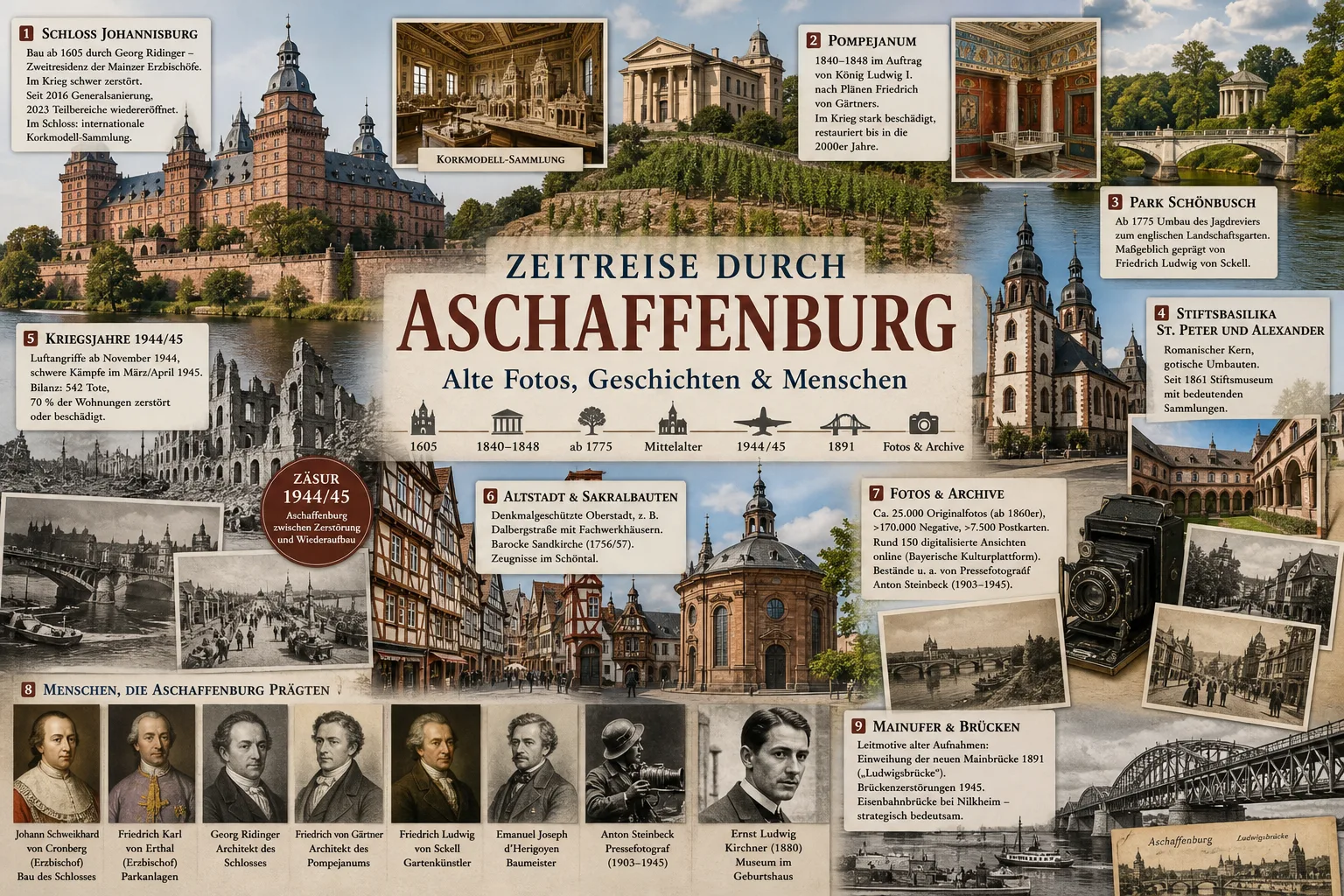
Johannisburg Castle & Riverbanks
For the photo walks, the Main riverbank around Johannisburg Castle is an ideal starting area: clear lines, recognizable silhouette, well-suited vantage points for perspective comparisons. During the tour, typical image questions are practiced: What does the photo definitely show? What is interpretation? And which details (window axes, roof edges, riverbank walls) help in rediscovering the photo location?
Pompejanum & Hillsides on the Main
The interplay of building, hillside, and river is particularly suitable as a motif for "then-and-now" shots—especially with similar light (late afternoon) and consistent focal length. The program shows how you can achieve comparable image effects with simple smartphone settings without exaggerating artificially.
Upper Town, Sand Church & Schöntal – Everyday Views
Away from the major landmarks, historical photos often have the strongest impact: street corners, paths, forecourts, and recurring everyday motifs. The formats practice how to find "subtle" image clues (house edges, street gradients, rows of trees) and how to take your own comparison photos without unintentionally making people recognizable.
Collegiate Basilica Area & Museum Rooms: Motifs for Quiet Series
For those who prefer working in series rather than single images, motif series with recurring axes are suitable—such as forecourts, passageways, courtyards, or exhibition views (where photography is allowed). The evening program explains how to correctly note image sources and how to label your own photos in a traceable way later on.
Schönbusch Park – Perspectives, Paths, Water Surfaces
For winter or late autumn dates, Schönbusch Park is particularly suitable as a motif space: path layouts, riverbank lines, and open spaces help to rediscover historical perspectives. At the same time, it is a great place to practice making a "photographic note" (vantage point + viewing direction + time), so your comparison photo remains reproducible later.
How to Prepare (Practical & Reliable)
- Bring: Smartphone or camera, optionally printed family photos (only copies if you want to protect originals), note app or small notebook.
- Careful handling of originals: Transport photos flat in a sleeve; avoid adhesive tape and direct sunlight.
- Respect image rights: Use third-party photos only with a clear source; for publications (web/print) check license, copyright, and personal rights.
- Data protection in public spaces: For your comparison photos, choose moments/locations where people are not clearly recognizable—or focus on architectural details.
- Weather & Light: For "matching shots," similar light helps. Allow enough time on site for outdoor formats.
Participate: Private Photos Become a Shared Memory
If you own photos from Aschaffenburg, you can prepare them at the "Bring Your Photo" event so that they remain usable in the long term—for your family, for a school project, or for possible transfer to a collection. The focus is on clean basic data (motif, place, approximate period, origin of the photo) and gentle digitization.