Urban Transformation in Aschaffenburg: new city districts in focus
Urban Transformation in Aschaffenburg: New City Districts & Projects (Outlook 2026–2028+)
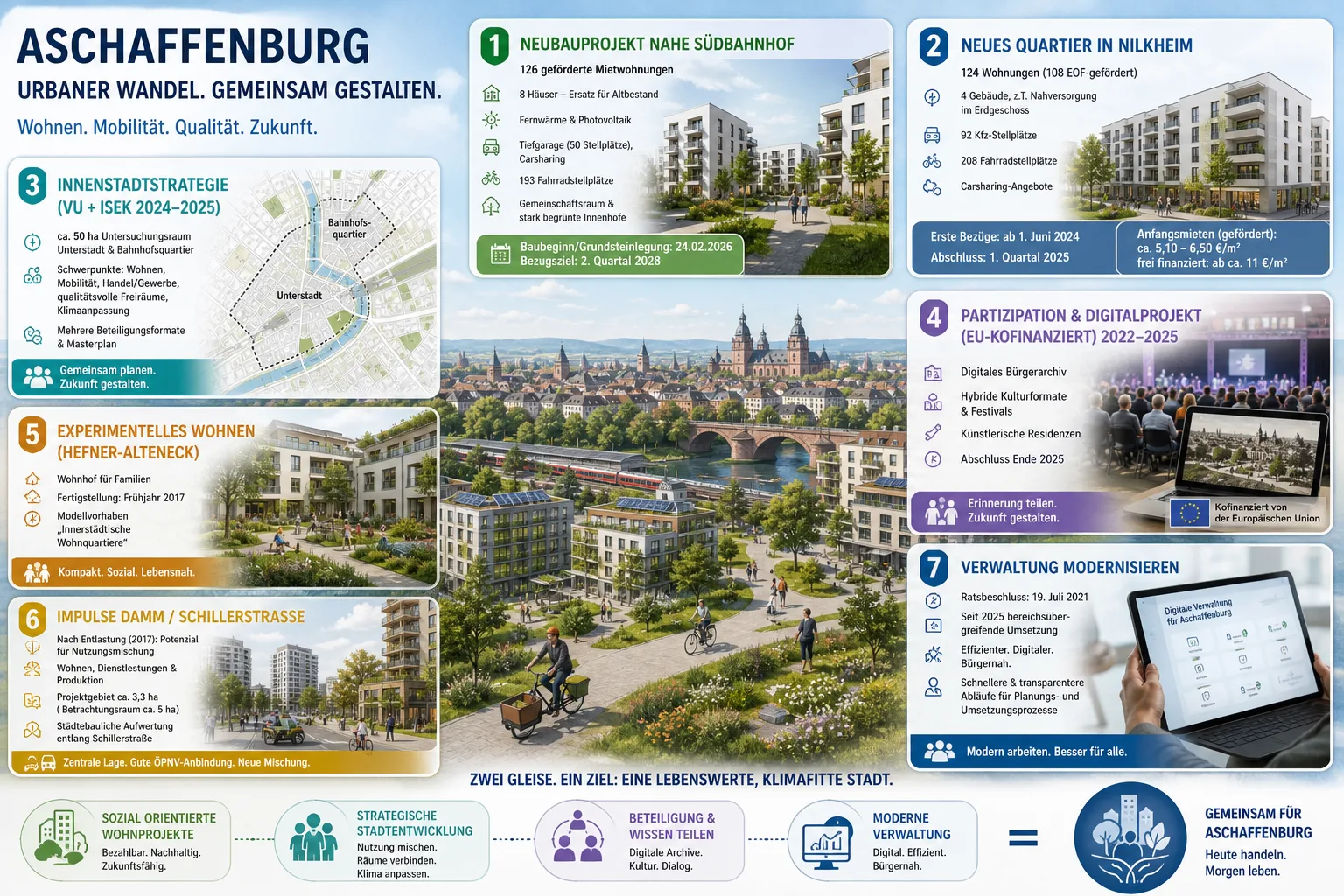
What changes await Aschaffenburg in the coming years? This overview summarizes the foreseeable developments around new residential quarters, mobility, and downtown planning – with a focus on projects that are expected to have an impact by 2028 and beyond.
What is likely to change for everyday life, mobility, and climate
New quarters change a city not only through additional housing, but through everyday logic: routes, quality of stay, traffic, and social infrastructure. For Aschaffenburg, the coming years will especially be shaped by three main areas typical of current urban development projects in Germany:
- More housing with social commitment: Subsidy programs like EOF aim to keep new apartments affordable permanently or for a limited time – a lever against displacement and housing cost stress.
- Mobility transition at the neighborhood level: The mix of reduced car parking spaces, car sharing, and a high proportion of bicycle parking is a planning approach that facilitates the switch without banning mobility.
- Climate adaptation is "built in": Green courtyards, shading, water-sensitive areas, and heat-resistant open spaces increase the quality of stay during increasingly frequent hot days.
The key is in the details: good bicycle parking facilities (secure, weather-protected, accessible), functioning sharing services, and open spaces that are actually usable (seating, shade, clear access).
Downtown & Station District: Strategy, Mixed Use, Climate Adaptation
In addition to new construction projects, downtown development especially shapes urban transformation. In Aschaffenburg – as in many medium-sized cities – the areas of Lower Town and Station District are the focus of strategic planning: strengthening housing, improving accessibility, connecting retail and gastronomy with new uses, and at the same time making the city center more climate-resilient.
What matters in the next planning rounds
- Downtown-near living: More residents near the center can increase foot traffic and safety – but requires rules for noise, usage conflicts, and social balance.
- Station as city gateway: The station district will function particularly well in the future if pedestrian and bicycle paths are logically routed, transfers are easy, and public spaces are not just thoroughfares but places to stay.
- Mixed-use ground floors: Services, culture, small-scale gastronomy, and new forms of work (e.g., co-working) can cushion vacancies if they are enabled by planning.
- Climate adaptation in existing buildings: More shade, fewer heat islands, unsealing, and water-sensitive design become location factors – especially in densely built-up areas.
Strategic concepts such as Integrated Urban Development Concepts (ISEK) and preparatory studies are common tools for this: They bundle goals, measures, priorities, and the basis for eligibility for funding – and create transparency about why certain spaces are redeveloped first.
Participation & Digital: how citizens can get involved
Urban development is only successful in the long term if it is understandable and participation does not start at the end. For the coming years, these forms of participation are particularly relevant (typical for municipal planning processes and increasingly digitally supported):
- Public workshops and dialogue formats: For guiding principles, priorities, and concrete measures (e.g., open space design, traffic management, places to stay).
- Digital participation platforms: For feedback on accessibility, safety, heat hotspots, missing crossings, or bicycle parking needs – in other words, everyday knowledge that improves planning.
- Transparent documentation: When decisions, plans, and project statuses are easy to find, the quality of the debate increases: fewer rumors, more facts.
Those who wish to participate can usually find information through the city's official publications (announcements, project pages, meeting calendars) and use the phases in which comments are expressly provided for. For quarters around the station and downtown, it is especially worthwhile to look at dates concerning mobility, public space, and climate adaptation.