Social Projects in Aschaffenburg: Diversity & Health
Social Projects & Initiatives Moving Aschaffenburg: Outlook on Upcoming Actions and Next Steps
Which projects will soon shape everyday life in Aschaffenburg? This article compiles foreseeable, planned, and expected initiatives around health, mental stability, neighborhoods, education, the working world, sustainability, and international solidarity – as guidance for people who want to stay informed, participate, or support in the future.
Mental Health: Creating Visibility and Easing Access
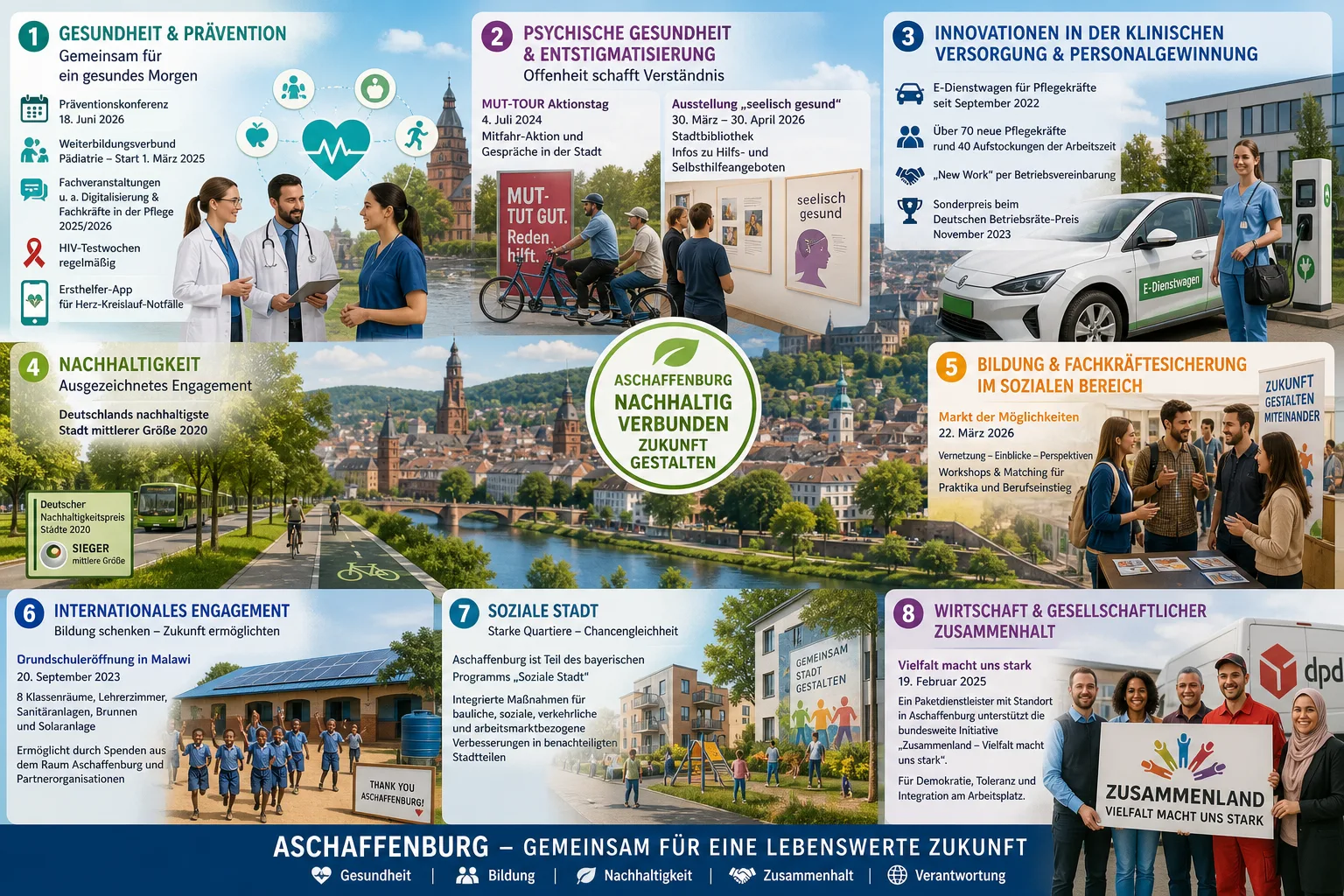
Mental stress will be discussed even more in the future as part of public life – not as a marginal topic, but as a question of participation, education, employability, and relationships. In Aschaffenburg, action days, mobile counseling offers, and exhibitions will be particularly suitable for this, as they enable encounters without those affected having to explain themselves.
For upcoming initiatives, three effects will be particularly decisive:
- Destigmatization: Formats in public spaces will show that crises, fears, and depression occur – and that help is available.
- Orientation: Well-curated information offers will explain which contact points (counseling, self-help, crisis services) might be suitable in an emergency.
- Early Help: Low-threshold impulses will encourage people to seek support earlier – before burdens become chronic.
Social Innovation in Hospitals: New Work and Sustainable Mobility
Social innovations will also become increasingly important in healthcare – especially where staff shortages, shift systems, and work-life balance are particularly noticeable. In Aschaffenburg, models that improve working conditions and at the same time promote climate-friendly mobility will therefore be in focus.
The following approaches are typically suitable as next steps:
- Flexible Working Time Models: Duty rosters that respond more to life phases will improve the retention of skilled workers.
- More Say in Everyday Life: New Work elements (e.g., structured feedback formats, team decisions in defined areas) will make processes more practical.
- E-Mobility as a Benefit: Programs around e-company cars, job bikes, or charging infrastructure will make nursing and hospital professions more attractive, provided they are fairly regulated and financially transparent.
The measure of success will not be a single "lighthouse project," but the tangible effect: more stability in teams, fewer absences, better care, and a realistic perspective for young talent.
Neighborhoods & Sustainability: Urban Development with a Social Focus
In the coming years, urban development in Aschaffenburg will be considered socially effective above all when it strengthens neighborhoods holistically: housing, routes, encounters, education, safety, and participation. Urban development funding programs will continue to provide a framework for this, as they combine structural measures with social components.
For upcoming neighborhood work, the following will be particularly important:
- Places for Encounters: Squares, libraries, youth centers, and neighborhood spaces will be planned and further developed as social infrastructure.
- Everyday Mobility: Safe walking and cycling paths as well as good public transport connections will facilitate participation – especially for children, older people, and those without their own car.
- Support for the School-to-Work Transition: Local networks will bundle offers so that young people can more easily access training and work.
Sustainability will not only be understood as climate protection, but as a combination of ecological, social, and economic stability in urban space.
Education & Skilled Workers: Attracting Young Talent and Opening Opportunities
“Marketplace of Opportunities” and Similar Formats
In the social sector, securing skilled workers in Aschaffenburg will increasingly depend on how well training institutions, providers, and municipalities work together. Networking events based on the principle of a “marketplace of opportunities” will play a central role, as they provide orientation and make it easier to enter practical fields.
For upcoming rounds of such formats, the following are particularly effective:
- Direct Conversations: Short distances between students/pupils and providers make job profiles tangible.
- Practice-Oriented Insights: Workshops on everyday situations (e.g., working with parents, inclusion, child protection) help to realistically assess expectations.
- Transparency about Framework Conditions: Clear information on working hours, onboarding, further training, and development paths builds trust.
Education as a Long-Term Location Factor
If Aschaffenburg invests in education, it will not only stabilize daycare centers, schools, and social services in the future. It will also increase quality of life: families will find more reliable offers, companies will benefit from predictable childcare, and the urban community will gain cohesion.
International Responsibility: Donations, Education, and Energy Supply
International solidarity in Aschaffenburg will be particularly effective in the future when donation projects are concrete, comprehensible, and partnership-based. Educational projects in the Global South are often chosen because they combine several goals: access to school, health (e.g., hygiene, safe water points), and prospects for entire communities.
For upcoming donation campaigns, measures that have a long-term impact will therefore be in the foreground:
- School Infrastructure: Construction, maintenance, or equipment of classrooms and sanitary facilities.
- Water and Hygiene: Well and hygiene solutions that ensure school attendance and health.
- Renewable Energy: Solar solutions that enable lighting, learning times, and basic digital equipment.
It will be crucial that project sponsors report transparently in the future on how funds are used and that local partners on site professionally accompany the implementation.
What This Could Mean for Aschaffenburg
If the outlined projects are implemented and further developed in the coming years, Aschaffenburg will profile itself as a city where social responsibility becomes practical – in everyday health, in neighborhoods, in the working world, and in education.
- Health as a Community Task: Prevention, education, and first aid will move closer to everyday life.
- Making Mental Health Visible: Public formats will increase knowledge and reduce stigmatization.
- Good Work in Care and Clinics: Modern work models and fair benefits will support care security.
- Strengthening Neighborhoods: Urban development will facilitate participation if it consistently considers encounters and mobility.
- Expanding Education: Securing skilled workers will succeed if training and practice work together in partnership.
- Acting Globally: Donations will be particularly effective if they are transparent and designed for the long term.
For people who want to get involved in the future: The best entry is usually through existing structures – associations, providers, educational institutions, neighborhood managements, or thematic action days. This makes engagement plannable, reliable, and effective.
Sources & Further Information
- World Health Organization (WHO): Mental health — Basics, terms, and public health relevance (accessed 2026-10-07)
- Robert Koch Institute (RKI): HIV/AIDS — Background information, prevention, and classification (accessed 2026-10-07)
- Urban Development Funding (Federal/States): Programs & Goals — Framework for integrated neighborhood development and social cohesion (accessed 2026-10-07)
- Federal Ministry of Health (BMG) — Classification of prevention and health promotion in the German system (accessed 2026-10-07)
- International Labour Organization (ILO): Decent Work — Reference points for good work, working conditions, and design (accessed 2026-10-07)