Networking in Aschaffenburg: Events for Founders & Startup
Networking in Aschaffenburg: Meetups, Startups & Entrepreneur Events (Outlook)
Which formats in Aschaffenburg are likely to offer the best opportunities for contacts, cooperation, and founding progress in the coming months – from open office hours to workshops, community meetups, and corporate formats.
Why networking in Aschaffenburg is especially worthwhile right now
If you want to start a business, grow with a startup, or build new contracts as a freelancer in Aschaffenburg in the next few weeks or months, networking is often the fastest lever: You meet people who open doors (mentors, potential co-founders, pilot customers, subject matter experts) and get early feedback before you invest time and budget in the wrong direction.
Aschaffenburg is especially practical for this because many formats are deliberately low-threshold: short after-work meetings, open office hours, compact workshops, or thematic regulars' tables. The decisive advantage: You can quickly find out which round fits your current phase – idea, validation, prototype, sales, scaling.
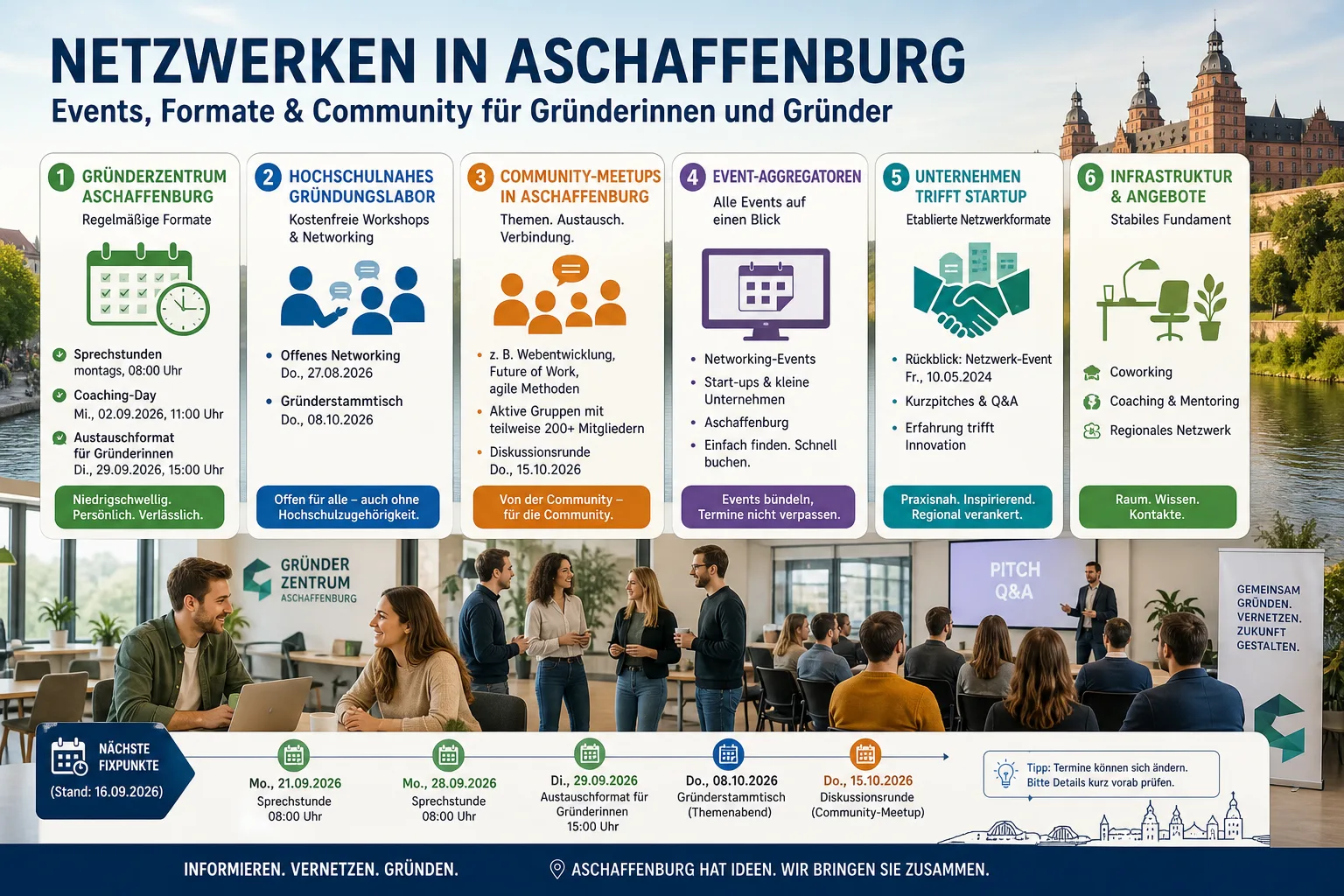
Startup Center: open formats for entry & coaching
A startup center (often with coworking, consulting, and event spaces) is usually the easiest starting point to get many relevant contacts in a short time. Pay particular attention to upcoming dates for formats that are explicitly open to beginners or early-stage teams.
Which event types you should plan for in the coming months
- Open founder office hours: ideal if you want to check an idea, prioritize next steps, or sort out a specific question (e.g., target group, legal form, funding logic).
- Coaching or consulting days: useful if you already have hypotheses, a service concept, or initial customer conversations and want to move forward in a structured way (e.g., business model, pricing, go-to-market).
- Networking evenings: suitable for finding co-founders, service providers, or pilot partners – especially if you can clearly explain your project in 30–60 seconds.
- Formats for specific target groups (e.g., female founders, international founders, solo self-employed): helpful for peer exchange and long-term peer groups.
How to recognize quality
Good events are transparent in advance: clear target group, agenda, duration, contact person, and a recognizable purpose (e.g., feedback, matching, knowledge transfer). If this is missing, it's better to plan a community meetup (see below) and use the startup center selectively for specific advice.
Startup Lab & University Proximity: Workshops and Exchange Formats
University-related startup offers (e.g., entrepreneurship labs, transfer offices, or incubation programs) are often particularly active in the coming semester months – with workshops, pitch training, method sessions, and open networking formats. Many of these offers are designed so that interested parties without formal university affiliation can also participate if places are available.
Formats that are particularly worthwhile in the short term
- Ideation and validation workshops (e.g., problem interviews, value proposition, lean methods): perfect if you want to quickly think your idea as "marketable."
- Pitch training: useful if you want to convince partners, customers, or funding agencies soon.
- Tool and practice sessions (e.g., prototyping, no-code, analytics, project organization): especially helpful if you want to quickly get into implementation.
- Open networking meetings: a good opportunity to meet students, researchers, and practitioners from the region – often resulting in project and team constellations.
If you want to position yourself strategically for the next few months, the combination is strong: methodological depth from the startup lab plus practical follow-up contacts via startup center and community.
Community Meetups: Tech, Product, Future of Work
In the coming months, informal meetups in and around Aschaffenburg are likely to be the fastest "contact boosters" again: You meet people without barriers, can test ideas, and learn pragmatic solutions first-hand.
Typical meetup formats you should have on your radar
- Lightning talks: several short presentations, followed by relaxed networking – ideal for getting to know many topics and people in a short time.
- Discussion rounds: good if you want to sharpen positions (e.g., AI in everyday life, remote work, sustainability in products).
- Hands-on sessions: valuable if you are looking for concrete help (e.g., feedback on landing page, tech stack, UX).
For founders, meetups are particularly effective because you often meet a mix of startup teams, freelancers, employees of established companies, and tech/product enthusiasts. This mix increases the chance of quickly finding suitable cooperation partners.
Corporate Formats: Cooperation between SMEs and Startups
If you want to specifically move towards B2B sales, pilot projects, or partnerships in the coming months, corporate formats (e.g., "Startup meets Company," innovation evenings, matching events) are particularly relevant. They are often more structured than meetups and offer you clear points of contact with decision-makers.
How to prepare for such events
- Formulate a pilot offer: What would be a realistic 4–8 week test that brings measurable benefits to the company?
- Bring evidence: even if you are still early – show prototype, demo, reference processes, security/data protection considerations (as far as applicable).
- Ask the right questions: What goals, budgets, decision-making processes, and timeframes are there? Who is the sponsor, who is the user?
Important: Serious cooperation rarely arises "in the room," but through the follow-up in the days after. Plan time for this.
How to reliably find upcoming events (without overload)
So that you don't miss any suitable dates in the coming months, but also don't end up in calendar chaos, a clear search and filter process helps.
Proven channels for event search
- Event platforms (e.g., Meetup, Eventbrite): filter by location, time period, topics (startup, business, tech, AI, product, marketing).
- LinkedIn Events: good for corporate formats, lectures, and industry rounds; use search terms like "Aschaffenburg," "founding," "network."
- Websites and newsletters of regional startup and economic institutions: often the most reliable info on office hours, workshops, and programs.
- Calendars in coworking spaces: often strong in the after-work area, including community evenings.
A simple routine for the next 8 weeks
- 10 minutes weekly: check two channels (e.g., LinkedIn + an event platform) and save a maximum of 2 dates.
- 20 minutes monthly: scan regionally relevant sites/newsletters and only add events that fit your goal.
- One goal per event: e.g., find 1 mentor, 1 pilot contact, 1 co-founder, 3 feedback conversations.
How to get the maximum value from the next event
In the coming months, it won't be the number of events that makes the difference, but your preparation and follow-up. With these steps, you will be significantly more effective:
- Your one-sentence pitch: "I help [target group] solve [problem] by [solution]."
- Your desired contact: Decide in advance who you want to meet (e.g., sales, tech, HR, production, administration, investors, mentors).
- Your conversation opener: Ask a specific question (e.g., "What hurdle is currently slowing you down on topic X?") instead of talking generally.
- Follow-up within 48 hours: short message with context ("We talked about X..."), a suggestion, and a clear next step.
- Secure notes: 3 bullet points per contact (interest, need, next step). This prevents good conversations from fizzling out.