Children's University Aschaffenburg: Discover Science
Children's University & Science Events in Aschaffenburg: Find Dates, Compare Offers, Plan Properly
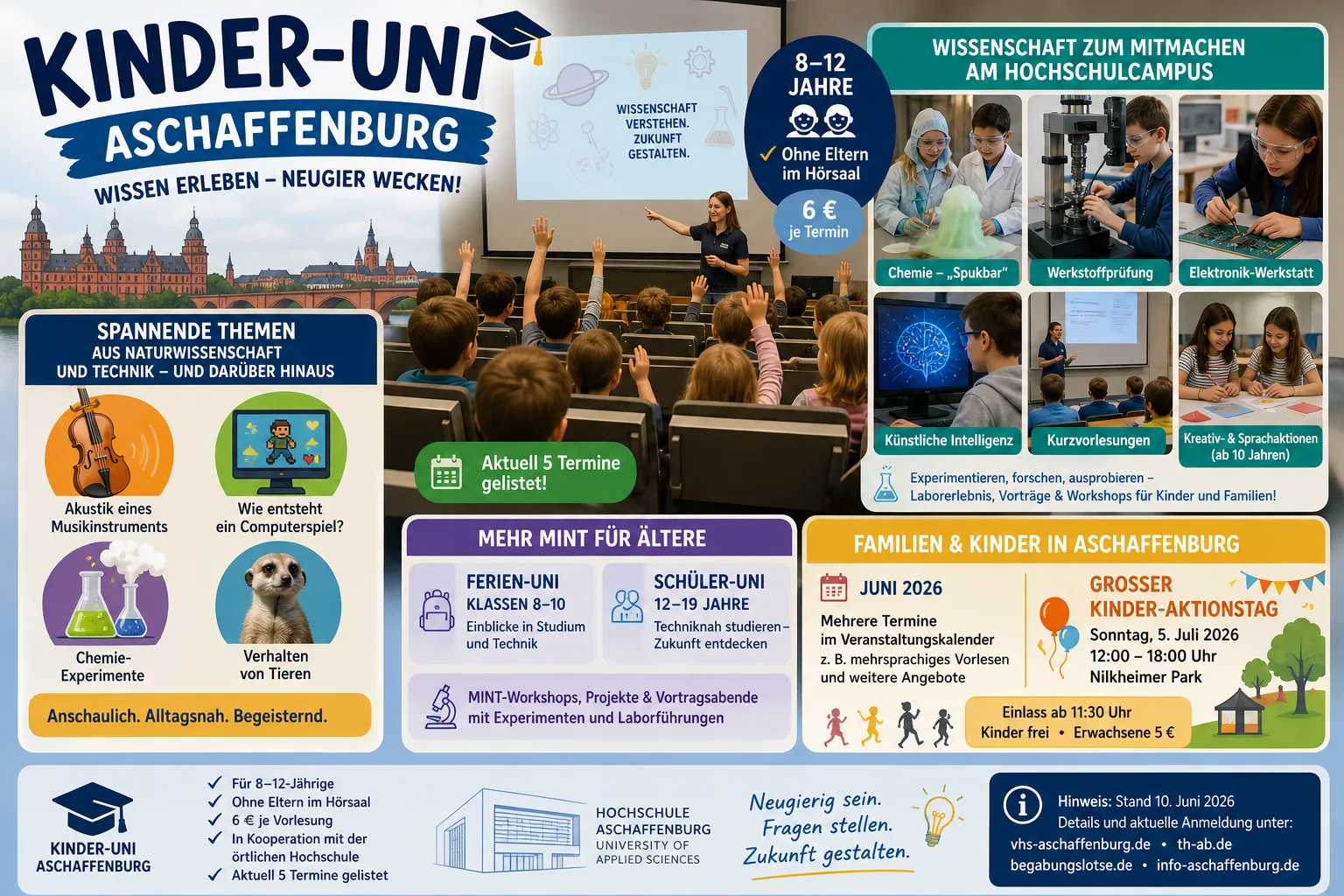
What happens when children experience a real lecture in a lecture hall (without parents), ask questions, and then get to experiment themselves in hands-on formats? In Aschaffenburg, there are several recurring formats for this – from the Children's University to STEM offers during the holidays, as well as action days on campus and in the city area. This overview helps families, teachers, and visitors realistically assess upcoming offers and select suitable events.
Overview: Which Science Formats in Aschaffenburg Will Be Relevant in the Future?
- Children's University (typical: elementary/lower secondary school; often 8–12 years): Lecture-like format, usually with registration.
- Campus and Action Days (families, children, teenagers): Open hands-on stations, lab insights, short lectures.
- STEM Holiday Offers (typical: middle school): Multi-day projects, practical group work.
- Student University/Orientation Formats (often: teenagers up to just before graduation): Modules, workshops, insights into study and career fields.
- Municipal Family Events with Educational Focus: Low-threshold discovery and creative offers, sometimes without registration.
Important: Content, age limits, registration deadlines, and fees are set by the respective organizers and may change from season to season. For binding details, the official sites (see sources) are decisive.
Children's University Aschaffenburg: Science Like at University – Child-Friendly but Serious
The Children's University is usually designed as a lecture series: Children sit in the lecture hall, listen, take notes, and ask questions. It is common for parents not to be present in the lecture hall during the lecture – this strengthens independence and concentration.
Who Is This Format Suitable For?
- Age: often for children in the 8–12 age range (the specific age indication varies depending on the date).
- Interests: ideal for curious children who like to ask "Why?" questions and enjoy explanations and demonstrations.
- Learning Style: suitable if the child can listen well and enjoys concentrating on a topic for an hour.
Registration & Costs – What to Expect in the Future?
Participation usually requires prior registration, as lecture halls and supervision capacities are limited. A moderate participation fee is often charged (usually low), to cover organization and materials. Whether and how payment is made (online, on site, by invoice) depends on the organizer.
Thematic Worlds: From Chemistry and Acoustics to Computer Science & Artificial Intelligence
Children's University lectures and hands-on formats are often designed so that they address everyday questions and at the same time convey scientific ways of thinking. Depending on the semester, action day, or project week, the focus may be, for example, in these areas:
- Natural Sciences (e.g., simple chemistry and physics phenomena, materials science, environmental issues)
- Technology & Electronics (e.g., understanding circuits, sensors, "How does it work?")
- Computer Science (e.g., first programming logic, data and patterns, playful applications)
- Acoustics & Media (e.g., sound, hearing, digital media design)
- Artificial Intelligence (explained fundamentally, focusing on examples and responsible use)
Many organizers are increasingly relying on vivid demonstrations instead of pure frontal teaching: short experiments, hands-on exhibits, or live examples help make abstract content understandable.
University Campus as an Experience: Hands-On Stations, Labs, Short Formats
Around the university, city center, and other event locations, action days and open formats are regularly announced in Aschaffenburg, where children and families can experience science "in motion." A typical mix includes:
- Hands-on stations (experimenting, building, testing, observing)
- Lab or workshop insights (depending on safety and age requirements)
- Short lectures or mini-lectures with a clear target group (e.g., "from 10 years")
- Information points for parents and teenagers (e.g., on study or career orientation)
STEM in the Holidays: Project Weeks and More Intensive Work
For older children and teenagers, STEM holiday formats are regularly offered in Aschaffenburg and the surrounding area. The typical difference to the Children's University: Here, it's less about the lecture experience and more about multi-day projects, teamwork, and tangible results.
What Teenagers Can Expect in Such Formats
- Working in small groups (e.g., construction, programming, measurements, evaluations)
- Supervision by experts (teachers, staff, sometimes students)
- Stronger focus on methods: planning, testing, improving, documenting
- Orientation: "Is a technical or scientific degree right for me?"
Since places may be limited, it is worth finding out early about registration periods and requirements (e.g., grade level, minimum age, prior knowledge).
Municipal Family Events: Education Meets Leisure
In addition to university formats, family-friendly events are regularly announced in the city area that combine education, culture, and leisure. Depending on the program year, these can include discovery afternoons, reading and language activities, creative workshops, or open hands-on offers in parks and facilities.
Such dates are particularly suitable if you want to try out in a low-threshold way whether your child enjoys science and discovery formats – without having to book a multi-week program right away.
How Families Plan Participation: Checklist for Registration, Age & Interests
- Check age & target group: Does the event really match the age indication (e.g., "8–12", "from 10", "grades 8–10")?
- Choose format: Lecture (listen & ask) or workshop (build/experiment yourself)?
- Registration & deadlines: Is there ticketing, waiting lists, or fixed time slots?
- Clarify supervision: Do parents have to stay on site, or is it explicitly without parents in the lecture hall?
- Check costs transparently: Participation fee, material flat rate, possible discounts.
- Arrival & time buffer: Especially on campus, it is worth allowing time for orientation (building, room, meeting points).
- Preparation for the child: Briefly explain in advance how a lecture works (sit quietly, questions at the end/during).
If you are planning a day trip, you can easily combine a visit to a science event with other offers in Aschaffenburg (e.g., walk along the Main, park visit, museum – depending on opening times and season).
Why Aschaffenburg Is Well Suited as a "Hands-On" Science Location
If the city, university, and educational providers continue to offer joint programs in the future, children and teenagers will benefit in several ways: early encounters with scientific topics, realistic insights into learning and working methods, and the experience that questions are welcome. At the same time, parents and teachers benefit from additional learning locations beyond the classroom.
What matters less is a single event, but rather the repetition: Those who experience a lecture once and later take part in a workshop or holiday project build up routine step by step – and can develop interests more specifically.