Discover Coworking & Creative Spaces in Aschaffenburg
Coworking & Creative Spaces in Aschaffenburg: What You Can Plan in the Coming Months
7 min readLaura Müller
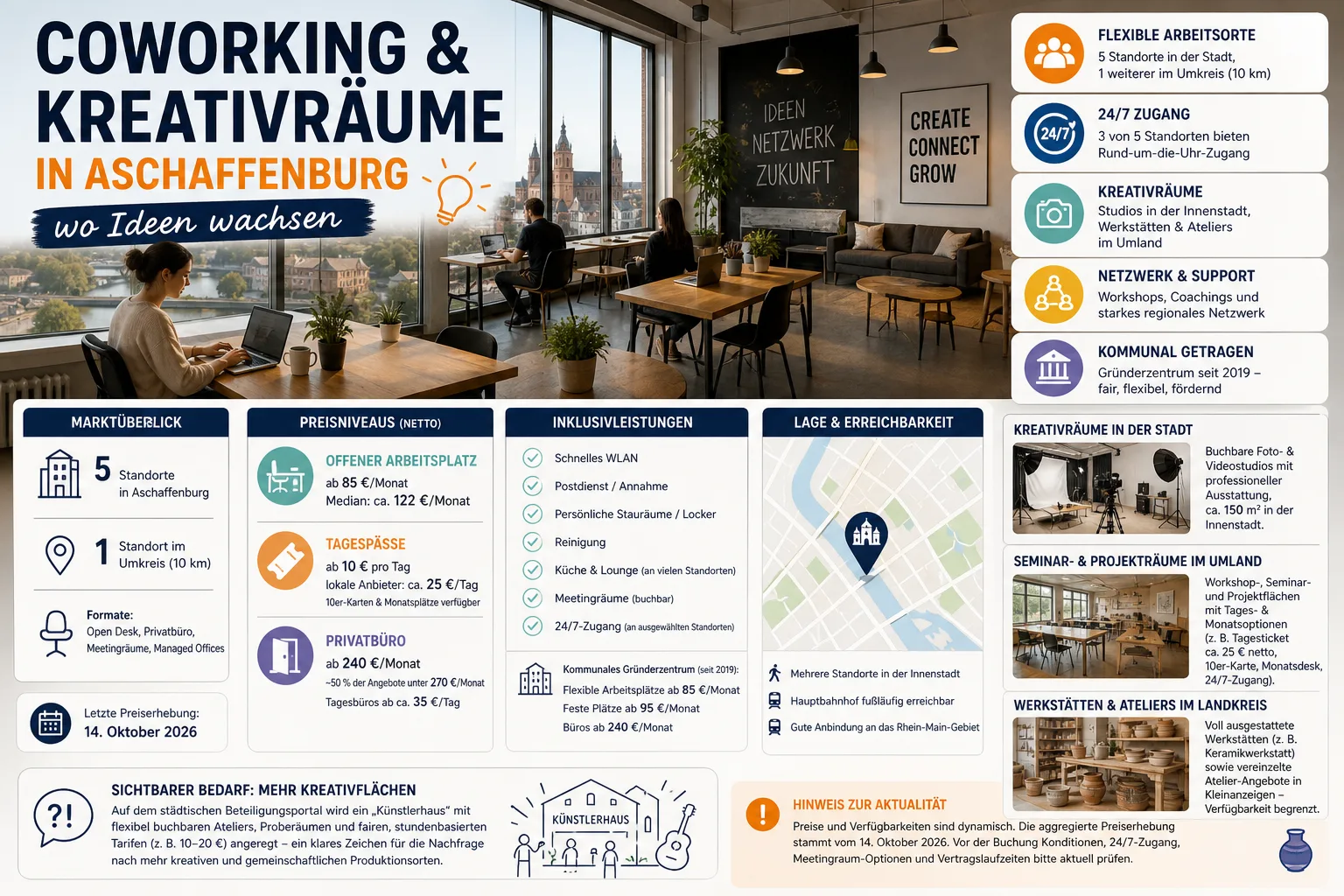
This guide is aimed at freelancers, teams, and creatives who want to use a workspace, studio, or flexible project area in Aschaffenburg (and the surrounding area) in the near future. Focus: concrete next steps, booking logic, and planning security for future uses.
Conditions you should check before booking in the future
Prices, availability, and contract models can change at short notice. To avoid the most common pitfalls in the coming weeks, clarify these points in writing before booking (an email is usually sufficient):
Access & Times
- Opening hours vs. 24/7 access: Does round-the-clock access really apply to your rate or only to certain memberships?
- Holidays & company vacations: What rules apply for access and support?
- Access system: Key, card, app — and what happens if lost?
Service package
- Internet: WLAN/LAN option, separate networks, guest access, minimum requirements for video conferences.
- Print/Scan/Phone: Is anything included, limited, or chargeable?
- Mail & parcel acceptance: Can the address be used as a business address, and if so, under what conditions?
- Meeting rooms: Are hours included, how far in advance can you book, and what are the cancellation deadlines?
Contract, term, cancellation
- Term: monthly flexible, minimum term, or project term?
- Notice period: suitable for your planning horizon (e.g., 4 weeks vs. quarterly).
- Deposit: only accept if it is clearly regulated when and how it will be refunded.
Data protection & confidentiality (important for consulting, HR, agencies)
- Phone and focus areas: Are there designated zones for calls and focused work?
- Confidential conversations: Is a small room bookable at short notice?
- Privacy protection: For sensitive screen content, privacy filters and room selection are part of your security planning.
If you work for clients, also plan for: Invoice requirements (e.g., monthly collective invoice) and liability issues (e.g., for stored equipment).
Connections & Commuting: How to plan the next weeks efficiently
For practical use in the coming weeks, not only the offer in the space is decisive, but also your everyday life: arrival, transfer times, parking, bike paths, and proximity to appointments. Use a simple, future-oriented method for planning:
- Define your “fixed points” for the next 2–4 weeks (client appointments, team days, childcare, training).
- Select 2–3 locations (city center, near the train station, surrounding area) that cover these fixed points with minimal friction.
- Test on real days: At least one working day per location, including your typical call times.
If you commute by public transport, plan buffers in the future: not only for arrival, but also for “setup time” (arriving, setting up your workspace, checking technology). This is especially true for studio or workshop use: setup and handover often take longer than expected.
Creative Production: How to organize studio, rehearsal room, and workshop needs
If you will not only be working on your laptop in Aschaffenburg in the near future, but also producing (photo/video/audio, art, crafts, performance), plan ahead — because production spaces are often more dependent on slot availability than coworking desks.
For studio work (photo/video/audio) in upcoming projects
- Equipment list: Clarify in advance what is available on site (lighting, backgrounds, tripods, audio interface) and what you need to bring.
- Sound & noise disturbances: Plan recording times so that they fit the environment (e.g., less traffic noise).
- Data handling: Bring your own SSDs for large media amounts; clarify upload/download rates and backup options.
For workshop and studio needs
- Safety: Ask about usage rules (protective clothing, extraction, storage of materials).
- Material logistics: Plan for transport, interim storage, and disposal (especially for dusty or odorous work).
- Insurance: Check whether your business liability/inventory insurance covers the use of external spaces.
For all production formats: In the future, book a longer slot with setup and takedown buffer rather than two tight slots — this reduces stress, quality risks, and additional costs.
Possible developments in the city: How to get involved early
In the coming months and years, new offers may arise — such as additional coworking capacities, new studio spaces, or municipal or semi-public initiatives for creative spaces. Such projects typically become visible early via public information channels, local networks, and participation formats.
This is how you recognize new opportunities early
- Monitor municipal participation and information pages of the city and district to get hints about planned space programs or interim uses.
- Follow local startup and creative networks: Announcements for new spaces and pilot projects often appear there first.
- Plan for feedback: If you have specific needs (e.g., rehearsal room times, affordable studios, workshop places), formulate them as short, actionable requirements. This increases the chance that new projects will meet real user needs.
If a “Künstlerhaus” or a similar model for flexible rental is created in the future, your benefit will strongly depend on whether bookable time slots, clear house rules, and reliable equipment are provided. You can specifically address these criteria when participating.
Checklist for your decision (for the next 7–30 days)
With this checklist, you can make a good short-term choice without committing yourself long-term:
- Define your goal: Productivity (focus), exchange (community), customer contact (professionalism), or production (studio/workshop).
- Set a time frame: How many days per week do you want to work on site in the next 4 weeks?
- Note must-have criteria: e.g., quiet calls, monitor spaces, barrier-free access, late hours, bicycle parking.
- Book a test day: Plan at least one day when you complete your real tasks (including calls).
- Check “friction costs”: Journey, parking search, setup time, noise, room temperature, ergonomics.
- Check contract & cancellation: Does the commitment fit your project situation in the coming months?
- Secure a plan B: Keep a second option ready in case your desired location is fully booked.
Sources & further links
- Google Search: Creating helpful, reliable, people-first content — Criteria for helpful content and trust signals (accessed 2026-11-25)
- Google Search: Page experience — Notes on user experience factors that may be relevant for location and offer pages (accessed 2026-11-25)
- Chambers of Industry and Commerce (IHK) – Portal — Guidance on founding, law, and business practice; select the responsible IHK for regional offers (accessed 2026-11-25)
- EXIST (Federal Program for Start-up Support) — Background on funding logic and requirements; helpful for planning start-up and innovation projects (accessed 2026-11-25)